+
India Secures Preferential Access To Two Thirds Of Global Trade
ECONOMY & POLICY

India Secures Preferential Access To Two Thirds Of Global Trade

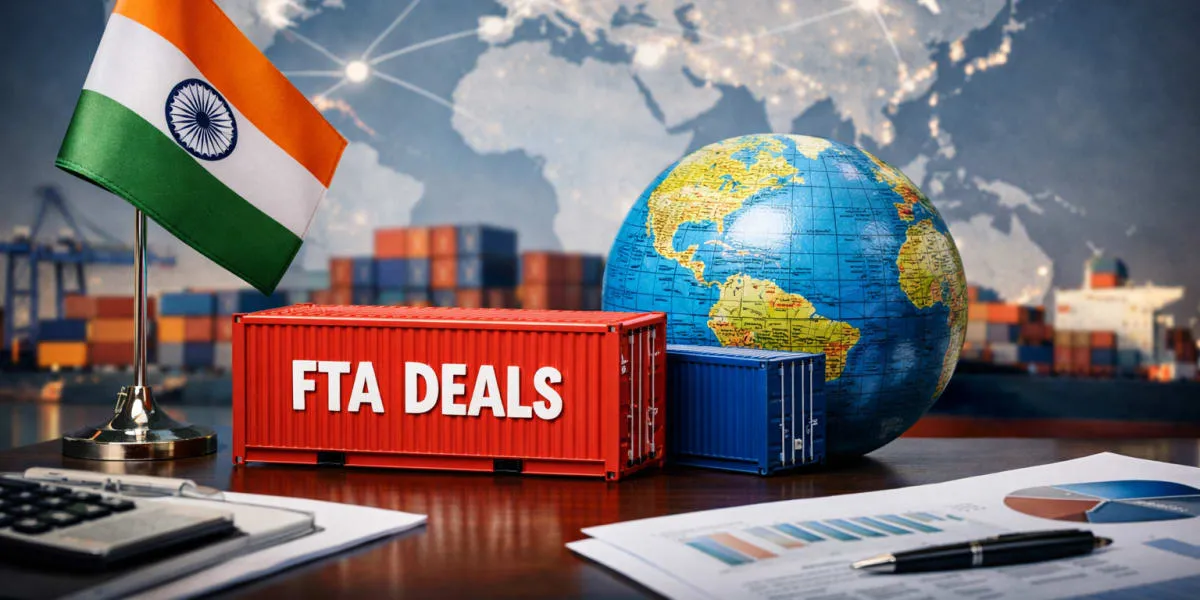
Union minister Piyush Goyal said India now enjoys preferential access to nearly two thirds of global trade after concluding high quality free trade agreements (FTAs) under Prime Minister Narendra Modi. Addressing the fifth CII National Exports Competitiveness Summit in Chennai, he said the nine FTAs were with developed economies that complement India’s growth. The agenda was framed as reform, perform and transform to integrate India with the global economy.\n\nThe minister outlined diplomatic momentum, noting the launch of negotiations with the six-nation Gulf Cooperation Council (GCC), advanced talks with Israel and Chile and preparations to begin discussions with Canada after an expected visit by the Canadian prime minister. The FTAs were presented as a strategy to de-risk trade and diversify partnerships. He noted that merchandise trade with Australia and the United Arab Emirates has doubled since FTAs were signed.\n\nAn Export Promotion Mission was launched to support micro, small and medium enterprises by improving access to credit, lowering operational costs and aiding compliance with demanding markets such as the European Union. The initiative aims to remove structural bottlenecks and increase small firms’ participation in global value chains. The minister urged industry to prioritise quality and to adopt the prime minister’s Zero Defect, Zero Effect approach.\n\nThe minister set out a four point roadmap to transform exports that emphasised grassroots FTA outreach, quality focus, value addition and building local export ecosystems through industry partnership. He called for dissemination of FTA benefits to clusters, districts and factory floors and for firms to mentor smaller enterprises to create district level export ecosystems. Progress up the value chain was urged to boost jobs, margins and competitiveness.\n\nThe release described India’s export story as one of confidence and resilience belonging to 1,400 million (1,400 mn) Indians and 100–110 million (100–110 mn) MSMEs across regions and professions. The government committed to provide clear pathways and support to enable high quality and sustained productivity required to establish India as a leading exporting nation.

Union minister Piyush Goyal said India now enjoys preferential access to nearly two thirds of global trade after concluding high quality free trade agreements (FTAs) under Prime Minister Narendra Modi. Addressing the fifth CII National Exports Competitiveness Summit in Chennai, he said the nine FTAs were with developed economies that complement India’s growth. The agenda was framed as reform, perform and transform to integrate India with the global economy.\n\nThe minister outlined diplomatic momentum, noting the launch of negotiations with the six-nation Gulf Cooperation Council (GCC), advanced talks with Israel and Chile and preparations to begin discussions with Canada after an expected visit by the Canadian prime minister. The FTAs were presented as a strategy to de-risk trade and diversify partnerships. He noted that merchandise trade with Australia and the United Arab Emirates has doubled since FTAs were signed.\n\nAn Export Promotion Mission was launched to support micro, small and medium enterprises by improving access to credit, lowering operational costs and aiding compliance with demanding markets such as the European Union. The initiative aims to remove structural bottlenecks and increase small firms’ participation in global value chains. The minister urged industry to prioritise quality and to adopt the prime minister’s Zero Defect, Zero Effect approach.\n\nThe minister set out a four point roadmap to transform exports that emphasised grassroots FTA outreach, quality focus, value addition and building local export ecosystems through industry partnership. He called for dissemination of FTA benefits to clusters, districts and factory floors and for firms to mentor smaller enterprises to create district level export ecosystems. Progress up the value chain was urged to boost jobs, margins and competitiveness.\n\nThe release described India’s export story as one of confidence and resilience belonging to 1,400 million (1,400 mn) Indians and 100–110 million (100–110 mn) MSMEs across regions and professions. The government committed to provide clear pathways and support to enable high quality and sustained productivity required to establish India as a leading exporting nation.

Next Story
Infrastructure Urban

We’ve cut 50,000 tonnes of carbon emmissions since 2019

MatchLog is challenging a decades-old logistics norm and empty container miles by directly matching import flows with export demand. Indeed, the platform is unlocking measurable cost savings, cutting emissions and driving structural change in landside operations. Dhruv Taneja, Founder and Global CEO, outlines the quantified impact, adoption  journey and the evolving future of container reuse in an exclusive interview with Construction World. MatchLog has partnered with carriers such as Maersk, ONE and HMM in India. Could you share quantified outcomes from one specific corri..

Next Story
Infrastructure Transport

Airports: Capacity is Key

A lotus-inspired terminal design in Navi Mumbai International Airport. A terminal in a garden in Bengaluru’s Kempegowda International Airport. A peacock-inspired canopy in Chhatrapati Shivaji Maharaj International Airport. A nature-inspired terminal in Guwahati’s Lokpriya Gopinath Bordoloi International Airport.Truly, “India’s airports are no longer constrained by architectural ambition,” avers Ravikanth Mididhodi, Chief Technical Officer, J&F, a German-based engineering firm with over 25 years of global legacy in delivering advanced engineering and BIM services for air..

Next Story
Real Estate

In 2025, Amaravati attracted ₹ 28,075 crore in investments

In an exclusive interview with Construction World, Kanna Babu, IAS, Commissioner, Andhra Pradesh Capital Region Development Authority (APCRDA), reveals how Amaravati is entering a decisive new phase of capital city development. With 36 MoUs worth ₹ 45,589 crore, a ₹ 58,000 crore tender pipeline, and rising institutional investments, he explains the strategic execution, infrastructure rollout, and governance framework driving Amaravati’s emergence as a structured, investment-ready, and future-focused capital.APCRDA has recently secured major financial tie-ups, including loans from NA..

Advertisement

Subscribe to Our Newsletter

Get daily newsletters around different themes from Construction world.

STAY CONNECTED

Advertisement

Advertisement

Advertisement

Open In App