India Showcases Governance Innovation to Global Delegates
ECONOMY & POLICY

India Showcases Governance Innovation to Global Delegates

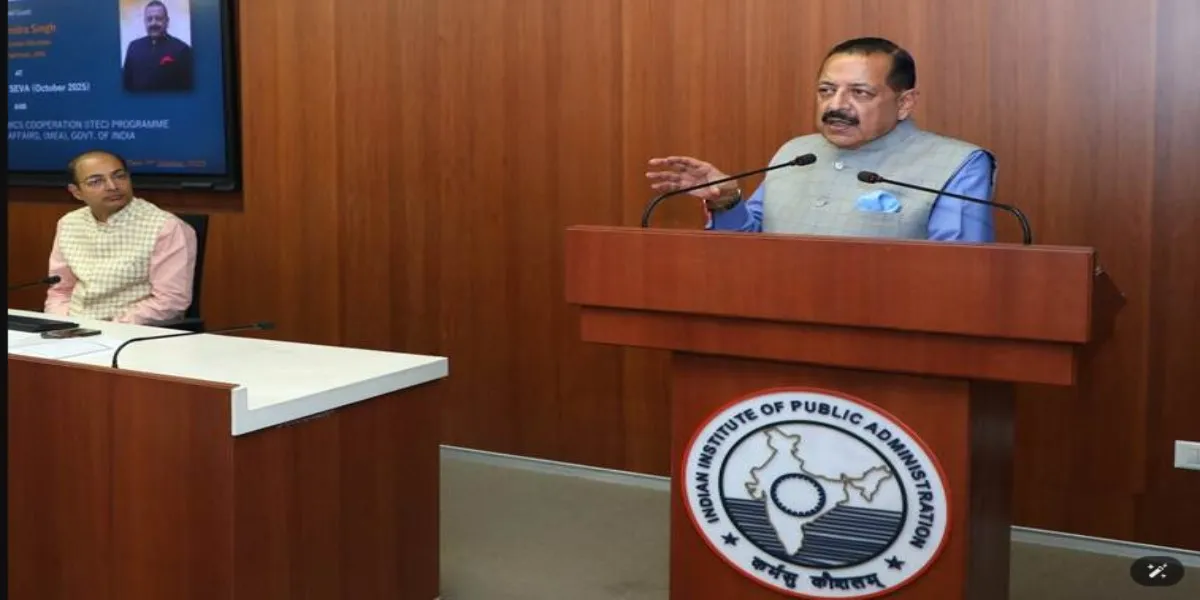
Dr Jitendra Singh, Union Minister of State (Independent Charge) for Science and Technology; Earth Sciences; and Minister of State in the PMO, Department of Atomic Energy, Department of Space, Personnel, Public Grievances and Pensions, today highlighted India’s achievements in governance innovation and technology-driven public service delivery during an interaction with participants of the Indian Technical and Economic Cooperation (ITEC) Programme at the Indian Institute of Public Administration (IIPA) in New Delhi.

Addressing participants from 19 countries, Dr Singh said that India’s best governance practices, such as the Aadhaar-enabled digital identity system and the PM Gati Shakti National Master Plan, have transformed service delivery through transparency, speed, and technology. He encouraged participants to share innovative governance models from their own nations, emphasising the importance of mutual learning and collaboration.

“Our governance model today thrives on innovation — both in technology and in creative problem-solving,” Dr Singh noted. “Nearly 90 per cent of the Government of India’s processes are now conducted online, ensuring continuity even during the pandemic. Technology has become the most powerful tool for promoting transparency, efficiency, and accountability.”

He added that under Prime Minister Narendra Modi’s leadership, India has undergone a major transformation in governance, with innovation becoming central to public policy and administration. “From infrastructure planning to digital service delivery, innovation is now a way of life in governance,” he remarked.

Dr Singh also described the session as a two-way learning experience, noting that the ITEC programme has trained over 2,500 officials to date, including 34 participants from 19 countries in the current batch. The initiative, he said, has become a global platform for exchanging governance ideas and best practices.

Responding to participants’ questions on urban governance challenges such as traffic management, Dr Singh cited India’s use of smart monitoring systems and digital enforcement mechanisms as examples of how technology can simplify administration and improve citizen trust. “Innovation and citizen participation go hand in hand in building more responsive governance systems,” he said.

He urged ITEC participants to remain connected virtually with IIPA and the Ministry of External Affairs after returning to their countries, encouraging them to share updates and experiences regularly. “With the technology available today, physical boundaries no longer limit cooperation. We can stay in touch online and continue learning from one another,” he added.

Earlier in the day, Dr Singh joined ITEC delegates in participating in the Swachhata Hi Sewa campaign and a plantation drive under the Ek Ped Maa Ke Naam initiative, underscoring the government’s focus on sustainability, environmental awareness, and citizen engagement.

Concluding his remarks, Dr Singh reaffirmed that India’s global partnerships through initiatives such as ITEC reflect Prime Minister Modi’s vision of shared growth, inclusive governance, and collective innovation for a better and more connected world.

Dr Jitendra Singh, Union Minister of State (Independent Charge) for Science and Technology; Earth Sciences; and Minister of State in the PMO, Department of Atomic Energy, Department of Space, Personnel, Public Grievances and Pensions, today highlighted India’s achievements in governance innovation and technology-driven public service delivery during an interaction with participants of the Indian Technical and Economic Cooperation (ITEC) Programme at the Indian Institute of Public Administration (IIPA) in New Delhi. Addressing participants from 19 countries, Dr Singh said that India’s best governance practices, such as the Aadhaar-enabled digital identity system and the PM Gati Shakti National Master Plan, have transformed service delivery through transparency, speed, and technology. He encouraged participants to share innovative governance models from their own nations, emphasising the importance of mutual learning and collaboration. “Our governance model today thrives on innovation — both in technology and in creative problem-solving,” Dr Singh noted. “Nearly 90 per cent of the Government of India’s processes are now conducted online, ensuring continuity even during the pandemic. Technology has become the most powerful tool for promoting transparency, efficiency, and accountability.” He added that under Prime Minister Narendra Modi’s leadership, India has undergone a major transformation in governance, with innovation becoming central to public policy and administration. “From infrastructure planning to digital service delivery, innovation is now a way of life in governance,” he remarked. Dr Singh also described the session as a two-way learning experience, noting that the ITEC programme has trained over 2,500 officials to date, including 34 participants from 19 countries in the current batch. The initiative, he said, has become a global platform for exchanging governance ideas and best practices. Responding to participants’ questions on urban governance challenges such as traffic management, Dr Singh cited India’s use of smart monitoring systems and digital enforcement mechanisms as examples of how technology can simplify administration and improve citizen trust. “Innovation and citizen participation go hand in hand in building more responsive governance systems,” he said. He urged ITEC participants to remain connected virtually with IIPA and the Ministry of External Affairs after returning to their countries, encouraging them to share updates and experiences regularly. “With the technology available today, physical boundaries no longer limit cooperation. We can stay in touch online and continue learning from one another,” he added. Earlier in the day, Dr Singh joined ITEC delegates in participating in the Swachhata Hi Sewa campaign and a plantation drive under the Ek Ped Maa Ke Naam initiative, underscoring the government’s focus on sustainability, environmental awareness, and citizen engagement. Concluding his remarks, Dr Singh reaffirmed that India’s global partnerships through initiatives such as ITEC reflect Prime Minister Modi’s vision of shared growth, inclusive governance, and collective innovation for a better and more connected world.

Next Story
Infrastructure Transport

Tripura Rail Survey Approved For Jirania–Bodhjung Link

The Ministry of Railways has approved a Final Location Survey (FLS) for a proposed new railway line between Jirania and Bodhjung Nagar in Tripura. The planned section will span 14 km and is estimated to cost around Rs 4.2 million, with the entire alignment located within West Tripura district. The approval marks a key step towards strengthening railway infrastructure and supporting industrial growth in the state. Bodhjung Nagar is Tripura’s principal industrial and commercial hub, developed mainly for resource-based industries such as rubber, bamboo and food processing. The proposed Jirania..

Next Story
Infrastructure Transport

MCF Raebareli Rolls Out Its 15,000th Passenger Coach

The Modern Coach Factory (MCF) in Raebareli, Uttar Pradesh, has reached a major production milestone with the manufacture of its 15,000th passenger coach on December 15, the Ministry of Railways said. During the current financial year 2025–26, the unit has produced a total of 1,310 coaches so far. Established in 2007 at Lalganj in Raebareli, MCF is among India’s most advanced passenger coach manufacturing facilities. Built at a cost of around Rs 31.92 billion, the factory has an installed annual capacity of 1,000 coaches and is located about 3 km from Lalganj on the Kanpur–Raebareli Roa..

Next Story
Infrastructure Transport

RVNL Wins Gandak River Rail Bridge Contract

Rail Vikas Nigam Limited (RVNL) has received a Letter of Award from North Eastern Railway for a major railway infrastructure project valued at Rs 1.65 billion. The contract relates to the construction of the substructure for a key railway bridge over the Gandak River. The bridge will be constructed between Paniyahwa and Valmikinagar stations as part of the doubling of the Gorakhpur Cantt–Valmikinagar railway section. Designed to enhance capacity and operational efficiency, the structure will comprise 14 spans of 61 metres each and will be supported by double D-type well foundations. The des..

Advertisement

Subscribe to Our Newsletter

Get daily newsletters around different themes from Construction world.

STAY CONNECTED

Advertisement

Advertisement

Advertisement

Advertisement

Open In App