INS Sudarshini Arrives At Sète For Maritime Festival
ECONOMY & POLICY

INS Sudarshini Arrives At Sète For Maritime Festival

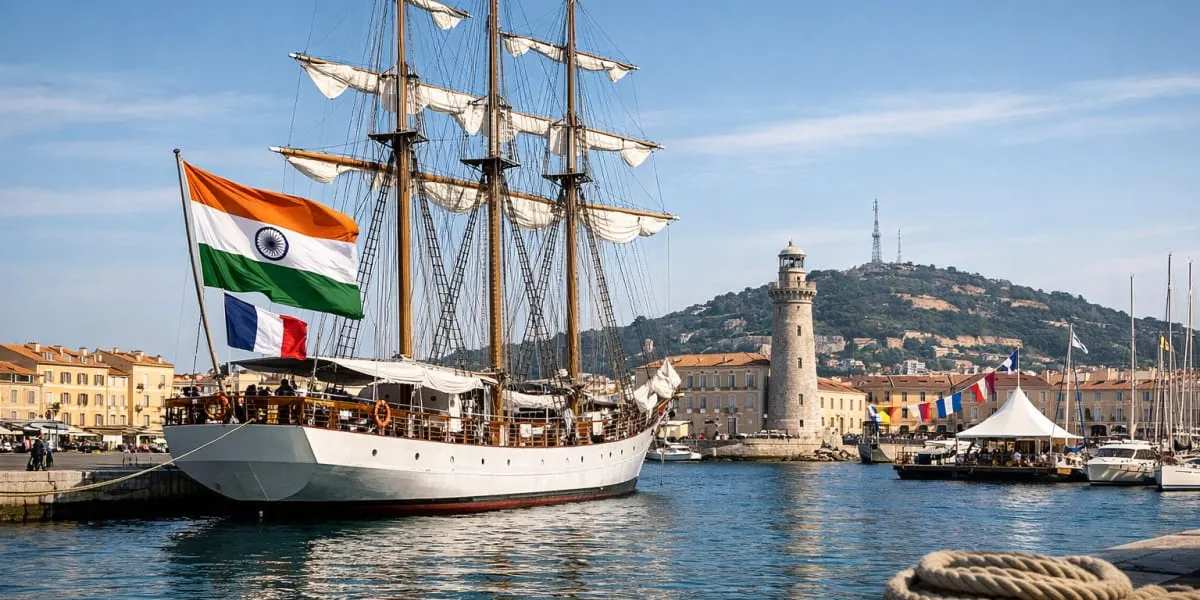
The Indian Navy (IN) sail training ship INS Sudarshini arrived at the historic port city of Sète in southern France on 26 March 2026 as part of the transoceanic expedition Lokayan-26. The arrival is a significant milestone in the vessel's extended voyage and underscores India's focus on maritime cooperation and cultural diplomacy. The port call will enable the navy to engage with local authorities, maritime organisations and visiting delegations during the scheduled festival activities.

INS Sudarshini will participate in the Escale à Sète maritime festival, which brings together traditional tall ships and seafaring communities from across Europe. The festival is expected to offer a platform for showcasing Indian maritime heritage and for fostering international camaraderie. The ship's presence aims to strengthen naval partnerships through cultural exchanges, shipboard visits and planned outreach activities with regional maritime stakeholders.

Prior to the arrival at Sète, the vessel completed port calls at Salalah in Oman, Safaga and Alexandria in Egypt, and Valletta in Malta, covering approximately 5,500 nautical miles. During these calls, the ship engaged with local maritime institutions, academies and civic groups to promote seamanship training and maritime awareness. The voyage under Lokayan-26 has combined practical training for cadets with public diplomacy, enabling students and crew to interact with diverse maritime communities and to exchange best practices in seamanship and navigation.

The training ship serves as a platform for developing skills in traditional sail handling alongside modern navigational techniques, and it continues to function as a floating ambassador for India. Crew and cadets have undertaken outreach programmes aimed at increasing awareness of maritime careers and environmental stewardship while visiting ports. The navy intends to use the remainder of the Lokayan-26 itinerary to consolidate training objectives, to deepen ties with partner navies and to promote India's maritime heritage through public engagement and port events.

The Indian Navy (IN) sail training ship INS Sudarshini arrived at the historic port city of Sète in southern France on 26 March 2026 as part of the transoceanic expedition Lokayan-26. The arrival is a significant milestone in the vessel's extended voyage and underscores India's focus on maritime cooperation and cultural diplomacy. The port call will enable the navy to engage with local authorities, maritime organisations and visiting delegations during the scheduled festival activities. INS Sudarshini will participate in the Escale à Sète maritime festival, which brings together traditional tall ships and seafaring communities from across Europe. The festival is expected to offer a platform for showcasing Indian maritime heritage and for fostering international camaraderie. The ship's presence aims to strengthen naval partnerships through cultural exchanges, shipboard visits and planned outreach activities with regional maritime stakeholders. Prior to the arrival at Sète, the vessel completed port calls at Salalah in Oman, Safaga and Alexandria in Egypt, and Valletta in Malta, covering approximately 5,500 nautical miles. During these calls, the ship engaged with local maritime institutions, academies and civic groups to promote seamanship training and maritime awareness. The voyage under Lokayan-26 has combined practical training for cadets with public diplomacy, enabling students and crew to interact with diverse maritime communities and to exchange best practices in seamanship and navigation. The training ship serves as a platform for developing skills in traditional sail handling alongside modern navigational techniques, and it continues to function as a floating ambassador for India. Crew and cadets have undertaken outreach programmes aimed at increasing awareness of maritime careers and environmental stewardship while visiting ports. The navy intends to use the remainder of the Lokayan-26 itinerary to consolidate training objectives, to deepen ties with partner navies and to promote India's maritime heritage through public engagement and port events.

Next Story
Infrastructure Urban

Centre Clears Power Distribution Upgrade for Uttar Pradesh

The Central Government has approved power distribution projects worth Rs 407.39 billion for Uttar Pradesh under the Revamped Distribution Sector Scheme (RDSS). The investment will be used to modernise the state's electricity distribution infrastructure and strengthen network capacity across urban and rural areas. The package targets one of the country's largest distribution networks as the state experiences rapid urbanisation and rising electricity consumption. Planned interventions include the strengthening of distribution lines, modernisation of substations, replacement of ageing electrical ..

Next Story
Infrastructure Energy

India Data Centres To Consume 191 TWh By 2040 Driving Renewables

A Wood Mackenzie report says India's operational data centre capacity is projected to increase more than fivefold to 12 gigawatt (GW) by 2030 from 2.2 GW in 2025 as artificial intelligence (AI) and cloud computing drive demand. It projects electricity consumption to rise from 10 terawatt-hour (TWh) in 2025 to 191 TWh by 2040. The study forecasts a compound annual growth rate of around 40 per cent and notes AI-dedicated capacity will surge nearly 24-fold from 275 megawatt (MW) in 2025 to 6,546 MW by 2030. The report places India's digital economy at Rs 32 trillion (tn) in 2025 and says it contr..

Next Story
Infrastructure Transport

Hydrogen Train Completes 1,200 Kilometres Of Trials

India's first hydrogen train was flagged off between Jind and Sonipat on July 17 and has travelled over 1,200 kilometres in trials, saving diesel consumption of more than 3,200 litres, a Railway Ministry press release said. The deployment marks the introduction of a zero-emission fuel cell train into route testing and represents a milestone in domestic rail innovation. The train generates electricity onboard through a chemical reaction between hydrogen and oxygen, producing electricity to propel the vehicle while emitting only water vapour as a by-product. There is no smoke and no tailpipe car..

Advertisement

Subscribe to Our Newsletter

Get daily newsletters around different themes from Construction world.

STAY CONNECTED

Advertisement

Advertisement

Advertisement