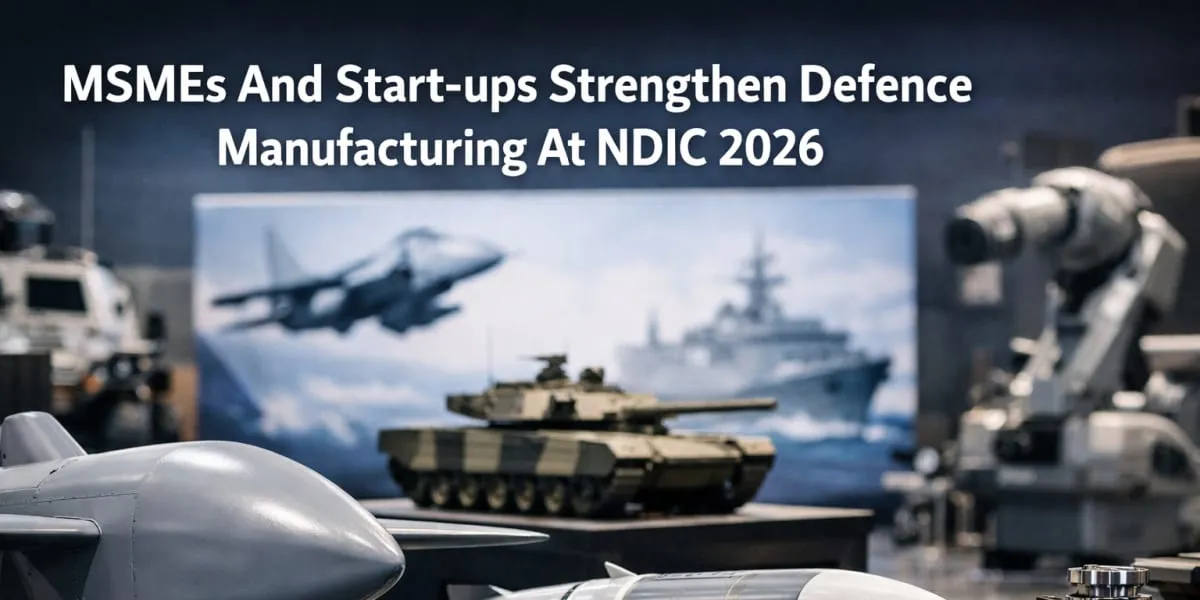
MSMEs And Start-ups Strengthen Defence Manufacturing At NDIC 2026
ECONOMY & POLICY

MSMEs And Start-ups Strengthen Defence Manufacturing At NDIC 2026

The National Defence Industries Conclave 2026, organised by the Department of Defence Production on the theme Advanced Manufacturing Technologies, concluded at the Manekshaw Centre in New Delhi on 20 March 2026 after two days of debate on advanced manufacturing and industry participation in defence production. The event brought together MSMEs, Defence Public Sector Undertakings, private defence firms, innovators, policymakers and academia to discuss strengthening the defence manufacturing ecosystem and accelerating adoption of emerging technologies.

At the valedictory session Raksha Rajya Mantri Sanjay Seth highlighted the role of MSMEs, start-ups and innovators in strengthening the industrial base and advancing Aatmanirbharta in defence. He said government support would aim to make India a defence manufacturing hub and expressed confidence in targets of Rs 500 billion (Rs 500 bn) of defence exports and Rs 3,000 billion (Rs 3,000 bn) of defence production by 2030. He noted that an allocation of Rs 7,850 billion (Rs 7,850 bn) in the Union Budget 2026-27 would open opportunities for MSMEs.

Secretary Defence Production Sanjeev Kumar summarised the sessions and said the conclave provided a platform for direct engagement between MSMEs, DPSUs, industry leaders and policymakers to identify collaboration, technology development and supply chain integration opportunities. He emphasised that interaction between government, industry and academia helped identify technology gaps and capability requirements across the defence manufacturing value chain. The discussions reinforced the importance of innovation and advanced manufacturing in enhancing defence production capabilities and global competitiveness.

Technical and domain sessions covered artillery, small arms and infantry weapons, defence metallurgy and manufacturing, advanced materials and composites, naval platforms and shipbuilding, armoured vehicles, ammunition and propellants, missile systems and maintenance, repair and overhaul. iDEX and DRDO led sessions focused on smart manufacturing, guidance and navigation systems, propulsion and mobility technologies and semiconductor manufacturing. The industry exhibition showcased automation, artificial intelligence, robotics and additive manufacturing and featured stalls from 20 large defence companies and 24 Indian and international firms. The conclave marked another step towards Aatmanirbhar Bharat in defence and a more robust, globally competitive defence manufacturing ecosystem.

The National Defence Industries Conclave 2026, organised by the Department of Defence Production on the theme Advanced Manufacturing Technologies, concluded at the Manekshaw Centre in New Delhi on 20 March 2026 after two days of debate on advanced manufacturing and industry participation in defence production. The event brought together MSMEs, Defence Public Sector Undertakings, private defence firms, innovators, policymakers and academia to discuss strengthening the defence manufacturing ecosystem and accelerating adoption of emerging technologies. At the valedictory session Raksha Rajya Mantri Sanjay Seth highlighted the role of MSMEs, start-ups and innovators in strengthening the industrial base and advancing Aatmanirbharta in defence. He said government support would aim to make India a defence manufacturing hub and expressed confidence in targets of Rs 500 billion (Rs 500 bn) of defence exports and Rs 3,000 billion (Rs 3,000 bn) of defence production by 2030. He noted that an allocation of Rs 7,850 billion (Rs 7,850 bn) in the Union Budget 2026-27 would open opportunities for MSMEs. Secretary Defence Production Sanjeev Kumar summarised the sessions and said the conclave provided a platform for direct engagement between MSMEs, DPSUs, industry leaders and policymakers to identify collaboration, technology development and supply chain integration opportunities. He emphasised that interaction between government, industry and academia helped identify technology gaps and capability requirements across the defence manufacturing value chain. The discussions reinforced the importance of innovation and advanced manufacturing in enhancing defence production capabilities and global competitiveness. Technical and domain sessions covered artillery, small arms and infantry weapons, defence metallurgy and manufacturing, advanced materials and composites, naval platforms and shipbuilding, armoured vehicles, ammunition and propellants, missile systems and maintenance, repair and overhaul. iDEX and DRDO led sessions focused on smart manufacturing, guidance and navigation systems, propulsion and mobility technologies and semiconductor manufacturing. The industry exhibition showcased automation, artificial intelligence, robotics and additive manufacturing and featured stalls from 20 large defence companies and 24 Indian and international firms. The conclave marked another step towards Aatmanirbhar Bharat in defence and a more robust, globally competitive defence manufacturing ecosystem.

Next Story
Infrastructure Transport

AFCONS & Navayuga set world records with Missing Link Expressway

Maharashtra’s most ambitious greenfield bypass — a 13.3-km alignment carrying twin record-setting tunnels and India’s tallest cable-stayed road bridge — was thrown open to traffic on Maharashtra Day, finally completing the Mumbai–Pune Expressway after a 23-year wait. CW reports…The 650-m cable-stayed bridge over Tiger Valley at sunset — the package executed by Afcons Infrastructure Ltd carries 182-m pylons, the tallest on any Indian road bridge.On 1 May 2026, Chief Minister Devendra Fadnavis, flanked by Deputy Chief Ministers Eknath Shinde and Sunetra Pawar (representing the late..

Next Story
Infrastructure Transport

Mumbai–Pune Missing Link boosts realty prospects

The recently opened ‘missing link’ on the Mumbai–Pune Expressway is set to significantly transform connectivity between the two cities by reducing travel time and bypassing the challenging ghat section. The new alignment, featuring tunnels and viaducts, is designed to improve safety, ease congestion and ensure a smoother, faster commute for both passenger and commercial traffic.With improved travel efficiency, the corridor is expected to strengthen intercity movement, encouraging more frequent travel for work, leisure and logistics. This enhanced accessibility is likely to benefit real e..

Next Story
Infrastructure Urban

How Hormuz is Hijacking Indian Highways

At the recently held RAHSTA Round Table on 29th April in Pune, and earlier during our webinars for Cement Expo by Indian Cement Review and by FIRST Construction Council on manufacturing construction equipment for the world, one thread lay common: the industry is being subjected to a cost-push chain reaction moving from crude oil → freight/insurance → steel, cement fuel, bitumen, polymers, packaging, logistics and finally project margins. Indeed, the West Asia crisis caused by the war and the Hormuz Strait blockade, which does not directly concern us, has turned around and hit us. If the wa..

Advertisement

Subscribe to Our Newsletter

Get daily newsletters around different themes from Construction world.

STAY CONNECTED

Advertisement

Advertisement

Advertisement