National MSME Council Reviews RAMP and Launches Portal
ECONOMY & POLICY

National MSME Council Reviews RAMP and Launches Portal

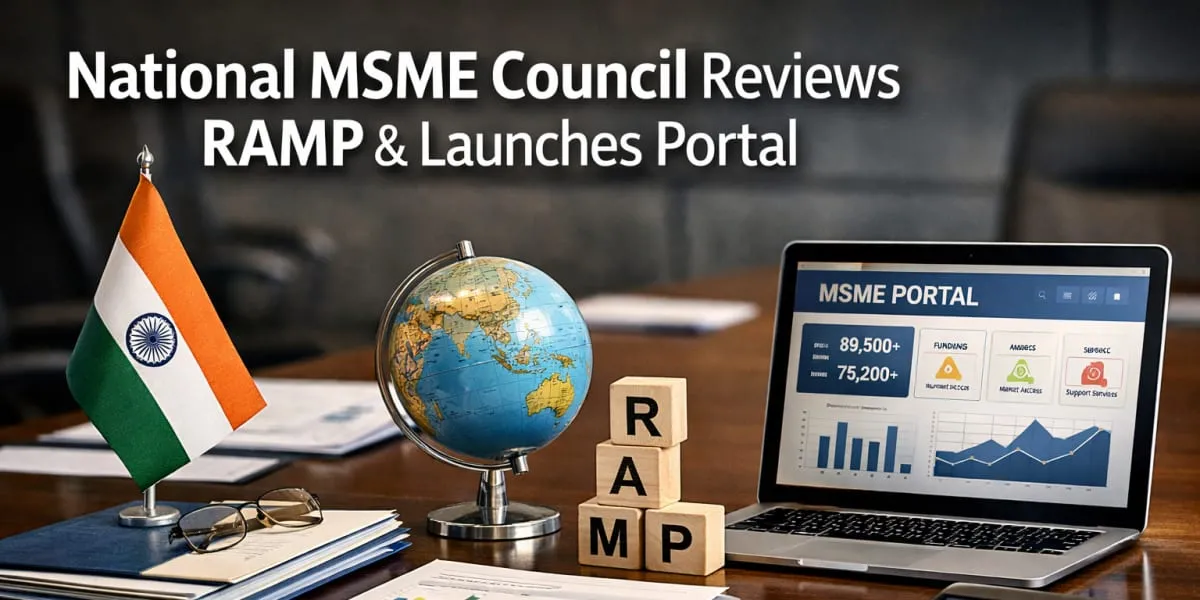
The Ministry of Micro, Small and Medium Enterprises (Ministry of MSME) organised the fifth meeting of the National MSME Council at NASC Complex, Pusa Road, New Delhi on 24 February 2026 to review progress of the World Bank supported RAMP programme and assess centre-state synergies. The council acts as the administrative and functional body for the programme and monitors reforms to improve access to markets and credit, strengthen institutions and governance, address delayed payments and promote greening of micro, small and medium enterprises. Representatives from central ministries, state and union territory governments and partner institutions attended to present project updates and policy measures.

Union Minister Jitan Ram Manjhi chaired the meeting and urged states and union territories to intensify efforts to promote MSME growth to raise income and employment and support economic growth. He launched the Udyami Bharat Portal (UBP) as an integrated one stop shop for MSME services and the MSME Technology Transfer Platform (MTTP) to enable access to advanced technologies, testing facilities, skilling and intellectual property commercialisation. The minister emphasised accelerating support for enterprises owned by women and marginalised communities to ensure inclusive growth and self-sustainability.

World Bank regional director Sebastian Eckardt welcomed the partnership with the Ministry of MSME and highlighted priorities including greening, gender inclusion, improved access to finance and innovations such as online dispute resolution for enterprises. He indicated interest in deepening efforts to mobilise private capital, strengthen enterprise competitiveness and support sustainable job creation across India. The programme framework was described as instrumental in enabling public and private cooperation to scale up impact at state level.

Dr Rajneesh, additional secretary and development commissioner, reviewed sector growth over the last four years and urged states and union territories to expedite implementation of approved RAMP projects so that benefits reach micro, small and medium enterprises promptly. Representatives from Jammu and Kashmir, Goa, Manipur, Nagaland and Odisha shared success stories under the programme, highlighting implementation lessons and outcomes. The meeting included officials from SIDBI, NSIC and partner agencies which agreed to continue coordinated support for project execution.

The Ministry of Micro, Small and Medium Enterprises (Ministry of MSME) organised the fifth meeting of the National MSME Council at NASC Complex, Pusa Road, New Delhi on 24 February 2026 to review progress of the World Bank supported RAMP programme and assess centre-state synergies. The council acts as the administrative and functional body for the programme and monitors reforms to improve access to markets and credit, strengthen institutions and governance, address delayed payments and promote greening of micro, small and medium enterprises. Representatives from central ministries, state and union territory governments and partner institutions attended to present project updates and policy measures. Union Minister Jitan Ram Manjhi chaired the meeting and urged states and union territories to intensify efforts to promote MSME growth to raise income and employment and support economic growth. He launched the Udyami Bharat Portal (UBP) as an integrated one stop shop for MSME services and the MSME Technology Transfer Platform (MTTP) to enable access to advanced technologies, testing facilities, skilling and intellectual property commercialisation. The minister emphasised accelerating support for enterprises owned by women and marginalised communities to ensure inclusive growth and self-sustainability. World Bank regional director Sebastian Eckardt welcomed the partnership with the Ministry of MSME and highlighted priorities including greening, gender inclusion, improved access to finance and innovations such as online dispute resolution for enterprises. He indicated interest in deepening efforts to mobilise private capital, strengthen enterprise competitiveness and support sustainable job creation across India. The programme framework was described as instrumental in enabling public and private cooperation to scale up impact at state level. Dr Rajneesh, additional secretary and development commissioner, reviewed sector growth over the last four years and urged states and union territories to expedite implementation of approved RAMP projects so that benefits reach micro, small and medium enterprises promptly. Representatives from Jammu and Kashmir, Goa, Manipur, Nagaland and Odisha shared success stories under the programme, highlighting implementation lessons and outcomes. The meeting included officials from SIDBI, NSIC and partner agencies which agreed to continue coordinated support for project execution.

Next Story
Infrastructure Transport

Sector 51-52 Metro skywalk in Noida remains shut despite being ready for over a year

Thousands of commuters travelling between Delhi Metro Rail Corporation’s (DMRC) Sector 52 station and Noida Metro Rail Corporation’s (NMRC) Sector 51 station continue to face daily inconvenience as the 300-metre air-conditioned skywalk connecting the two stations remains closed, despite being completed over a year ago, according to a report.The Noida Metro Rail Corporation built the foot overbridge to enable a seamless interchange between the Delhi Metro and Noida Metro networks. However, pending finishing work and a structural obstruction have delayed its opening.Krishna Karunesh, Chief E..

Next Story
Infrastructure Transport

Maharashtra clears Metro Line 5A, expansion of Mumbai Metro Line 5

The Maharashtra government has approved the expansion of Mumbai Metro Line 5 along with a new integrated corridor, Metro Line 5A, forming a combined 34.2-km metro network across the Thane-Bhiwandi-Kalyan-Ulhasnagar belt. The integrated project has been cleared at an estimated cost of ₹18,130.55 crore, according to a government resolution (GR).Metro Line 5 was originally approved in October 2017 as a 24.9-km fully elevated corridor with 17 stations connecting Thane, Bhiwandi and Kalyan, with an initial project cost of ₹8,416.51 crore. The corridor is being developed in two phases.The first ..

Next Story
Infrastructure Transport

Bengaluru Metro expansion seen driving office demand

Bengaluru’s expanding metro network is expected to emerge as a major catalyst for real estate growth, with the Yellow and Pink Lines likely to boost both office demand and residential prices across key micro-markets, according to a report by Colliers India.The report estimates that over the next two years, Bengaluru could witness an additional 5–7 million sq ft of Grade A office space demand across the Central Business District (CBD), Secondary Business District (SBD) and Electronic City. Improved metro connectivity and reduced commute times are expected to drive higher occupier interest a..

Advertisement

Subscribe to Our Newsletter

Get daily newsletters around different themes from Construction world.

STAY CONNECTED

Advertisement

Advertisement

Advertisement