+
NHSRCL Completes Launch of 13 Heavy Portal Beams in Ahmedabad
ECONOMY & POLICY

NHSRCL Completes Launch of 13 Heavy Portal Beams in Ahmedabad

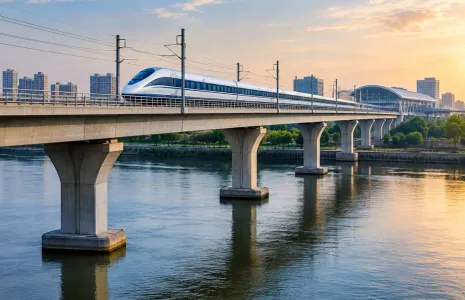
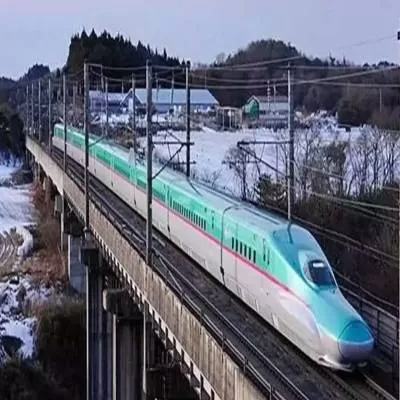
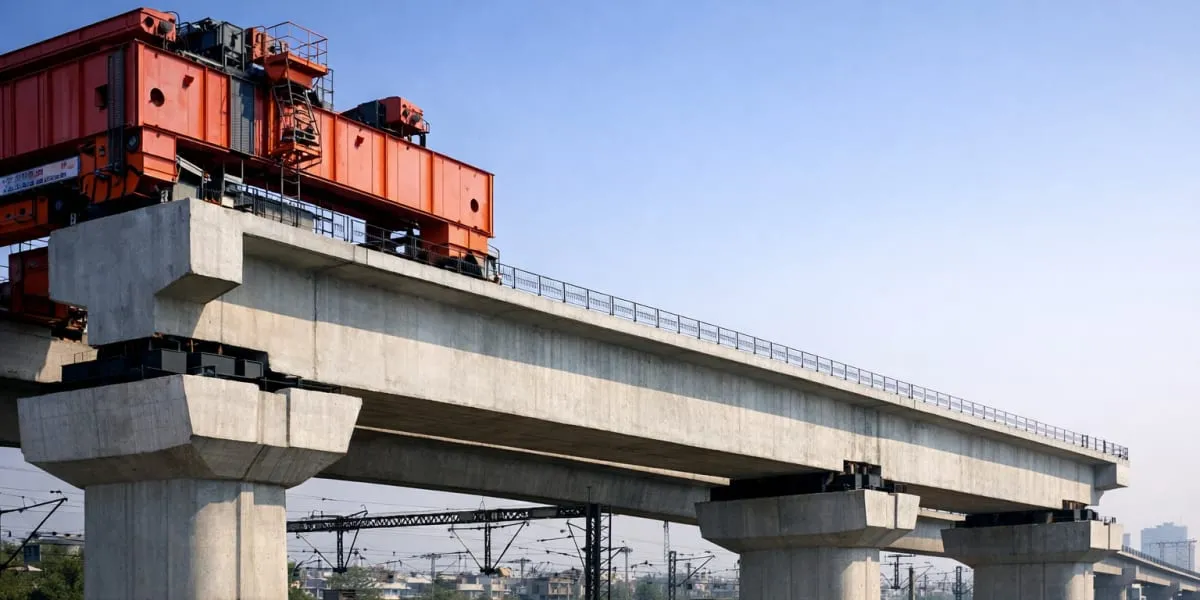
National High Speed Rail Corporation Limited (NHSRCL) has completed the launch of 13 heavy precast portal beams for the Ahmedabad section of the Mumbai-Ahmedabad High Speed Rail (MAHSR) corridor, supporting an 18 km viaduct that crosses several existing railway lines. The beams include five installed over the Mumbai-Ahmedabad main line at Maninagar, seven over the same main line at Vatva and one over the Ahmedabad-Delhi main line at Sabarmati. The work forms a key milestone in viaduct construction for the project.

The final precast-prestressed portal beam launched at Sabarmati weighed approximately 1,640 metric tonne (t) and was the heaviest among the 13 portal beams launched for the Ahmedabad section. The beam measured 34.5 metres in length and had a cross-section of 5.5 metres by 4.5 metres, making it one of the largest precast portal beams used in the MAHSR corridor. These dimensions reflect the scale of precasting and lifting operations for the project.

NHSRCL reported that the entire launching operation was completed in approximately three hours and was carried out using a 2,200 t crawler crane. It noted that despite restricted working space, the operation had been meticulously planned and executed under stringent safety protocols in close coordination with Indian Railways, ensuring safe and uninterrupted train operations throughout the lifting process. Careful scheduling and site management were highlighted as key to the successful lift.

The NHSRCL is developing the Ahmedabad bullet train station as a world-class multi-modal transport hub to enable easy interchange between metro trains, buses, taxis, autos and local transport and to ensure smooth traffic flow around the station. The station design is inspired by a kite and aims to integrate form with passenger circulation and local urban context.

The station will be equipped with modern passenger amenities including a waiting lounge, a nursery, restrooms and retail outlets, while multiple lifts and escalators will enable movement between levels and improve accessibility. Passenger guidance systems such as clear signage, information kiosks and public announcement systems will be installed to assist movement across the concourse, platforms and exit areas.

National High Speed Rail Corporation Limited (NHSRCL) has completed the launch of 13 heavy precast portal beams for the Ahmedabad section of the Mumbai-Ahmedabad High Speed Rail (MAHSR) corridor, supporting an 18 km viaduct that crosses several existing railway lines. The beams include five installed over the Mumbai-Ahmedabad main line at Maninagar, seven over the same main line at Vatva and one over the Ahmedabad-Delhi main line at Sabarmati. The work forms a key milestone in viaduct construction for the project. The final precast-prestressed portal beam launched at Sabarmati weighed approximately 1,640 metric tonne (t) and was the heaviest among the 13 portal beams launched for the Ahmedabad section. The beam measured 34.5 metres in length and had a cross-section of 5.5 metres by 4.5 metres, making it one of the largest precast portal beams used in the MAHSR corridor. These dimensions reflect the scale of precasting and lifting operations for the project. NHSRCL reported that the entire launching operation was completed in approximately three hours and was carried out using a 2,200 t crawler crane. It noted that despite restricted working space, the operation had been meticulously planned and executed under stringent safety protocols in close coordination with Indian Railways, ensuring safe and uninterrupted train operations throughout the lifting process. Careful scheduling and site management were highlighted as key to the successful lift. The NHSRCL is developing the Ahmedabad bullet train station as a world-class multi-modal transport hub to enable easy interchange between metro trains, buses, taxis, autos and local transport and to ensure smooth traffic flow around the station. The station design is inspired by a kite and aims to integrate form with passenger circulation and local urban context. The station will be equipped with modern passenger amenities including a waiting lounge, a nursery, restrooms and retail outlets, while multiple lifts and escalators will enable movement between levels and improve accessibility. Passenger guidance systems such as clear signage, information kiosks and public announcement systems will be installed to assist movement across the concourse, platforms and exit areas.

Related Stories

Gold Stories

Next Story
Infrastructure Transport

MMRDA Targets Completion of Projects by December 2028

The Mumbai Metropolitan Region Development Authority (MMRDA) is targeting the completion of all its ongoing infrastructure projects by December 2028, a year ahead of its December 2029 deadline, Metropolitan Commissioner Dr Sanjay Mukherjee has said.Speaking at the sixth edition of the Real Estate & Infrastructure Investors' Summit (REIIS) 2026 in Mumbai, Mukherjee said the authority was developing an integrated network of roads, tunnels, sea links and Metro corridors under its broader vision of “Mumbai in 59 Minutes”.The objective is to improve east-west and north-south connectivity an..

Next Story
Building Material

High-Performance Façades Gain Ground in Indian Buildings

High-performance façades are gaining greater importance in Indian architecture as developers and architects increasingly focus on energy efficiency, thermal comfort and building performance, according to Shankar Fenestrations & Glasses.The company said modern façade systems are increasingly being considered as part of a building's overall performance strategy rather than being used primarily as aesthetic elements.High-performance glass, curtain wall systems and structural glazing can contribute to thermal regulation, solar control, daylight management and indoor comfort. Their growing ad..

Next Story
Technology

SPML Infra's 104.4 kWh BESS Battery Pack Clears Global Tests

SPML Infra has announced that its proprietary 104.4 kWh Battery Energy Storage System (BESS) battery pack has completed key international safety, performance and transportation testing and certification requirements, marking a step towards its commercial deployment.Developed under the company's own intellectual property, the battery pack has completed requirements under UL9540A, IEC 62619, IEC 63056, IEC 60730, IEC 61000-6-2, IEC 61000-6-4 and UN38.3 standards.The testing covers areas including thermal runaway safety, battery performance, system functional safety, electromagnetic compatibility..

Advertisement

Subscribe to Our Newsletter

Get daily newsletters around different themes from Construction world.

STAY CONNECTED

Advertisement

SPECIAL OFFER
QR Code