
PM Modi Opens Rising Northeast Summit in New Delhi
ECONOMY & POLICY

PM Modi Opens Rising Northeast Summit in New Delhi

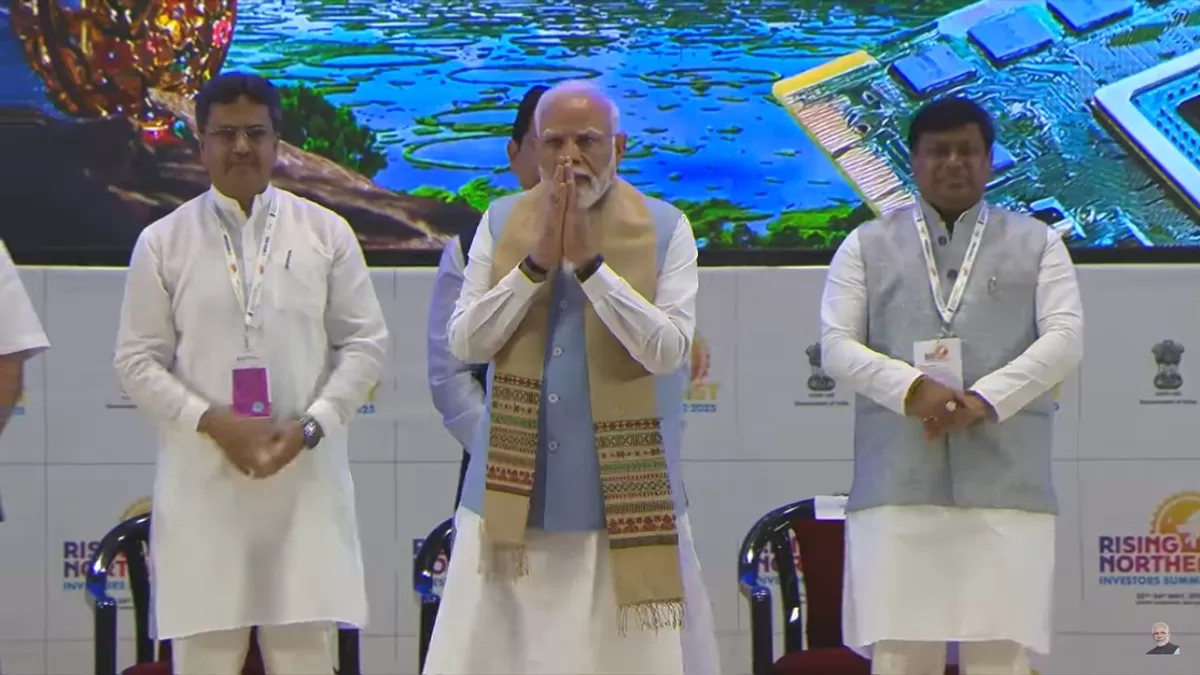
Prime Minister Narendra Modi inaugurated the Rising North East Investors Summit 2025 at Bharat Mandapam in New Delhi, highlighting the region’s strategic importance and investment potential. Calling the Northeast “India’s most diverse region”, he underscored its unique role in national development and its emerging status as a hub for trade, tourism, energy, and innovation.

The two-day summit, held from 23–24 May, brings together key stakeholders, investors, and policymakers to showcase the Northeast as a land of opportunity. Supported by the central and state governments, the summit is part of a wider effort to promote the region through pre-summit roadshows, roundtables, and international outreach initiatives.

The Prime Minister praised the region’s transformation over the past decade, noting that more than 700 ministerial visits had helped foster a direct connection with communities and guide tailored development efforts. Infrastructure investments—such as the Sela Tunnel, Bhupen Hazarika Bridge, 11,000 km of new highways, and the 1,600 km Northeast Gas Grid—are rapidly changing the region’s economic landscape. Digital connectivity is also expanding, with 4G and 5G coverage and over 13,000 km of optical fibre being rolled out.

Modi positioned the Northeast as India’s gateway to ASEAN, citing rising trade volumes and key connectivity projects like the India-Myanmar-Thailand Trilateral Highway and the Kaladan Multimodal Transit Project. Logistics hubs in Guwahati, Imphal, and Agartala, along with new Land Custom Stations in Meghalaya and Mizoram, are further strengthening international trade routes.

The Prime Minister urged investors to consider the Northeast’s rich biodiversity, natural environment, and cultural heritage as an ideal platform for wellness tourism, agro-processing, and organic exports. He noted the region’s strength in organic farming, which has doubled in scale over the last ten years, producing high-demand products such as pineapples, ginger, turmeric, and specialty teas.

Modi also announced progress in the semiconductor sector, stating that the first “Made in Northeast” chip will soon be unveiled. With thousands of crores in new energy projects—including solar and hydropower—and the upcoming launch of mega food parks and palm oil farming initiatives, the region is being positioned as a key pillar in India’s food and energy security.

Emphasising peace and security, the Prime Minister credited government efforts for enabling over 10,000 former insurgents to return to mainstream society. He highlighted the MUDRA scheme, which has supported thousands of youth-led businesses, and extensive investment in education, including new AIIMS, IIITs, skill centres, and the region’s first sports university.

“The Rising Northeast is more than an investors’ summit,” said Modi. “It is a movement—a commitment to turning the region’s rich potential into a cornerstone of Viksit Bharat.”

Union ministers, governors, and chief ministers from all eight Northeastern states joined the summit, which is focusing on priority sectors including tourism, agro-processing, textiles, healthcare, IT, logistics, energy, and sports.

Prime Minister Narendra Modi inaugurated the Rising North East Investors Summit 2025 at Bharat Mandapam in New Delhi, highlighting the region’s strategic importance and investment potential. Calling the Northeast “India’s most diverse region”, he underscored its unique role in national development and its emerging status as a hub for trade, tourism, energy, and innovation.The two-day summit, held from 23–24 May, brings together key stakeholders, investors, and policymakers to showcase the Northeast as a land of opportunity. Supported by the central and state governments, the summit is part of a wider effort to promote the region through pre-summit roadshows, roundtables, and international outreach initiatives.The Prime Minister praised the region’s transformation over the past decade, noting that more than 700 ministerial visits had helped foster a direct connection with communities and guide tailored development efforts. Infrastructure investments—such as the Sela Tunnel, Bhupen Hazarika Bridge, 11,000 km of new highways, and the 1,600 km Northeast Gas Grid—are rapidly changing the region’s economic landscape. Digital connectivity is also expanding, with 4G and 5G coverage and over 13,000 km of optical fibre being rolled out.Modi positioned the Northeast as India’s gateway to ASEAN, citing rising trade volumes and key connectivity projects like the India-Myanmar-Thailand Trilateral Highway and the Kaladan Multimodal Transit Project. Logistics hubs in Guwahati, Imphal, and Agartala, along with new Land Custom Stations in Meghalaya and Mizoram, are further strengthening international trade routes.The Prime Minister urged investors to consider the Northeast’s rich biodiversity, natural environment, and cultural heritage as an ideal platform for wellness tourism, agro-processing, and organic exports. He noted the region’s strength in organic farming, which has doubled in scale over the last ten years, producing high-demand products such as pineapples, ginger, turmeric, and specialty teas.Modi also announced progress in the semiconductor sector, stating that the first “Made in Northeast” chip will soon be unveiled. With thousands of crores in new energy projects—including solar and hydropower—and the upcoming launch of mega food parks and palm oil farming initiatives, the region is being positioned as a key pillar in India’s food and energy security.Emphasising peace and security, the Prime Minister credited government efforts for enabling over 10,000 former insurgents to return to mainstream society. He highlighted the MUDRA scheme, which has supported thousands of youth-led businesses, and extensive investment in education, including new AIIMS, IIITs, skill centres, and the region’s first sports university.“The Rising Northeast is more than an investors’ summit,” said Modi. “It is a movement—a commitment to turning the region’s rich potential into a cornerstone of Viksit Bharat.”Union ministers, governors, and chief ministers from all eight Northeastern states joined the summit, which is focusing on priority sectors including tourism, agro-processing, textiles, healthcare, IT, logistics, energy, and sports.

Next Story
Infrastructure Urban

Mount Expands Tumkur Facility with New Automated Panel, PEB Lines

Mount Roofing & Structures Private Limited, one of India's fastest-growing manufacturers in PUF and a leading solutions provider across pre-engineered building (PEB) and polycarbonate sheets, simultaneously inaugurated its second fully automated continuous sandwich panel manufacturing line and a new PEB manufacturing plant at its integrated campus in Tumkur.The milestone expansion, part of a total investment of Rs 250 crore, marks a significant advancement in the company's commitment to engineered performance, manufacturing scale, and industrial growth. The integrated facility spans approx..

Next Story
Infrastructure Transport

India Becomes First to Produce Bio-Bitumen for Roads

India has become the first country in the world to commercially produce bio-bitumen for use in road construction, according to Road, Transport and Highways Minister Nitin Gadkari. Bitumen, a black and viscous hydrocarbon derived from crude oil, is a key binding material in road building, and the bio-based alternative is expected to significantly improve the sector’s environmental footprint.Addressing the CSIR Technology Transfer Ceremony in New Delhi, Mr Gadkari congratulated Council of Scientific and Industrial Research on achieving the milestone, noting that the initiative would help curb ..

Next Story
Infrastructure Urban

HILT Policy Seen Boosting Telangana Revenue Sharply

The Hyderabad Industrial Land Transformation (HILT) Policy is expected to generate around Rs 1.08 billion in revenue for the Telangana state exchequer, according to Deputy Chief Minister Bhatti Vikramarka Mallu. Speaking in the Telangana Legislative Assembly, he said the policy would be implemented within a six-month timeframe in a transparent manner, with uniform rules applicable to all stakeholders. Mr Vikramarka noted that without the HILT Policy, the state would have earned only about Rs 1.2 million per acre. Under the new framework, however, revenue is projected to rise sharply to Rs 70 ..

Advertisement

Subscribe to Our Newsletter

Get daily newsletters around different themes from Construction world.

STAY CONNECTED

Advertisement

Advertisement

Advertisement

Advertisement

Open In App