Retail Leasing Outpaces Grade A Mall Supply In H1 2026
ECONOMY & POLICY

Retail Leasing Outpaces Grade A Mall Supply In H1 2026

Retail leasing continued to outstrip the supply of Grade A mall space across India's top seven cities in the first half of 2026, underscoring a persistent shortage of quality retail assets, property consultant Anarock said. Gross leasing of Grade A mall space stood at four point one million (mn) square feet during January to June 2026, against just zero point nine mn of new completions, implying retailers leased nearly four and a half times the space delivered.

The imbalance followed a record 2025, when new Grade A mall supply reached five point two mn while leasing surged to 13 mn. Anarock said geopolitical uncertainty had delayed mall delivery and expansion decisions in H1 2026, and the firm's retail chief said the supply problem had been building for several years.

Historical data showed that in 2023 the top seven cities added five point three mn of new supply against gross leasing of six point five mn, while in 2024 new supply fell to one point one mn and leasing remained at six point five mn. Both leasing and new mall supply eased from the levels seen in H1 2025, with leasing down 24 per cent year-on-year and new completions falling 57 per cent. Among the top seven markets, Delhi-NCR was the only one to add Grade A mall space in H1 2026, contributing around zero point nine mn, with leasing there of about one point two six mn.

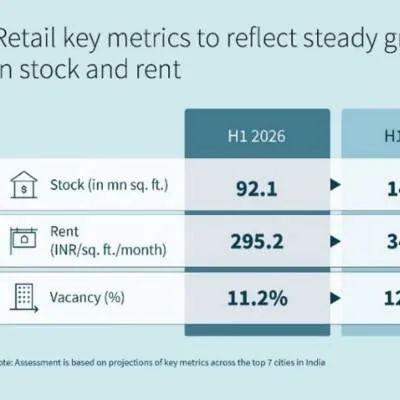
Anarock attributed the shortage to development complexity, including land availability, rising land costs, approval timelines, financing conditions and construction schedules. Vacancy in Grade A malls declined to six point seven per cent in H1 2026, while Grade B and C malls continued to report higher vacancies ranging from around eight per cent to thirty five per cent. The consultant said low vacancy and sustained retailer demand presented a significant opportunity for developers and institutional investors, but warned that without meaningful improvement in the supply pipeline retailers were likely to face longer wait times for prime locations and higher occupancy costs.

Retail leasing continued to outstrip the supply of Grade A mall space across India's top seven cities in the first half of 2026, underscoring a persistent shortage of quality retail assets, property consultant Anarock said. Gross leasing of Grade A mall space stood at four point one million (mn) square feet during January to June 2026, against just zero point nine mn of new completions, implying retailers leased nearly four and a half times the space delivered. The imbalance followed a record 2025, when new Grade A mall supply reached five point two mn while leasing surged to 13 mn. Anarock said geopolitical uncertainty had delayed mall delivery and expansion decisions in H1 2026, and the firm's retail chief said the supply problem had been building for several years. Historical data showed that in 2023 the top seven cities added five point three mn of new supply against gross leasing of six point five mn, while in 2024 new supply fell to one point one mn and leasing remained at six point five mn. Both leasing and new mall supply eased from the levels seen in H1 2025, with leasing down 24 per cent year-on-year and new completions falling 57 per cent. Among the top seven markets, Delhi-NCR was the only one to add Grade A mall space in H1 2026, contributing around zero point nine mn, with leasing there of about one point two six mn. Anarock attributed the shortage to development complexity, including land availability, rising land costs, approval timelines, financing conditions and construction schedules. Vacancy in Grade A malls declined to six point seven per cent in H1 2026, while Grade B and C malls continued to report higher vacancies ranging from around eight per cent to thirty five per cent. The consultant said low vacancy and sustained retailer demand presented a significant opportunity for developers and institutional investors, but warned that without meaningful improvement in the supply pipeline retailers were likely to face longer wait times for prime locations and higher occupancy costs.

Next Story
Infrastructure Urban

Centre Clears Power Distribution Upgrade for Uttar Pradesh

The Central Government has approved power distribution projects worth Rs 407.39 billion for Uttar Pradesh under the Revamped Distribution Sector Scheme (RDSS). The investment will be used to modernise the state's electricity distribution infrastructure and strengthen network capacity across urban and rural areas. The package targets one of the country's largest distribution networks as the state experiences rapid urbanisation and rising electricity consumption. Planned interventions include the strengthening of distribution lines, modernisation of substations, replacement of ageing electrical ..

Next Story
Infrastructure Energy

India Data Centres To Consume 191 TWh By 2040 Driving Renewables

A Wood Mackenzie report says India's operational data centre capacity is projected to increase more than fivefold to 12 gigawatt (GW) by 2030 from 2.2 GW in 2025 as artificial intelligence (AI) and cloud computing drive demand. It projects electricity consumption to rise from 10 terawatt-hour (TWh) in 2025 to 191 TWh by 2040. The study forecasts a compound annual growth rate of around 40 per cent and notes AI-dedicated capacity will surge nearly 24-fold from 275 megawatt (MW) in 2025 to 6,546 MW by 2030. The report places India's digital economy at Rs 32 trillion (tn) in 2025 and says it contr..

Next Story
Infrastructure Transport

Hydrogen Train Completes 1,200 Kilometres Of Trials

India's first hydrogen train was flagged off between Jind and Sonipat on July 17 and has travelled over 1,200 kilometres in trials, saving diesel consumption of more than 3,200 litres, a Railway Ministry press release said. The deployment marks the introduction of a zero-emission fuel cell train into route testing and represents a milestone in domestic rail innovation. The train generates electricity onboard through a chemical reaction between hydrogen and oxygen, producing electricity to propel the vehicle while emitting only water vapour as a by-product. There is no smoke and no tailpipe car..

Advertisement

Subscribe to Our Newsletter

Get daily newsletters around different themes from Construction world.

STAY CONNECTED

Advertisement

Advertisement

Advertisement