+
RWE Reaches Midway in Construction of 1.1 Gigawatt Thor
ECONOMY & POLICY

RWE Reaches Midway in Construction of 1.1 Gigawatt Thor

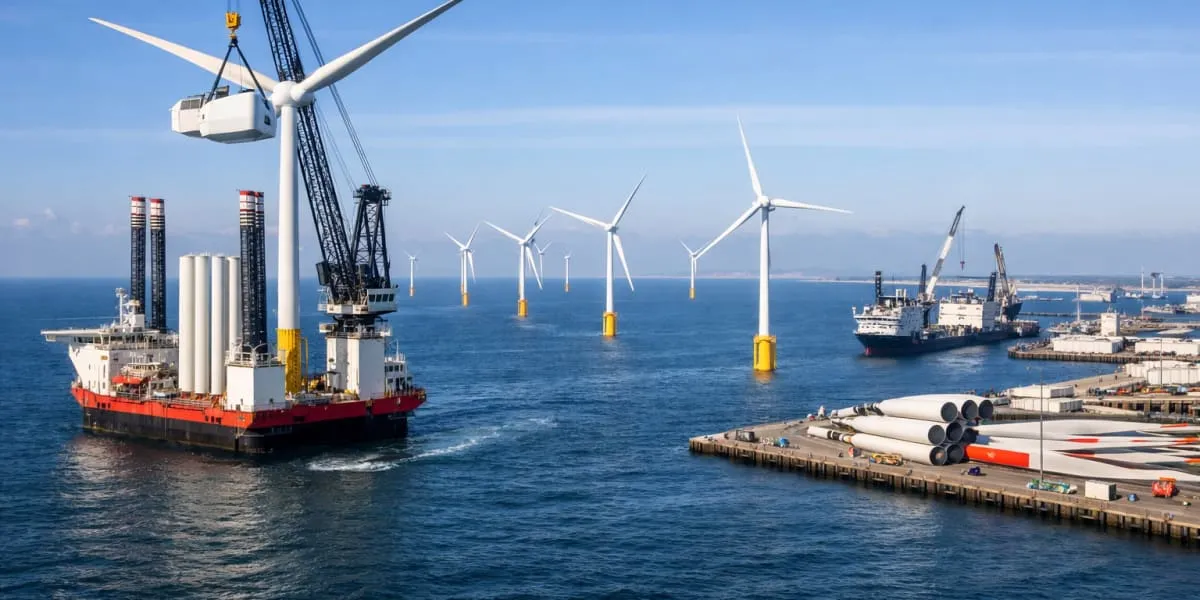
RWE has reached the midway point in constructing the 1.1 gigawatt (GW) Thor offshore wind project off the west coast of Jutland, with 36 of the planned 72 turbines now in place. The installation moves the project towards becoming Denmark's largest offshore wind farm and the company indicated it remains on course for full commercial operation by spring 2027. Installation logistics are being coordinated from the Port of Esbjerg where turbine staging and vessel operations are under way.

The turbines are supplied by Siemens Gamesa and each has a generation capacity of up to 15 Megawatt (MW); rotor blades measure 115 metres and nacelle heights reach about 148 metres. Installation is being carried out from the Port of Esbjerg using the Fred. Olsen Windcarrier vessel Brave Tern, and the operator expects to complete the remaining 36 turbines by the end of 2026. The project will then proceed to testing and commissioning ahead of the planned commercial start.

Thor incorporates sustainability features including 36 carbon-reduced steel turbine towers and 120 recyclable rotor blades fitted across 40 turbines, which the developer said will reduce lifecycle emissions and improve recyclability. Once operational the offshore wind farm is expected to generate enough renewable electricity to meet the annual demand of more than one million Danish households. The scale of the project is being presented as a step towards larger decarbonisation goals in the North Sea region.

The project is being developed as a joint venture in which RWE holds a 51 per cent stake and Norges Bank Investment Management 49 per cent, with RWE responsible for construction, operation and lifecycle management. The company emphasised the role of supply chain partners and said coordinated logistics and vessel availability have been central to progress. Further milestones will be reported as the installation campaign advances.

RWE's chief technology officer expressed thanks to staff and partners and outlined the remaining focus on safe completion and commissioning in 2027. The developer said lessons from the Thor programme will inform future offshore projects and supply arrangements.

RWE has reached the midway point in constructing the 1.1 gigawatt (GW) Thor offshore wind project off the west coast of Jutland, with 36 of the planned 72 turbines now in place. The installation moves the project towards becoming Denmark's largest offshore wind farm and the company indicated it remains on course for full commercial operation by spring 2027. Installation logistics are being coordinated from the Port of Esbjerg where turbine staging and vessel operations are under way. The turbines are supplied by Siemens Gamesa and each has a generation capacity of up to 15 Megawatt (MW); rotor blades measure 115 metres and nacelle heights reach about 148 metres. Installation is being carried out from the Port of Esbjerg using the Fred. Olsen Windcarrier vessel Brave Tern, and the operator expects to complete the remaining 36 turbines by the end of 2026. The project will then proceed to testing and commissioning ahead of the planned commercial start. Thor incorporates sustainability features including 36 carbon-reduced steel turbine towers and 120 recyclable rotor blades fitted across 40 turbines, which the developer said will reduce lifecycle emissions and improve recyclability. Once operational the offshore wind farm is expected to generate enough renewable electricity to meet the annual demand of more than one million Danish households. The scale of the project is being presented as a step towards larger decarbonisation goals in the North Sea region. The project is being developed as a joint venture in which RWE holds a 51 per cent stake and Norges Bank Investment Management 49 per cent, with RWE responsible for construction, operation and lifecycle management. The company emphasised the role of supply chain partners and said coordinated logistics and vessel availability have been central to progress. Further milestones will be reported as the installation campaign advances. RWE's chief technology officer expressed thanks to staff and partners and outlined the remaining focus on safe completion and commissioning in 2027. The developer said lessons from the Thor programme will inform future offshore projects and supply arrangements.

Related Stories

Gold Stories

Next Story
Infrastructure Urban

KONE Opens India's First Digital Experience Centre in Pune

KONE, a global elevator and escalator manufacturer, has inaugurated its first Digital Experience Centre (DEC) in India, located in Pune. The facility aims to showcase how artificial intelligence (AI), connectivity and data-driven technologies can enhance customer experiences and improve building operations.The centre was inaugurated by Jussi Herlin, Executive Vice Chair, KONE Corporation; Philippe Delorme, President and CEO, KONE; and Nandan Nilekani, Co-founder and Chairman of the Board, Infosys.Designed as an interactive customer environment, the facility demonstrates digital solutions cover..

Next Story
Infrastructure Urban

CII GreenCo Launches Circularity Guidelines for Indian Industry

The Confederation of Indian Industry (CII) GreenCo Council has launched the CII GreenCo Circularity Guidelines – Pilot Version at the 17th CII GreenCo Waste & Resource Management Summit 2026 in Chennai. The initiative aims to strengthen resource efficiency, waste reduction and circular economy practices across Indian manufacturing and process industries.The guidelines introduce a structured framework with circularity indices covering raw materials, consumables, packaging and other resource inputs. These indicators will help industries assess existing practices, identify opportunities to ..

Next Story
Infrastructure Energy

Global Electronics Association Launches IPC-1783-CO2E Standard

The Global Electronics Association has introduced IPC-1783-CO2E, a new international standard aimed at improving consistency, transparency and comparability in product carbon footprint reporting across the electronics manufacturing industry.The standard, titled International Standard for Data Collection and Reporting of CO2 Equivalent (CO2e) Emissions for the Electronics Manufacturing Supply Chain, provides industry-specific guidance for collecting, estimating and reporting carbon emissions data.With increasing regulatory requirements and customer expectations, electronics manufacturers face c..

Advertisement

Subscribe to Our Newsletter

Get daily newsletters around different themes from Construction world.

STAY CONNECTED

Advertisement

SPECIAL OFFER
QR Code