+
Scindia Launches Rs 800 Mn Agarwood Value Chain Scheme in Tripura
ECONOMY & POLICY

Scindia Launches Rs 800 Mn Agarwood Value Chain Scheme in Tripura

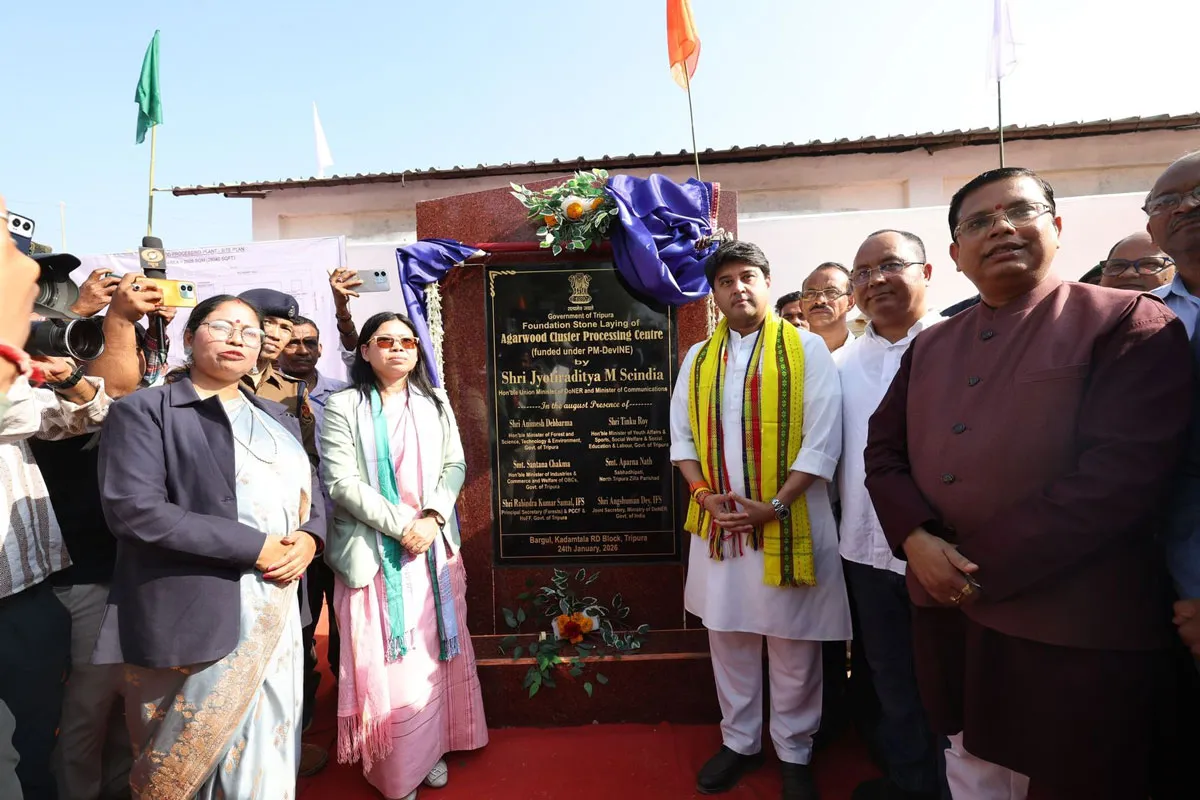
Union Minister for Development of North Eastern Region and Communications Jyotiraditya M. Scindia recently laid the foundation stone for the Rs 800 million Agarwood Value Chain Development Scheme at North Fulkabari in Tripura, marking a major push to strengthen one of the region’s most distinctive agro-based industries.

Addressing the gathering, the Union Minister said the initiative aligns with the vision of Prime Minister Narendra Modi to build a developed North East by focusing on each state’s unique strengths. He noted that India’s agarwood production is largely concentrated in Tripura and Assam, and the new scheme is designed to unlock the full potential of both states.

Under the scheme, the entire agarwood value chain will be strengthened—from cultivation in farmers’ fields to processing, branding and marketing in global markets. Two Central Processing Centres will be established, one in Golaghat, Assam, and another in Tripura. These centres will enable end-to-end processing and marketing, remove intermediaries and ensure farmers receive full value for their produce.

The Union Minister highlighted several enabling measures to make the sector globally competitive. The process for securing a Geographical Indication tag is underway, export quotas have been significantly enhanced, and agarwood chip exports have been increased from 25,000 kg to 1.5 lakh kg, while agarwood oil exports have risen from 1,500 kg to 7,500 kg. Digital integration of sites and permissions will allow farmers to directly access international markets.

Fulkabari’s agarwood ecosystem was cited as a strong example of the ‘Local to Global’, ‘Vocal for Local’ and One District One Product approach. The Minister noted that nearly 90 per cent of India’s estimated 150 million agarwood trees are located in the North East, and Tripura’s production capacity is expected to rise by up to 50 per cent under the scheme.

Looking ahead, the Union Minister said Tripura’s agarwood sector has the potential to achieve an annual turnover of around Rs 20 billiom within the next three to four years. Buyer–seller meets are being organised to establish direct global linkages, including recent engagements with international buyers from Qatar.

Concluding, he said the scheme reflects sustained efforts by the Centre in partnership with the Manik Saha-led state government, and expressed confidence that Tripura’s agarwood sector will gain global recognition while contributing to Atmanirbhar Bharat.

Union Minister for Development of North Eastern Region and Communications Jyotiraditya M. Scindia recently laid the foundation stone for the Rs 800 million Agarwood Value Chain Development Scheme at North Fulkabari in Tripura, marking a major push to strengthen one of the region’s most distinctive agro-based industries. Addressing the gathering, the Union Minister said the initiative aligns with the vision of Prime Minister Narendra Modi to build a developed North East by focusing on each state’s unique strengths. He noted that India’s agarwood production is largely concentrated in Tripura and Assam, and the new scheme is designed to unlock the full potential of both states. Under the scheme, the entire agarwood value chain will be strengthened—from cultivation in farmers’ fields to processing, branding and marketing in global markets. Two Central Processing Centres will be established, one in Golaghat, Assam, and another in Tripura. These centres will enable end-to-end processing and marketing, remove intermediaries and ensure farmers receive full value for their produce. The Union Minister highlighted several enabling measures to make the sector globally competitive. The process for securing a Geographical Indication tag is underway, export quotas have been significantly enhanced, and agarwood chip exports have been increased from 25,000 kg to 1.5 lakh kg, while agarwood oil exports have risen from 1,500 kg to 7,500 kg. Digital integration of sites and permissions will allow farmers to directly access international markets. Fulkabari’s agarwood ecosystem was cited as a strong example of the ‘Local to Global’, ‘Vocal for Local’ and One District One Product approach. The Minister noted that nearly 90 per cent of India’s estimated 150 million agarwood trees are located in the North East, and Tripura’s production capacity is expected to rise by up to 50 per cent under the scheme. Looking ahead, the Union Minister said Tripura’s agarwood sector has the potential to achieve an annual turnover of around Rs 20 billiom within the next three to four years. Buyer–seller meets are being organised to establish direct global linkages, including recent engagements with international buyers from Qatar. Concluding, he said the scheme reflects sustained efforts by the Centre in partnership with the Manik Saha-led state government, and expressed confidence that Tripura’s agarwood sector will gain global recognition while contributing to Atmanirbhar Bharat.

Next Story
Infrastructure Urban

Implementation Status of Jal Jeevan Mission

Since August 2019 the Government has implemented Jal Jeevan Mission to provide assured potable water through household tap connections in rural India. At the start of the mission only 32.3 million (mn) rural households, representing 16.7 per cent, were reported to have tap water connections. States and union territories have reported that 125.8 mn additional rural households have since been provided with tap connections. As a result, of about 193.6 mn rural households roughly 158.2 mn, or 81.71 per cent, are reported to have tap water supply at home.\n\nThe State, district and village level st..

Next Story
Infrastructure Urban

Jal Jeevan Mission Reaches Eighty One Per Cent Rural Coverage

The Government reported substantial progress under the Jal Jeevan Mission, launched in August 2019 to provide tap water to every rural household. At launch only 32.3 million (mn) rural households had tap connections and states and Union territories reported provision of 125.8 mn additional households by March 2026. Consequently, out of about 193.6 mn rural households around 158.2 mn, or 81.71 per cent, are reported to have tap water at home. The Finance Minister announced extension of the mission until 2028 in the 2025-26 budget speech. The Swachh Bharat Mission Grameen, launched in October 20..

Next Story
Infrastructure Urban

Empowering Local Governance for Sustainable Rural Water Supply

The Ministry of Jal Shakti has aligned the Jal Jeevan Mission (JJM) with the 73rd Amendment to strengthen village level planning and community ownership of water supply. Gram Panchayats, village water and sanitation committees and Pani Samitis are to plan, implement, manage and maintain piped water systems, with gram sabha processes formalising handover and oversight. Implementation support agencies including non government organisations, community based organisations and self help groups have been empanelled to train local committees and promote women participation. Under JJM, the department ..

Advertisement

Subscribe to Our Newsletter

Get daily newsletters around different themes from Construction world.

STAY CONNECTED

Advertisement

Advertisement

Advertisement