Shree Cement Forecasts Higher Costs For Financial Year 2026-27
ECONOMY & POLICY

Shree Cement Forecasts Higher Costs For Financial Year 2026-27

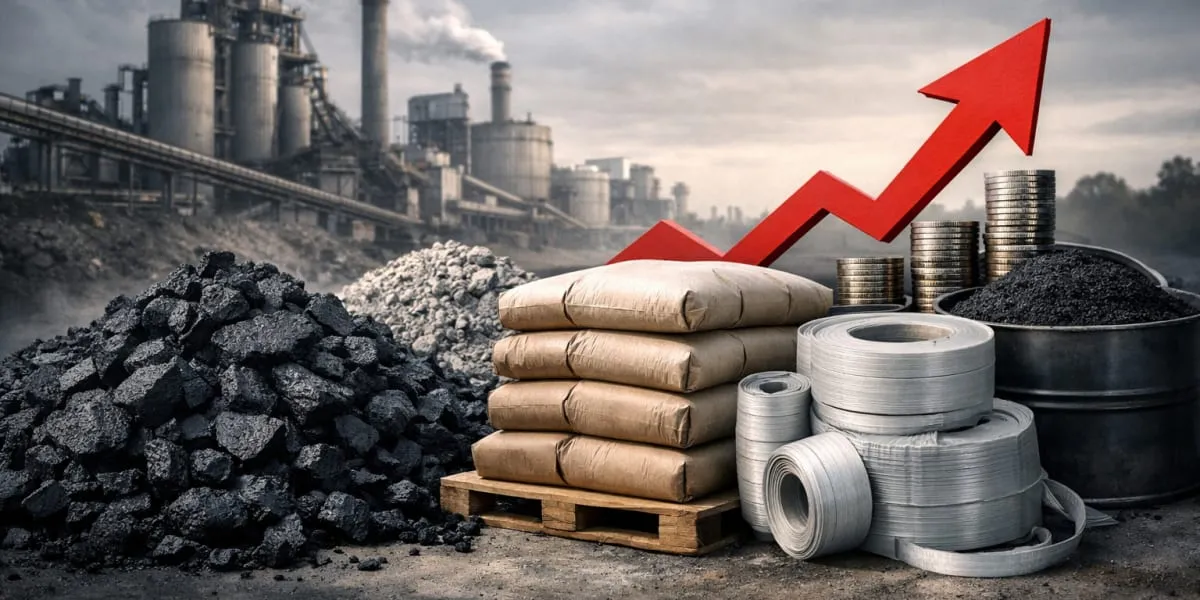
Shree Cement has warned that production costs will rise sharply in financial year 2026-27 as global supply chain disruptions and geopolitical tensions increase prices of key inputs. In its annual report the company said that while input costs remained largely stable during the first half of 2025-26, prices of raw materials began to trend upward from the start of the second half. The company attributed a late fiscal year spike in the cost of coal, petcoke, packing bags and other materials to disruptions linked to tensions in West Asia.

The company said that the major impact of this intense increase on production costs would be felt in 2026-27 and that those pressures are likely to affect margins. It nevertheless indicated optimism about demand fundamentals, citing continued infrastructure investment in roads, railways, metro networks and ports as support for cement consumption. Elevated housing demand driven by favourable demographics, urbanisation and government housing schemes was described as another sustaining factor.

Shree Cement noted that a gradual recovery in private real estate and commercial construction activity is expected to provide further support to demand. The company flagged risks to the outlook, warning that escalating geopolitical tensions and forecasts of a moderate monsoon could pose a threat to the favourable demand scenario. Management highlighted that close monitoring of input costs and supply chain logistics will be essential.

On the ready-mix concrete business the company reported steady structural growth and rising relevance within the domestic construction ecosystem. The segment was said to be expected to grow at a compound annual growth rate of approximately seven to nine per cent over the medium term. Increasing urbanisation, infrastructure-led construction and a rising preference for organised construction solutions were cited as the main growth drivers.

The company argued that the shift towards ready-mix concrete aligns with broader trends of formalisation, safety, sustainability and productivity enhancement and that these factors provide long-term growth opportunities. It said that, despite near-term cost pressures, strong demand fundamentals should help maintain robust cement consumption.

Shree Cement has warned that production costs will rise sharply in financial year 2026-27 as global supply chain disruptions and geopolitical tensions increase prices of key inputs. In its annual report the company said that while input costs remained largely stable during the first half of 2025-26, prices of raw materials began to trend upward from the start of the second half. The company attributed a late fiscal year spike in the cost of coal, petcoke, packing bags and other materials to disruptions linked to tensions in West Asia. The company said that the major impact of this intense increase on production costs would be felt in 2026-27 and that those pressures are likely to affect margins. It nevertheless indicated optimism about demand fundamentals, citing continued infrastructure investment in roads, railways, metro networks and ports as support for cement consumption. Elevated housing demand driven by favourable demographics, urbanisation and government housing schemes was described as another sustaining factor. Shree Cement noted that a gradual recovery in private real estate and commercial construction activity is expected to provide further support to demand. The company flagged risks to the outlook, warning that escalating geopolitical tensions and forecasts of a moderate monsoon could pose a threat to the favourable demand scenario. Management highlighted that close monitoring of input costs and supply chain logistics will be essential. On the ready-mix concrete business the company reported steady structural growth and rising relevance within the domestic construction ecosystem. The segment was said to be expected to grow at a compound annual growth rate of approximately seven to nine per cent over the medium term. Increasing urbanisation, infrastructure-led construction and a rising preference for organised construction solutions were cited as the main growth drivers. The company argued that the shift towards ready-mix concrete aligns with broader trends of formalisation, safety, sustainability and productivity enhancement and that these factors provide long-term growth opportunities. It said that, despite near-term cost pressures, strong demand fundamentals should help maintain robust cement consumption.

Next Story
Infrastructure Urban

AI Data Centre Leaders Map India’s Infrastructure Roadmap

Mumbai, 22 July 2026: As artificial intelligence reshapes global digital infrastructure, industry leaders gathered in Mumbai today at the AI-Powered Data Centre Conference 2026 to discuss how India can build the capacity, technology and ecosystem required to emerge as a global AI infrastructure hub. Organised by ASAPP Info Global Group and conceptualised by FIRST Construction Council, the conference revolved around the theme, “From Capacity Gap to AI Superpower: Building India's Digital Backbone for the Intelligence Economy.” Bringing together developers, technology providers, enterpr..

Next Story
Infrastructure Urban

SCLR Extension Nears Completion Linking BKC With Signal-Free Route

The Santacruz-Chembur Link Road (SCLR) extension towards Bandra-Kurla Complex (BKC) via the Mumbai University campus has entered its final stage, bringing motorists closer to a direct, signal-free connection between the Western Express Highway and the city’s commercial district. The elevated connector is being built as an arm from the SCLR alignment and will link the western suburbs with BKC without surface signals. The link is designed to reduce journey times for commuters travelling from the western suburbs to BKC and to improve access to eastern Mumbai. By carrying through traffic above s..

Next Story
Infrastructure Transport

Raiganj MP Seeks Bengal Only Highway Link To Siliguri

Raiganj Member of Parliament Kartik Chandra Paul met Union Minister for Road Transport and Highways Nitin Gadkari in New Delhi to press for a new stretch of national highway in North Dinajpur district. He urged approval for a Bengal-to-Bengal link that would connect National Highways 12 and 27 to allow vehicles bound for Siliguri to avoid the current route through Kishanganj in neighbouring Bihar. He also submitted a proposed alignment of the new road to the ministry for consideration. At present vehicles from Raiganj travel along NH-12 and join NH-27 at Purnia More in Dalkhola, a route that p..

Advertisement

Subscribe to Our Newsletter

Get daily newsletters around different themes from Construction world.

STAY CONNECTED

Advertisement

Advertisement

Advertisement