Supreme Court Directs Centre To Link Fuel To Insurance Status
ECONOMY & POLICY

Supreme Court Directs Centre To Link Fuel To Insurance Status

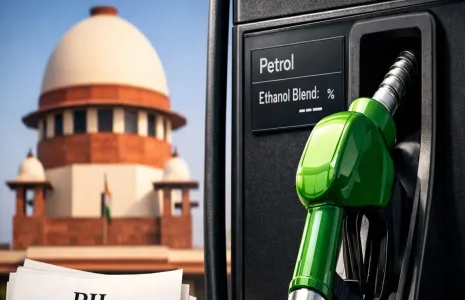
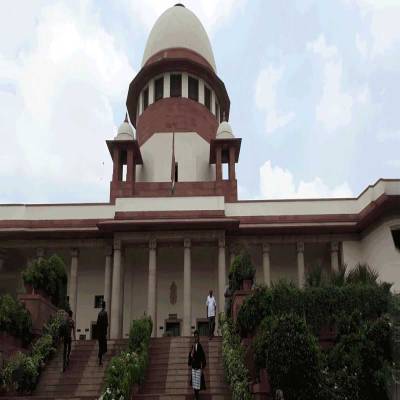
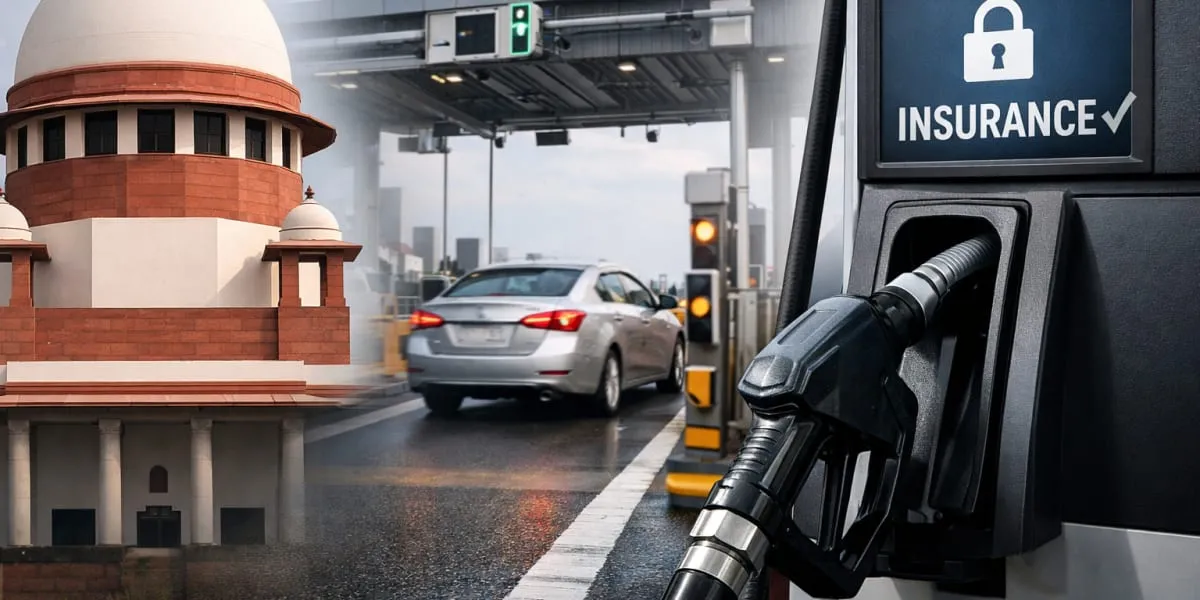
The Supreme Court has directed the central government to launch pilot projects to replace stopping at toll plazas with automatic detection of vehicles and to link fuel dispensation to valid insurance status. A bench of Justices Sanjay Karol and Prashant Kumar Mishra asked the Insurance Regulatory and Development Authority (IRDA) and the Ministry of Road Transport and Highways (MoRTH) to design the pilots.\n\nThe court highlighted poor compliance with the Motor Vehicles Act requirement for third-party insurance and cited a standing committee report that placed uninsured vehicles at nearly 56 per cent of the fleet. It recorded that the absolute figure corresponds to 165.4 mn vehicles out of 304.8 mn and said this undermines victim compensation.\n\nThe bench directed the IRDA to consider a scheme under which petrol pumps would refuse fuel to vehicles without valid insurance until cover was obtained, and it suggested the use of Automatic Number Plate Recognition (ANPR) cameras for identification. It noted that the Ministry of Petroleum and Natural Gas had in principle no objection to the linkage.\n\nThe court recalled its 2018 direction requiring three years of third-party cover for new cars and five years for new two-wheelers at registration, and said the period should be enhanced by one year. It therefore directed that third-party cover be for four years for new cars and six years for new two-wheelers and asked the IRDA to issue directions.\n\nThe bench ordered deployment of ANPR systems integrated with data from the Insurance Information Bureau and the VAHAN portal to enable automatic e-challans for uninsured vehicles, and directed that state police be provided handheld devices or downloadable apps linked to those databases. It asked the IRDA and the MoRTH to ensure availability of policy options including add-on covers, personal accident cover and own damage cover alongside a base policy meeting statutory minima.\n\nThe court said the measures aim to ensure ground-level compliance with Section 146 of the Motor Vehicles Act. It said they are intended to reduce delays faced by accident victims when seeking compensation.

The Supreme Court has directed the central government to launch pilot projects to replace stopping at toll plazas with automatic detection of vehicles and to link fuel dispensation to valid insurance status. A bench of Justices Sanjay Karol and Prashant Kumar Mishra asked the Insurance Regulatory and Development Authority (IRDA) and the Ministry of Road Transport and Highways (MoRTH) to design the pilots.\n\nThe court highlighted poor compliance with the Motor Vehicles Act requirement for third-party insurance and cited a standing committee report that placed uninsured vehicles at nearly 56 per cent of the fleet. It recorded that the absolute figure corresponds to 165.4 mn vehicles out of 304.8 mn and said this undermines victim compensation.\n\nThe bench directed the IRDA to consider a scheme under which petrol pumps would refuse fuel to vehicles without valid insurance until cover was obtained, and it suggested the use of Automatic Number Plate Recognition (ANPR) cameras for identification. It noted that the Ministry of Petroleum and Natural Gas had in principle no objection to the linkage.\n\nThe court recalled its 2018 direction requiring three years of third-party cover for new cars and five years for new two-wheelers at registration, and said the period should be enhanced by one year. It therefore directed that third-party cover be for four years for new cars and six years for new two-wheelers and asked the IRDA to issue directions.\n\nThe bench ordered deployment of ANPR systems integrated with data from the Insurance Information Bureau and the VAHAN portal to enable automatic e-challans for uninsured vehicles, and directed that state police be provided handheld devices or downloadable apps linked to those databases. It asked the IRDA and the MoRTH to ensure availability of policy options including add-on covers, personal accident cover and own damage cover alongside a base policy meeting statutory minima.\n\nThe court said the measures aim to ensure ground-level compliance with Section 146 of the Motor Vehicles Act. It said they are intended to reduce delays faced by accident victims when seeking compensation.

Next Story
Real Estate

BXB Estates Sets AED 110 Million Jumeirah Golf Estates Record

BXB Estates has completed an AED 110 million residential transaction at Jumeirah Golf Estates, setting a new sales record for the prestigious Dubai residential community.Negotiated by Alfie Tabrez, Managing Partner of BXB Estates, the deal surpassed the previous record of AED 58 million for a completed ready villa in the development.The six-bedroom residence offers 21,714 sq ft of built-up space on a 15,873-sq-ft plot. It features nine bathrooms, four living lounges, a home office, bar lounge, private cinema and rooftop terrace.The property also includes a dedicated wellness area comprising a ..

Next Story
Infrastructure Urban

SECR Floats Rs 6,019 Mn EPC Tender For Paradol Nagpur Link

South East Central Railway (SECR) has invited bids for an Engineering, Procurement and Construction (EPC) contract to build a new broad gauge single line between Paradol Takeoff Point and Nagpur Road Station in Chhattisgarh. The contract carries an estimated cost of Rs 6,019.0 mn and requires an earnest money deposit of Rs 120.4 mn. The work is framed as an EPC assignment intended to strengthen regional rail infrastructure. The tender, issued under number CAO-C-BSP-26-27-15, specifies a completion period of 730 days and a bid validity of 180 days. Two pre-bid meetings are scheduled for 24 Augu..

Next Story
Infrastructure Transport

Indian Railways Reports Nine Per Cent Rise In July Freight Loading

Indian Railways handled 141.3 million tonnes (141.3 mn t) of freight in July, marking a rise of nine per cent year on year. Freight loading maintained a positive trajectory across the network compared with the same month last year. Passenger traffic also increased in July, contributing to higher overall network utilisation. The July outcome continued a pattern of steady monthly gains, reflecting gradual improvement in industrial and logistics activity. The growth in freight volumes reflected stronger demand across multiple sectors and improvements in logistics and train turnarounds. Enhanced r..

Advertisement

Subscribe to Our Newsletter

Get daily newsletters around different themes from Construction world.

STAY CONNECTED

Advertisement

Advertisement

Advertisement