Tata Steel Ludhiana Plant to Begin Operations in March
ECONOMY & POLICY

Tata Steel Ludhiana Plant to Begin Operations in March

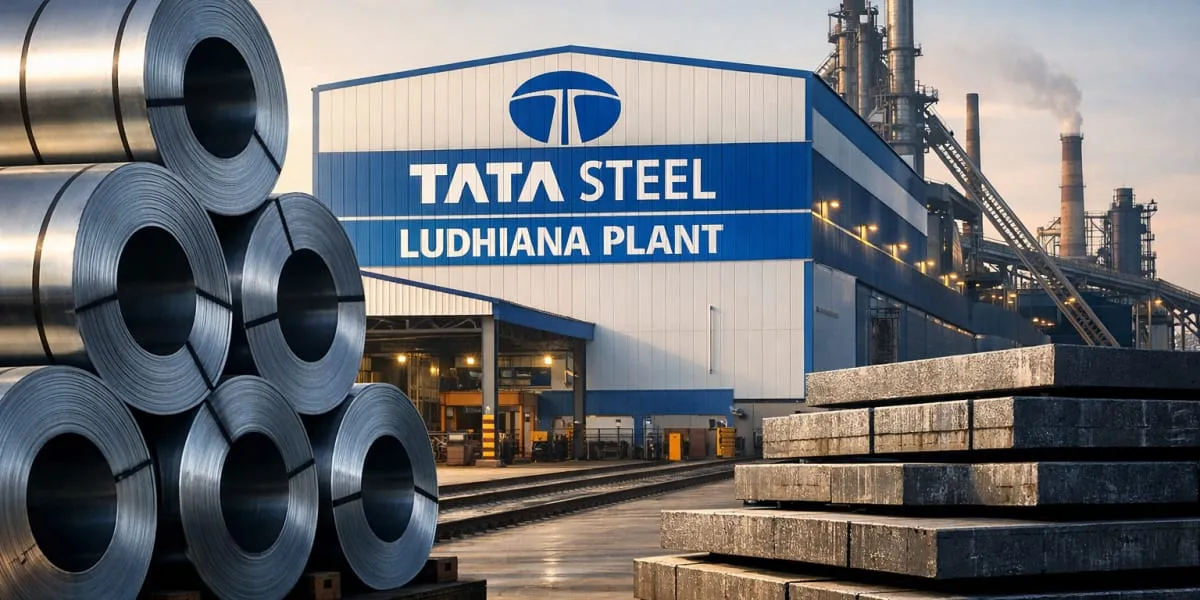
Tata Steel's new plant in Ludhiana is scheduled to commence operations in March, the Punjab chief minister Bhagwant Mann announced, describing the project as a major addition to regional manufacturing. The plant has been developed at a cost of Rs 3,200 crore, equivalent to Rs 32 billion (32 bn), and represents a significant investment in local steel production. The announcement followed completion of construction and commissioning activities ahead of the planned timeline. Commissioning and testing of equipment were completed and trial runs were carried out to verify production systems.

The state government said it ensured timely execution of the project and pledged full support for its smooth operation and future expansion. Officials indicated that regulatory clearances and infrastructure links were coordinated to enable an early start of commercial activity. The company has finalised arrangements for utilities and logistics to align with operational requirements. Coordination with local authorities and suppliers was prioritised to reduce operational delays.

Industry analysts suggested the facility will bolster manufacturing capacity in the region and strengthen supply chains for nearby firms. The project is expected to support employment during operations and maintenance phases and to create vendor opportunities across the local economy. Tata Steel is reported to continue exploring further investments for scaling production over the coming years. Sustained operations are likely to require a mix of technical and supervisory staff drawn from the region.

Observers noted that the investment underlines renewed private sector confidence in industrial projects within the state and may attract ancillary enterprises. The administration framed the plant as part of a broader effort to enhance manufacturing competitiveness and to generate sustainable economic activity. Government and company representatives indicated ongoing collaboration on expansion planning and community engagement. Authorities stated that environmental and safety compliance will be monitored as operations progress.

Tata Steel's new plant in Ludhiana is scheduled to commence operations in March, the Punjab chief minister Bhagwant Mann announced, describing the project as a major addition to regional manufacturing. The plant has been developed at a cost of Rs 3,200 crore, equivalent to Rs 32 billion (32 bn), and represents a significant investment in local steel production. The announcement followed completion of construction and commissioning activities ahead of the planned timeline. Commissioning and testing of equipment were completed and trial runs were carried out to verify production systems. The state government said it ensured timely execution of the project and pledged full support for its smooth operation and future expansion. Officials indicated that regulatory clearances and infrastructure links were coordinated to enable an early start of commercial activity. The company has finalised arrangements for utilities and logistics to align with operational requirements. Coordination with local authorities and suppliers was prioritised to reduce operational delays. Industry analysts suggested the facility will bolster manufacturing capacity in the region and strengthen supply chains for nearby firms. The project is expected to support employment during operations and maintenance phases and to create vendor opportunities across the local economy. Tata Steel is reported to continue exploring further investments for scaling production over the coming years. Sustained operations are likely to require a mix of technical and supervisory staff drawn from the region. Observers noted that the investment underlines renewed private sector confidence in industrial projects within the state and may attract ancillary enterprises. The administration framed the plant as part of a broader effort to enhance manufacturing competitiveness and to generate sustainable economic activity. Government and company representatives indicated ongoing collaboration on expansion planning and community engagement. Authorities stated that environmental and safety compliance will be monitored as operations progress.

Next Story
Infrastructure Transport

Sector 51-52 Metro skywalk in Noida remains shut despite being ready for over a year

Thousands of commuters travelling between Delhi Metro Rail Corporation’s (DMRC) Sector 52 station and Noida Metro Rail Corporation’s (NMRC) Sector 51 station continue to face daily inconvenience as the 300-metre air-conditioned skywalk connecting the two stations remains closed, despite being completed over a year ago, according to a report.The Noida Metro Rail Corporation built the foot overbridge to enable a seamless interchange between the Delhi Metro and Noida Metro networks. However, pending finishing work and a structural obstruction have delayed its opening.Krishna Karunesh, Chief E..

Next Story
Infrastructure Transport

Maharashtra clears Metro Line 5A, expansion of Mumbai Metro Line 5

The Maharashtra government has approved the expansion of Mumbai Metro Line 5 along with a new integrated corridor, Metro Line 5A, forming a combined 34.2-km metro network across the Thane-Bhiwandi-Kalyan-Ulhasnagar belt. The integrated project has been cleared at an estimated cost of ₹18,130.55 crore, according to a government resolution (GR).Metro Line 5 was originally approved in October 2017 as a 24.9-km fully elevated corridor with 17 stations connecting Thane, Bhiwandi and Kalyan, with an initial project cost of ₹8,416.51 crore. The corridor is being developed in two phases.The first ..

Next Story
Infrastructure Transport

Bengaluru Metro expansion seen driving office demand

Bengaluru’s expanding metro network is expected to emerge as a major catalyst for real estate growth, with the Yellow and Pink Lines likely to boost both office demand and residential prices across key micro-markets, according to a report by Colliers India.The report estimates that over the next two years, Bengaluru could witness an additional 5–7 million sq ft of Grade A office space demand across the Central Business District (CBD), Secondary Business District (SBD) and Electronic City. Improved metro connectivity and reduced commute times are expected to drive higher occupier interest a..

Advertisement

Subscribe to Our Newsletter

Get daily newsletters around different themes from Construction world.

STAY CONNECTED

Advertisement

Advertisement

Advertisement