+
ArcelorMittal Sees EU Tariffs Boosting Profits And Capacity Use
Steel

ArcelorMittal Sees EU Tariffs Boosting Profits And Capacity Use

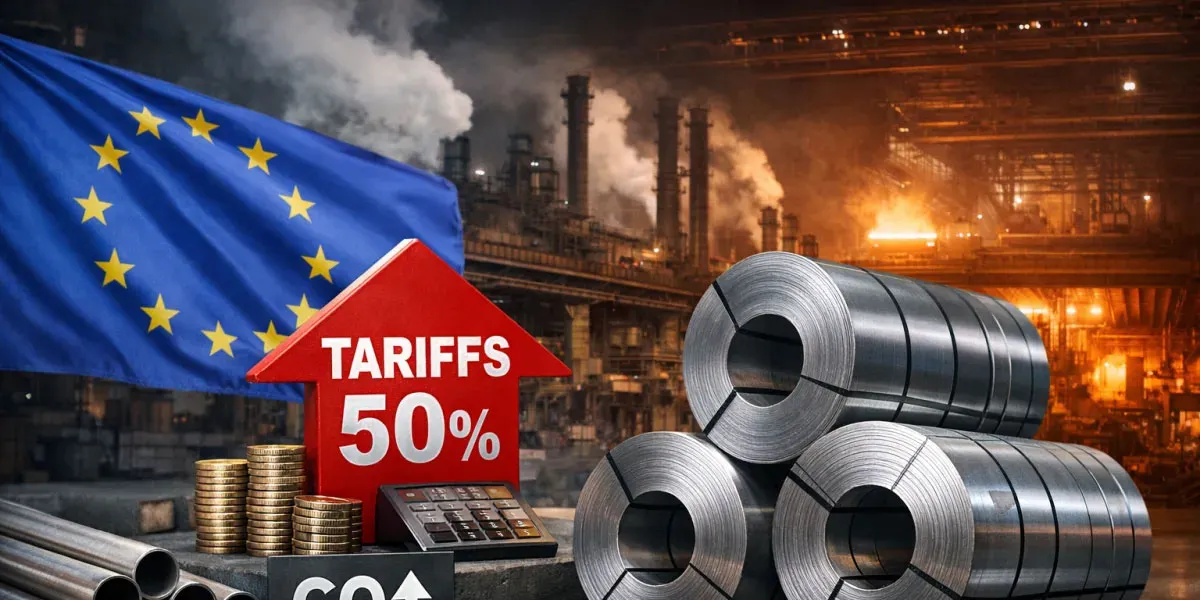
ArcelorMittal SA said it expects earnings and capacity use in Europe to improve after the European Union proposed doubling tariffs to 50 per cent on steel imports above a reduced quota and its Carbon Border Adjustment Mechanism for emissions intensive goods was extended to certain downstream sectors. The company said the new import regime is due to come into force in July and will reduce pressure from cheap foreign steel. It added that rising protectionist measures in India, the United States and Latin America, along with moves by Beijing to tackle overcapacity in its one bn t a year steel sector, have eased earlier concerns about market flooding.

ArcelorMittal said the carbon levy and higher tariffs would enable European producers to recover to sustainable utilisation levels and to generate healthier returns on capital, according to the chief executive, Aditya Mittal. The group stated it was well positioned to benefit from the changed regulatory environment and intends to focus on running its facilities at higher capacity to regain market share from imports. The chief financial officer, Genuino Christino, said European capacity utilisation was running below 70 per cent and that import restrictions could lift utilisation to roughly 85 per cent.

The company reported fourth quarter earnings before interest, taxes, depreciation and amortisation of 1.59 bn dollars, marginally above analyst estimates, and its shares rose as much as 3.3 per cent in Amsterdam trading. ArcelorMittal said apparent steel demand outside China, a barometer of global economic activity, was expected to grow by two per cent in 2026. Management described the regulatory changes as likely to make continental steelmakers more efficient and profitable.

Analysts said higher tariffs and the carbon levy would support capacity utilisation and returns across the sector, while reducing incentives for relocation of manufacturing overseas. The company indicated that a tighter import regime would allow it to plan longer term for investment and output in Europe. It urged continued monitoring of policy implementation and market developments as the new rules take effect.

ArcelorMittal SA said it expects earnings and capacity use in Europe to improve after the European Union proposed doubling tariffs to 50 per cent on steel imports above a reduced quota and its Carbon Border Adjustment Mechanism for emissions intensive goods was extended to certain downstream sectors. The company said the new import regime is due to come into force in July and will reduce pressure from cheap foreign steel. It added that rising protectionist measures in India, the United States and Latin America, along with moves by Beijing to tackle overcapacity in its one bn t a year steel sector, have eased earlier concerns about market flooding. ArcelorMittal said the carbon levy and higher tariffs would enable European producers to recover to sustainable utilisation levels and to generate healthier returns on capital, according to the chief executive, Aditya Mittal. The group stated it was well positioned to benefit from the changed regulatory environment and intends to focus on running its facilities at higher capacity to regain market share from imports. The chief financial officer, Genuino Christino, said European capacity utilisation was running below 70 per cent and that import restrictions could lift utilisation to roughly 85 per cent. The company reported fourth quarter earnings before interest, taxes, depreciation and amortisation of 1.59 bn dollars, marginally above analyst estimates, and its shares rose as much as 3.3 per cent in Amsterdam trading. ArcelorMittal said apparent steel demand outside China, a barometer of global economic activity, was expected to grow by two per cent in 2026. Management described the regulatory changes as likely to make continental steelmakers more efficient and profitable. Analysts said higher tariffs and the carbon levy would support capacity utilisation and returns across the sector, while reducing incentives for relocation of manufacturing overseas. The company indicated that a tighter import regime would allow it to plan longer term for investment and output in Europe. It urged continued monitoring of policy implementation and market developments as the new rules take effect.

Next Story
Infrastructure Urban

Implementation Status of Jal Jeevan Mission

Since August 2019 the Government has implemented Jal Jeevan Mission to provide assured potable water through household tap connections in rural India. At the start of the mission only 32.3 million (mn) rural households, representing 16.7 per cent, were reported to have tap water connections. States and union territories have reported that 125.8 mn additional rural households have since been provided with tap connections. As a result, of about 193.6 mn rural households roughly 158.2 mn, or 81.71 per cent, are reported to have tap water supply at home.\n\nThe State, district and village level st..

Next Story
Infrastructure Urban

Jal Jeevan Mission Reaches Eighty One Per Cent Rural Coverage

The Government reported substantial progress under the Jal Jeevan Mission, launched in August 2019 to provide tap water to every rural household. At launch only 32.3 million (mn) rural households had tap connections and states and Union territories reported provision of 125.8 mn additional households by March 2026. Consequently, out of about 193.6 mn rural households around 158.2 mn, or 81.71 per cent, are reported to have tap water at home. The Finance Minister announced extension of the mission until 2028 in the 2025-26 budget speech. The Swachh Bharat Mission Grameen, launched in October 20..

Next Story
Infrastructure Urban

Empowering Local Governance for Sustainable Rural Water Supply

The Ministry of Jal Shakti has aligned the Jal Jeevan Mission (JJM) with the 73rd Amendment to strengthen village level planning and community ownership of water supply. Gram Panchayats, village water and sanitation committees and Pani Samitis are to plan, implement, manage and maintain piped water systems, with gram sabha processes formalising handover and oversight. Implementation support agencies including non government organisations, community based organisations and self help groups have been empanelled to train local committees and promote women participation. Under JJM, the department ..

Advertisement

Subscribe to Our Newsletter

Get daily newsletters around different themes from Construction world.

STAY CONNECTED

Advertisement

Advertisement

Advertisement