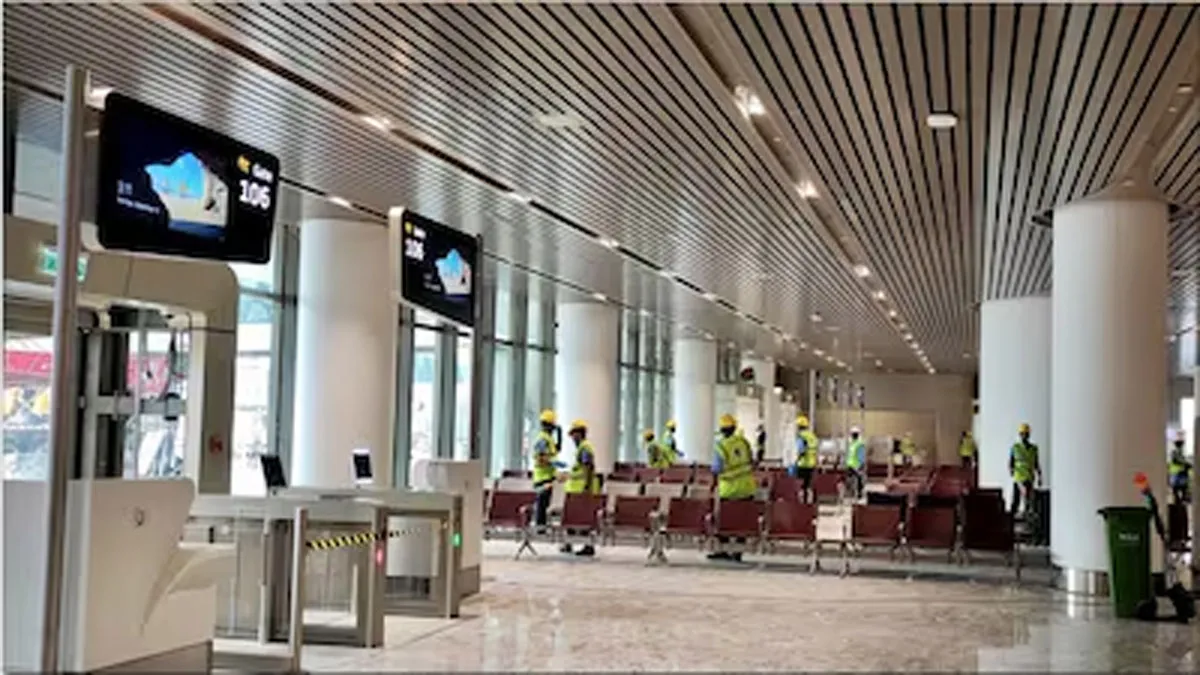
Adani To Invest $15bn To Lift Airport Capacity To 200m
AVIATION & AIRPORTS

Adani To Invest $15bn To Lift Airport Capacity To 200m

The Adani Group plans to invest $15 billion over the next five years to expand passenger-handling capacity across its airport network to 200 million annually, according to people familiar with the matter. The move aims to position the group at the forefront of India’s rapidly accelerating aviation market as it prepares to list its airports business.

The expansion strategy includes new terminals, additional taxiways and preparation for a second runway at Navi Mumbai International Airport, which is scheduled to open on 25 December. Capacity enhancement works are also planned at airports in Ahmedabad, Jaipur, Thiruvananthapuram, Lucknow and Guwahati.

Around 70 per cent of the planned investment is expected to be financed through debt raised over five years, with the remainder brought in as equity, the people said. The programme aligns with projections that India’s annual air passenger numbers will more than double to 300 million by 2030. By scaling capacity to nearly two-thirds of this figure, Adani aims to play a central role in facilitating the sector’s growth while boosting the appeal of its forthcoming airport unit IPO.

The planned expansion—expected to increase the group’s total passenger capacity by more than 60 per cent—does not include the additional 20 million capacity at Navi Mumbai or the 11 million at the new Guwahati terminal opening this month.

The Adani Group plans to invest $15 billion over the next five years to expand passenger-handling capacity across its airport network to 200 million annually, according to people familiar with the matter. The move aims to position the group at the forefront of India’s rapidly accelerating aviation market as it prepares to list its airports business. The expansion strategy includes new terminals, additional taxiways and preparation for a second runway at Navi Mumbai International Airport, which is scheduled to open on 25 December. Capacity enhancement works are also planned at airports in Ahmedabad, Jaipur, Thiruvananthapuram, Lucknow and Guwahati. Around 70 per cent of the planned investment is expected to be financed through debt raised over five years, with the remainder brought in as equity, the people said. The programme aligns with projections that India’s annual air passenger numbers will more than double to 300 million by 2030. By scaling capacity to nearly two-thirds of this figure, Adani aims to play a central role in facilitating the sector’s growth while boosting the appeal of its forthcoming airport unit IPO. The planned expansion—expected to increase the group’s total passenger capacity by more than 60 per cent—does not include the additional 20 million capacity at Navi Mumbai or the 11 million at the new Guwahati terminal opening this month.

Next Story
Infrastructure Urban

Rosatom Delivers Nuclear Fuel for Kudankulam Unit 3

Rosatom has recently supplied nuclear fuel for the initial loading of the VVER-1000 reactor core at Unit 3 of the Kudankulam Nuclear Power Plant, marking a key milestone in the second stage of the Russian-designed nuclear power project in southern India.The fuel was supplied by Rosatom’s Nuclear Fuel Division, managed by TVEL, and manufactured at the Novosibirsk Chemical Concentrates Plant. The delivery includes the initial reactor load along with reserve fuel assemblies and is part of a long-term contract covering the entire operational life of Units 3 and 4.Building on operational experien..

Next Story
Infrastructure Transport

CBL International Enables First LNG Bunkering at Xiaomo Port

CBL International recently completed the first-ever LNG bunkering operation at Xiaomo Port, supplying liquefied natural gas to vessels operated by BYD in support of its maritime decarbonisation strategy. The operation was facilitated through a physical supplier in collaboration with China National Offshore Oil Corporation (CNOOC), which supported the port’s inaugural LNG bunkering activity. The milestone represents a strategic expansion of CBL International's sustainable fuel offerings beyond biofuels, while also diversifying revenue streams. As global shipping intensifies efforts to cut em..

Next Story
Infrastructure Urban

Aimtron, Aurassure Partner for IoT Weather Systems

Aimtron Electronics has recently entered into an OEM manufacturing engagement with Aurassure to produce new-age, IoT-enabled weather and environmental monitoring systems in India. The collaboration supports the growing demand for real-time environmental intelligence across urban, industrial and infrastructure applications. The engagement comes as global focus on climate-risk management and data-driven planning accelerates. The global weather monitoring systems market, valued at around USD 2.1 billion in 2024, is projected to reach nearly USD 4.8 billion by 2034, driven by the rapid adoption o..

Advertisement

Subscribe to Our Newsletter

Get daily newsletters around different themes from Construction world.

STAY CONNECTED

Advertisement

Advertisement

Advertisement

Advertisement

Open In App