Haryana Installed Zero Air Monitoring Stations in 2026: CAQM Report
AVIATION & AIRPORTS

Haryana Installed Zero Air Monitoring Stations in 2026: CAQM Report

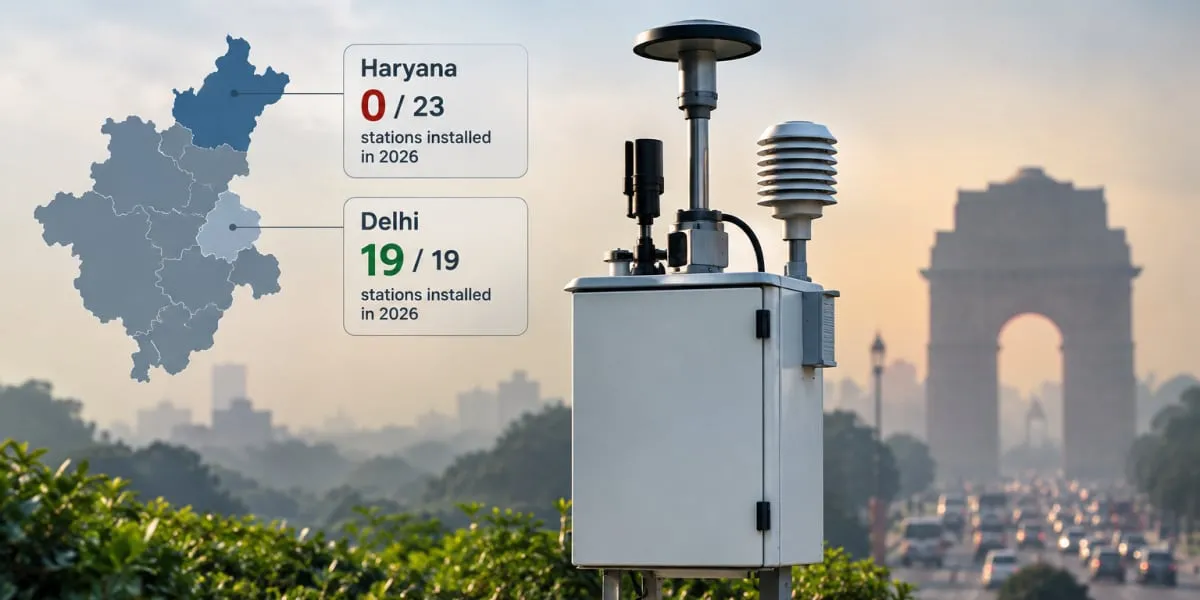
The Commission for Air Quality Management (CAQM) has found that Haryana installed none of the 23 air-monitoring stations targeted for 2026, while Delhi completed all 19 planned stations. The assessment also identified delays in parking infrastructure, public transport, waste processing and green crematoriums across Delhi, Haryana, Rajasthan and Uttar Pradesh.

The report covers implementation up to October 31, 2026, with a final assessment scheduled for January 2027. Delhi constructed 15 of its targeted 266 parking lots, achieving 6 per cent of the goal, while Haryana completed nine of 79 and Rajasthan four of 16. Uttar Pradesh performed better, completing 21 of 24 planned lots.

Air-quality monitoring showed a mixed performance. Delhi met its target of installing 19 Continuous Ambient Air Quality Monitoring Stations (CAAQMS), while Rajasthan completed three of five and Uttar Pradesh installed 22 of 25. Haryana had not installed any of its 23 targeted stations by the end of the assessment period.

Public transport expansion was also uneven. Delhi achieved 71 per cent of its target for adding city buses, compared with 44 per cent in Uttar Pradesh and 8 per cent in Haryana, which added 70 buses against a target of 875. Rajasthan made no progress against its target of 100 buses. Delhi added no municipal solid waste processing capacity against a target of 650 tonnes per day, while Haryana, Rajasthan and Uttar Pradesh achieved 23 per cent, 28 per cent and 31 per cent of their respective targets.

The report found that none of the 421 targeted green crematoriums had been established across the four regions. Haryana used 35 per cent of its targeted biomass pellet and briquette quantity, while Punjab achieved 53 per cent, with both performances classified as unsatisfactory. Delhi met its targets for construction waste processing, and all four regions achieved their goals for last-mile connectivity vehicles. CAQM said governments could still improve implementation before the final review in January 2027.

The Commission for Air Quality Management (CAQM) has found that Haryana installed none of the 23 air-monitoring stations targeted for 2026, while Delhi completed all 19 planned stations. The assessment also identified delays in parking infrastructure, public transport, waste processing and green crematoriums across Delhi, Haryana, Rajasthan and Uttar Pradesh. The report covers implementation up to October 31, 2026, with a final assessment scheduled for January 2027. Delhi constructed 15 of its targeted 266 parking lots, achieving 6 per cent of the goal, while Haryana completed nine of 79 and Rajasthan four of 16. Uttar Pradesh performed better, completing 21 of 24 planned lots. Air-quality monitoring showed a mixed performance. Delhi met its target of installing 19 Continuous Ambient Air Quality Monitoring Stations (CAAQMS), while Rajasthan completed three of five and Uttar Pradesh installed 22 of 25. Haryana had not installed any of its 23 targeted stations by the end of the assessment period. Public transport expansion was also uneven. Delhi achieved 71 per cent of its target for adding city buses, compared with 44 per cent in Uttar Pradesh and 8 per cent in Haryana, which added 70 buses against a target of 875. Rajasthan made no progress against its target of 100 buses. Delhi added no municipal solid waste processing capacity against a target of 650 tonnes per day, while Haryana, Rajasthan and Uttar Pradesh achieved 23 per cent, 28 per cent and 31 per cent of their respective targets. The report found that none of the 421 targeted green crematoriums had been established across the four regions. Haryana used 35 per cent of its targeted biomass pellet and briquette quantity, while Punjab achieved 53 per cent, with both performances classified as unsatisfactory. Delhi met its targets for construction waste processing, and all four regions achieved their goals for last-mile connectivity vehicles. CAQM said governments could still improve implementation before the final review in January 2027.

Related Stories

Gold Stories

Next Story
Infrastructure Energy

JSW Motors Signs MoU with ARAI for Vehicle Development

JSW Motors, the passenger vehicle arm of JSW Group, has signed a memorandum of understanding (MoU) with the Automotive Research Association of India (ARAI) for technical collaboration on the design, validation and localisation of new energy vehicles (NEVs). The agreement is intended to create technical foundations for vehicles designed for Indian operating conditions. The companies will work on vehicle engineering and technical baselines, testing, validation and performance assessment, according to JSW Motors. Their programme will also cover advanced driver assistance systems (ADAS), battery s..

Next Story
Infrastructure Urban

Karnataka Offers Support for Toyota Expansion Plans

Karnataka Chief Minister D K Shivakumar assured Toyota Motor Corporation of the state government’s support for expanding its manufacturing operations during a meeting with the company’s senior leadership in Japan. The discussions covered higher production, new mobility solutions and further investment in Karnataka, as Toyota looks to increase vehicle production capacity to 1 mn in the near future. Shivakumar was accompanied by M B Patil, Karnataka’s Minister for Large and Medium Industries and Infrastructure Development. The Toyota delegation was led by Masakazu Yoshimura, the company’..

Next Story
Infrastructure Transport

Railways to Begin Bullet Train Trial on Surat-Bilimora Section

Indian Railways will begin a trial run of its bullet train service on the 50 km Surat-Bilimora section by May 2027. The section is part of the Mumbai-Ahmedabad high-speed rail corridor and is expected to provide the first operational segment of the project. The trial will use an indigenous trainset capable of travelling at 280 km per hour. Railway Ministry sources said the first section of the corridor, extending from Surat to Vapi, is scheduled to become operational by the end of 2027. The planned trial marks a step towards introducing high-speed rail services on the corridor, which connects ..

Subscribe to Our Newsletter

Get daily newsletters around different themes from Construction world.

STAY CONNECTED

Advertisement

SPECIAL OFFER
QR Code