+
Delhi Approves Rs Eight Point Zero Two Billion Road Redevelopment
ROADS & HIGHWAYS

Delhi Approves Rs Eight Point Zero Two Billion Road Redevelopment

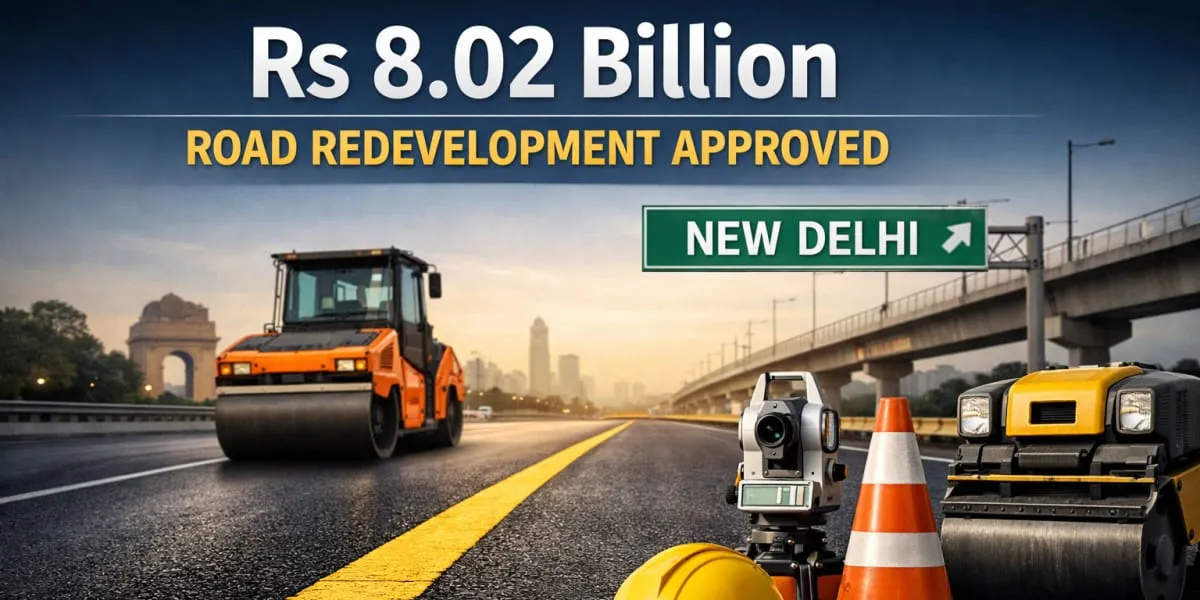
The Delhi government has approved a road redevelopment project worth Rs eight point zero two billion (bn) that will cover 400 km of urban roads across the city. The scheme aims to upgrade arterial and feeder roads to improve mobility and reduce wear and tear. The announcement follows planning studies that identified a need for coordinated resurfacing and structural rehabilitation.

The work will include resurfacing, reconstruction of damaged carriageways, improvement of pedestrian pathways and cycle tracks, and upgrade of stormwater drainage to reduce waterlogging. Street lighting and road signage will be modernised and measures to enhance road safety will be prioritised. The project is expected to address surface deterioration and provide a more durable pavement structure.

Implementation will proceed in phases to manage traffic disruption and allow continuous maintenance of critical routes. The city public works department will oversee tendering and contract management and will coordinate with local agencies responsible for utilities and traffic management. Contractors will be required to meet technical specifications and timelines set by the authority.

The authorities expect the redevelopment to ease congestion, shorten travel times and improve conditions for public transport and non-motorised mobility. Long term maintenance planning has been highlighted as essential to preserve the benefits of the investment and to avoid premature deterioration. The project is presented as a step towards a more resilient urban road network.

The Delhi government has approved a road redevelopment project worth Rs eight point zero two billion (bn) that will cover 400 km of urban roads across the city. The scheme aims to upgrade arterial and feeder roads to improve mobility and reduce wear and tear. The announcement follows planning studies that identified a need for coordinated resurfacing and structural rehabilitation. The work will include resurfacing, reconstruction of damaged carriageways, improvement of pedestrian pathways and cycle tracks, and upgrade of stormwater drainage to reduce waterlogging. Street lighting and road signage will be modernised and measures to enhance road safety will be prioritised. The project is expected to address surface deterioration and provide a more durable pavement structure. Implementation will proceed in phases to manage traffic disruption and allow continuous maintenance of critical routes. The city public works department will oversee tendering and contract management and will coordinate with local agencies responsible for utilities and traffic management. Contractors will be required to meet technical specifications and timelines set by the authority. The authorities expect the redevelopment to ease congestion, shorten travel times and improve conditions for public transport and non-motorised mobility. Long term maintenance planning has been highlighted as essential to preserve the benefits of the investment and to avoid premature deterioration. The project is presented as a step towards a more resilient urban road network.

Next Story
Equipment

Kabelschlepp India Installs Robotic VMC in Bengaluru

Kabelschlepp India, part of the Tsubaki Group, has installed a state-of-the-art Vertical Machining Center (VMC) integrated with robotic automation at its Bengaluru facility. The inauguration was held in the presence of Henning Preis, President & CEO, Kabelschlepp Group, Jörg Schulz, Vice President – Production, and Srinivas P. Kamisetty, Managing Director, Kabelschlepp India.The high-precision CNC VMC is designed for advanced milling, drilling, tapping and multi-axis machining. Equipped with a vertical spindle orientation, automatic tool changer and intelligent CNC control system, it en..

Next Story
Infrastructure Transport

Highway Delivery Reset!

Project delays and inefficiencies continue to bedevil the progress of India’s National Highways network. A multi-pronged reform agenda is needed to inject greater transparency and accountability at every stage – from planning and procurement to execution, maintenance and oversight. This article offers key recommendations and reform strategies that government stakeholders – from the Ministry of Road Transport & Highways (MoRTH) and the National Highways Authority of India (NHAI) to state agencies and oversight bodies – should pursue to put highway development on a better track.Decen..

Next Story
Infrastructure Transport

MSIDC Executes ₹37,000 Crore Road Programme

With Rs 37,000 crore worth of road projects under execution across Maharashtra, Maharashtra State Infrastructure Development Corporation (MSIDC) is driving one of the state’s largest infrastructure programmes. Dr Brijesh Dixit, Managing Director, discusses the institutional reforms, execution frameworks, financing strategies and technology adoption enabling timely, high-quality delivery, in conversation with PRATAP PADODE, Editor-in-Chief, CW.With over Rs 37,000 crore worth of road projects underway across districts – many under tight timelines – what institutional and executio..

Advertisement

Subscribe to Our Newsletter

Get daily newsletters around different themes from Construction world.

STAY CONNECTED

Advertisement

Advertisement

Advertisement

Open In App