NHAI Outlines Conservation Measures For Bhaniyawala Rishikesh Highway
ROADS & HIGHWAYS

NHAI Outlines Conservation Measures For Bhaniyawala Rishikesh Highway

The National Highways Authority of India (NHAI) reiterated that the proposed Bhaniyawala-Rishikesh highway has been designed with extensive wildlife protection measures, responding to concerns over its potential impact on ecologically sensitive areas near the Rajaji Tiger Reserve. The authority said environmental safeguards were incorporated from the planning stage to balance infrastructure development with biodiversity conservation.

The proposed highway is intended to improve connectivity between Dehradun and Rishikesh while reducing congestion on one of Uttarakhand's busiest road corridors. NHAI noted increasing traffic volumes, frequent bottlenecks and safety concerns necessitated expansion, particularly during peak tourist and pilgrimage seasons.

Addressing concerns raised by conservationists, NHAI stated that the alignment has been developed following detailed environmental assessments and consultations with relevant authorities. The project incorporates several mitigation measures intended to minimise disturbance to wildlife movement and reduce ecological fragmentation.

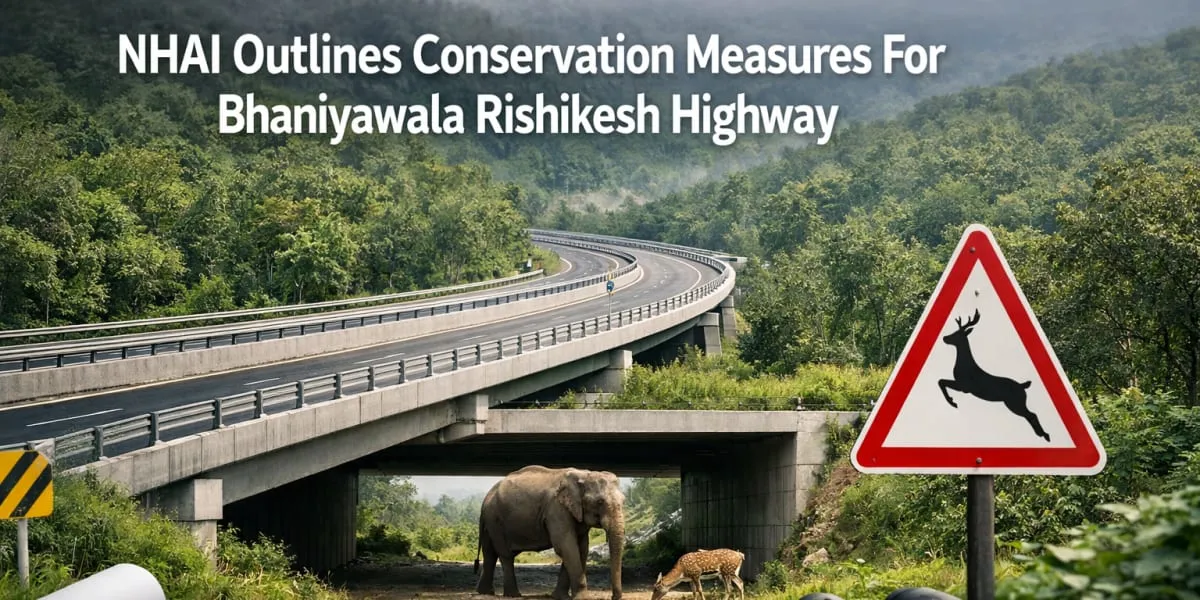
Among the key provisions are dedicated wildlife underpasses and animal crossings at identified movement corridors, planned according to wildlife movement patterns to enable safe passage for animals without disrupting traffic flow. Noise barriers and controlled lighting have also been proposed in selected stretches to minimise disturbance to surrounding habitats.

NHAI further stated that speed management measures, protective fencing and appropriate road signage will be introduced near wildlife-sensitive zones to reduce the risk of vehicle-animal collisions. Construction activities will also be regulated to limit environmental disturbance, with contractors required to comply with conditions laid down under environmental and forest clearances.

The authority emphasised that the project has been designed to comply with statutory requirements prescribed by environmental and wildlife agencies and that approvals involved multiple stages of technical scrutiny, with mitigation measures incorporated as part of the project's environmental management framework. Environmental organisations have sought greater scrutiny of ecological impact and strict implementation of mitigation measures during construction and operation, while NHAI maintained that continuous monitoring will help ensure measures remain effective and that the highway will deliver improved connectivity, enhanced road safety and reduced travel time for commuters between Dehradun, Rishikesh and adjoining regions.

The National Highways Authority of India (NHAI) reiterated that the proposed Bhaniyawala-Rishikesh highway has been designed with extensive wildlife protection measures, responding to concerns over its potential impact on ecologically sensitive areas near the Rajaji Tiger Reserve. The authority said environmental safeguards were incorporated from the planning stage to balance infrastructure development with biodiversity conservation. The proposed highway is intended to improve connectivity between Dehradun and Rishikesh while reducing congestion on one of Uttarakhand's busiest road corridors. NHAI noted increasing traffic volumes, frequent bottlenecks and safety concerns necessitated expansion, particularly during peak tourist and pilgrimage seasons. Addressing concerns raised by conservationists, NHAI stated that the alignment has been developed following detailed environmental assessments and consultations with relevant authorities. The project incorporates several mitigation measures intended to minimise disturbance to wildlife movement and reduce ecological fragmentation. Among the key provisions are dedicated wildlife underpasses and animal crossings at identified movement corridors, planned according to wildlife movement patterns to enable safe passage for animals without disrupting traffic flow. Noise barriers and controlled lighting have also been proposed in selected stretches to minimise disturbance to surrounding habitats. NHAI further stated that speed management measures, protective fencing and appropriate road signage will be introduced near wildlife-sensitive zones to reduce the risk of vehicle-animal collisions. Construction activities will also be regulated to limit environmental disturbance, with contractors required to comply with conditions laid down under environmental and forest clearances. The authority emphasised that the project has been designed to comply with statutory requirements prescribed by environmental and wildlife agencies and that approvals involved multiple stages of technical scrutiny, with mitigation measures incorporated as part of the project's environmental management framework. Environmental organisations have sought greater scrutiny of ecological impact and strict implementation of mitigation measures during construction and operation, while NHAI maintained that continuous monitoring will help ensure measures remain effective and that the highway will deliver improved connectivity, enhanced road safety and reduced travel time for commuters between Dehradun, Rishikesh and adjoining regions.

Next Story
Infrastructure Transport

CM Announces Rs 1.5 bn Plan To Tackle Jorabat Floods

Chief Minister Himanta Biswa Sarma announced a Rs 1.5 billion (Rs 1.5 bn) flood mitigation allocation for Jorabat under the proposed Guwahati Ring Road project following recent flash flooding that disrupted traffic and waterlogged parts of the area. The measure is intended to provide a permanent solution to recurring inundation at one of the principal entry points linking Assam and Meghalaya. The sum has been included in the Detailed Project Report for the ring road. Consultants engaged on the project are preparing engineering drawings and have been instructed to obtain technical approval from..

Next Story
Infrastructure Transport

Gorakhpur Southern Road Network Upgraded With Rs 4,450 Million Works

The long neglected roads of Gorakhpur’s southern region are undergoing a major transformation as work proceeds on nine road projects costing Rs 4,450 million (mn; Rs 445 crore) across a 118 km network. The programme comprises road widening, strengthening and construction of new stretches aimed at remodelling connectivity and travel efficiency. The schemes are intended to link key routes to the Gorakhpur–Varanasi four-lane highway and the Link Expressway and reflect the Chief Minister Yogi Adityanath’s infrastructure priorities. Authorities have directed accelerated work on four-lane conn..

Next Story
Infrastructure Transport

Artefact Projects Secures Rs 30.8 mn NHAI Supervision Contract

Artefact Projects has secured an order worth Rs 30.8 million (mn) from the National Highways Authority of India for supervision services on a highway project in Chhattisgarh. The contract award was announced by the company and will be executed in association with KCS Engineering. The company indicated the award will support its order book and reinforce its presence in the highway sector. The assignment requires the firm to act as Supervision Consultant during the operation and maintenance phase of the four-lane Bilaspur-Urga section of NH-130A, covering design chainage 0.000 to 70.200 km from ..

Advertisement

Subscribe to Our Newsletter

Get daily newsletters around different themes from Construction world.

STAY CONNECTED

Advertisement

Advertisement

Advertisement