

Old vehicles will be off roads from April 2022
ROADS & HIGHWAYS

Old vehicles will be off roads from April 2022

The Ministry of Road Transport and Highways (MoRTH) has confirmed that under the recently approved vehicle scrappage policy, government vehicles older than 15 years will also be scrapped.

The policy will come into effect from 1 April 2022. From that date onwards, vehicles used by the government departments which are older than 15 years would be put off service.

A bench headed by NGT Chairperson Justice Adarsh Kumar Goel had said a proper mechanism to set up authorised recycling centres compliant with environmental norms was an urgent need in view of a large number of End of Life Vehicles (ELVs).

The draft scrappage policy, whose details were yet to be shared in the public domain by MoRTH, was also expected to offer an incentive to motorists who decide to scrap their old vehicles. The incentives were expected to include a waiver of the registration fee and a discount on the road tax. The old vehicles would be used in recycling clusters, thereby reducing the cost of raw materials.


4th Indian Cement Review Conference 2021

17-18 March 

Click for event info


Make in Steel 2021

24 February 

Click for event info


The scrappage policy is expected to boost demand for new vehicles in a Covid-hit economy. But longer-term, the policy directly influences pollution levels. In July last year, the National Green Tribunal (NGT) had pulled up MoRTH for the delay in issuing guidelines on the scrapping of vehicles. A similar policy has been in place in Delhi for more than a decade, but in 2015, the NGT had ruled that diesel vehicles that are more than 10 years old and petrol vehicles older than 15 must be off the roads. The Supreme Court had rapped the state government for going slow on the order.

New demand from “recycling”. As we have reported before, 15-20% of the vehicles in India are over 15 years old, and as Ashok Leyland’s MD and CEO Vipin Sondhi told us in September, that is the level of additional demand that may be logically expected. An HDFC Bank study anticipates that wheeling out over 28 million vehicles from the roads into scrappage would open up business opportunities to the tune of $6 billion. Meanwhile, Mahindra Accelo (previously known as Mahindra Intertrade) and MSTC (a Government of India Enterprise) have joined hands and established Cero, India’s first government-authorised vehicle recycling initiative that aims to reduce environmental footprint through its eco-friendly practices of recycling.

Green Tax. Besides incentives, several disincentives for those retaining old vehicles were also reportedly discussed. The ministry has also approved a proposal to levy a "Green Tax" on old vehicles polluting the environment. The proposal will now go to the states for consultation before being formally notified. The Green Tax levy will be in the form of a higher fee for 15-year-old personal vehicles' fitness certificates.

The main principles to be followed while levying the Green Tax are :

  • Transport vehicles older than eight years could be charged Green Tax at the time of renewal of fitness certificate, at the rate of 10 to 25 % of road tax.
  • Personal vehicles to be charged Green Tax at the time of renewal of Registration Certification after 15 years.
  • Public transport vehicles, such as city buses, to be charged lower Green tax.
  • Higher Green tax (50% of road tax) for vehicles being registered in highly polluted cities.
  • Differential tax, depending on fuel (petrol/diesel) and type of vehicle.
  • Vehicles like strong hybrids, electric vehicles and alternate fuels like CNG, ethanol, LPG, etc, to be exempted.
  • Vehicles used in farming, such as tractors, harvesters, tillers etc, to be exempted.
  • Revenue collected from the Green Tax is to be kept in a separate account and used to tackle pollution and set up state-of-art facilities for emission monitoring.

Also read: New scrappage policy for 15-year old vehicles soon: Nitin Gadkari

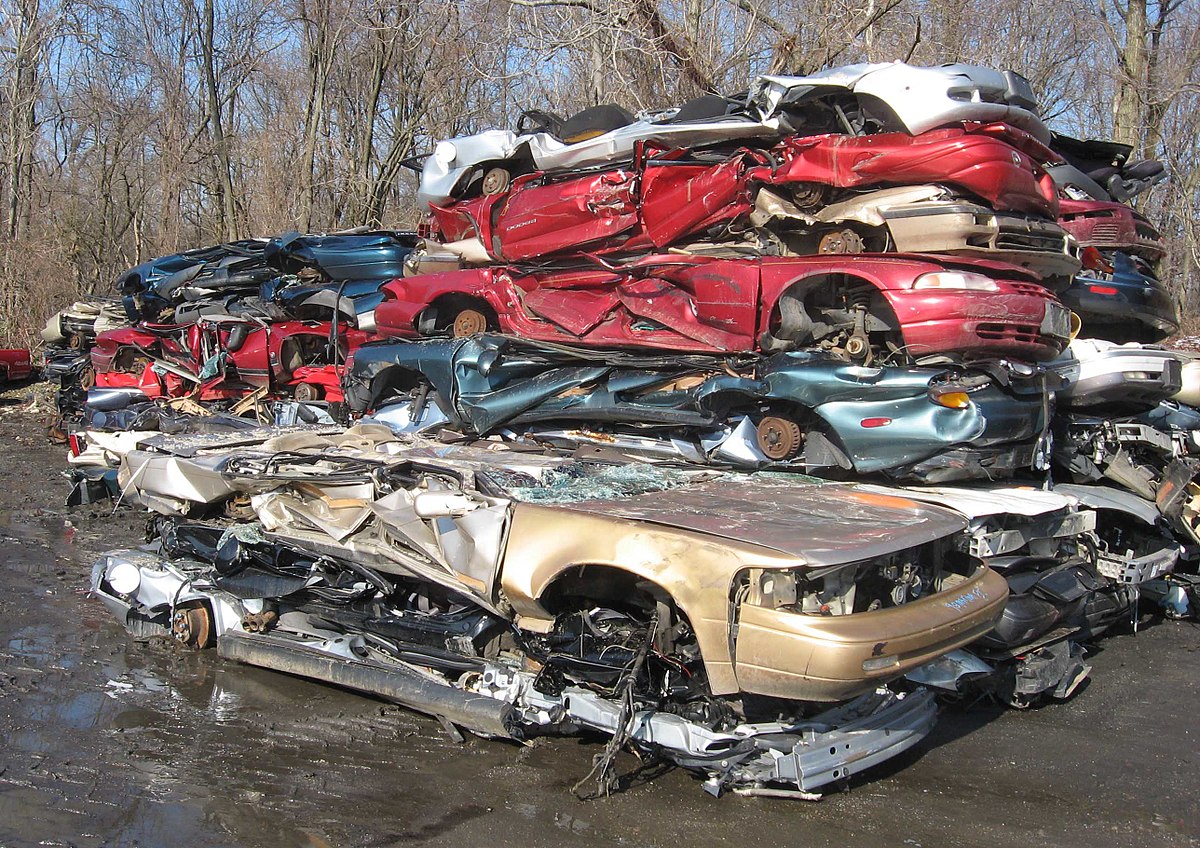
Image Source: Wikipedia/ vehicle recycling

The Ministry of Road Transport and Highways (MoRTH) has confirmed that under the recently approved vehicle scrappage policy, government vehicles older than 15 years will also be scrapped. The policy will come into effect from 1 April 2022. From that date onwards, vehicles used by the government departments which are older than 15 years would be put off service.A bench headed by NGT Chairperson Justice Adarsh Kumar Goel had said a proper mechanism to set up authorised recycling centres compliant with environmental norms was an urgent need in view of a large number of End of Life Vehicles (ELVs).The draft scrappage policy, whose details were yet to be shared in the public domain by MoRTH, was also expected to offer an incentive to motorists who decide to scrap their old vehicles. The incentives were expected to include a waiver of the registration fee and a discount on the road tax. The old vehicles would be used in recycling clusters, thereby reducing the cost of raw materials.4th Indian Cement Review Conference 202117-18 March Click for event infoMake in Steel 202124 February Click for event infoThe scrappage policy is expected to boost demand for new vehicles in a Covid-hit economy. But longer-term, the policy directly influences pollution levels. In July last year, the National Green Tribunal (NGT) had pulled up MoRTH for the delay in issuing guidelines on the scrapping of vehicles. A similar policy has been in place in Delhi for more than a decade, but in 2015, the NGT had ruled that diesel vehicles that are more than 10 years old and petrol vehicles older than 15 must be off the roads. The Supreme Court had rapped the state government for going slow on the order.New demand from “recycling”. As we have reported before, 15-20% of the vehicles in India are over 15 years old, and as Ashok Leyland’s MD and CEO Vipin Sondhi told us in September, that is the level of additional demand that may be logically expected. An HDFC Bank study anticipates that wheeling out over 28 million vehicles from the roads into scrappage would open up business opportunities to the tune of $6 billion. Meanwhile, Mahindra Accelo (previously known as Mahindra Intertrade) and MSTC (a Government of India Enterprise) have joined hands and established Cero, India’s first government-authorised vehicle recycling initiative that aims to reduce environmental footprint through its eco-friendly practices of recycling.Green Tax. Besides incentives, several disincentives for those retaining old vehicles were also reportedly discussed. The ministry has also approved a proposal to levy a Green Tax on old vehicles polluting the environment. The proposal will now go to the states for consultation before being formally notified. The Green Tax levy will be in the form of a higher fee for 15-year-old personal vehicles' fitness certificates.The main principles to be followed while levying the Green Tax are :Transport vehicles older than eight years could be charged Green Tax at the time of renewal of fitness certificate, at the rate of 10 to 25 % of road tax.Personal vehicles to be charged Green Tax at the time of renewal of Registration Certification after 15 years.Public transport vehicles, such as city buses, to be charged lower Green tax.Higher Green tax (50% of road tax) for vehicles being registered in highly polluted cities.Differential tax, depending on fuel (petrol/diesel) and type of vehicle.Vehicles like strong hybrids, electric vehicles and alternate fuels like CNG, ethanol, LPG, etc, to be exempted.Vehicles used in farming, such as tractors, harvesters, tillers etc, to be exempted.Revenue collected from the Green Tax is to be kept in a separate account and used to tackle pollution and set up state-of-art facilities for emission monitoring.Also read: New scrappage policy for 15-year old vehicles soon: Nitin GadkariImage Source: Wikipedia/ vehicle recycling

Next Story
Infrastructure Energy

Vedanta Aluminium Uses 1.57 bn Units of Green Energy in FY25

Vedanta Aluminium, India’s largest aluminium producer, recently reported consumption of 1.57 billion units of renewable energy in FY25, marking a significant milestone in its 2030 decarbonisation roadmap. The company also achieved an 8.96 per cent reduction in greenhouse gas (GHG) emissions intensity compared to FY21, reinforcing its leadership in India’s low-carbon manufacturing transition. During FY25, Vedanta Aluminium expanded its renewable energy portfolio through long-term power purchase agreements, strengthening its strategy to source nearly 1,500 MW of renewable power over the lon..

Next Story
Real Estate

Oberoi Group to Develop Luxury Resort at Makaibari Tea Estate

EIH Limited, the flagship company of The Oberoi Group, has announced the signing of a management agreement to develop an Oberoi luxury resort at the iconic Makaibari Tea Estate in Darjeeling. The project marks a key milestone in the Group’s long-term strategy of creating distinctive hospitality experiences in rare and environmentally significant locations. Established in 1859, Makaibari is one of the world’s oldest tea estates and is globally recognised for its Himalayan landscape, primary forests and exceptional biodiversity. Spread across 1,236 acres, the estate houses one of the world..

Next Story
Real Estate

GHV Infra Secures Rs 1.09 Bn EPC Order in Jamshedpur

GHV Infra Projects Ltd, a fast-growing EPC company in India’s infrastructure and construction sector, has recently secured a Rs 1.09 billion work order in Jamshedpur, Jharkhand. Awarded by a reputed group entity, the contract covers end-to-end civil construction, mechanical, electrical and plumbing (MEP) systems, along with high-quality finishing works for a large building development. The project will be executed over a 30-month period, with defined benchmarks for quality, safety and timely delivery. The order strengthens GHV Infra’s footprint in Jamshedpur, a key industrial hub known fo..

Advertisement

Subscribe to Our Newsletter

Get daily newsletters around different themes from Construction world.

STAY CONNECTED

Advertisement

Advertisement

Advertisement

Advertisement

Open In App