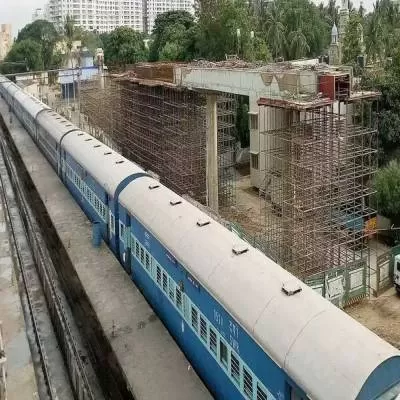
The mandate of the Rail Land Development Authority (RLDA) is to monetise railway land, especially surplus railway land available across India, and it offers several opportunities to consultants, developers and investors. RLDA is currently developing 62 stations by leveraging available land resources in all major towns. It is also in the process of bidding out development works for New Delhi Railway Station. In an exclusive video interview hosted by CW, Ved Parkash Dudeja, Vice Chairman, Rail Land Development Authority, shares more on plans and opportunities and how the authority is coping with the current pandemic.
Excerpts:
How is RLDA leveraging private-sector participation for railway development works?
We are developing 62 stations by leveraging land resources available in all the major towns in the country. We will be developing these stations on the PPP mode by leveraging the strengths of both the private and public sectors.
The private sector has the expertise of new innovations in construction and architecture and we have the land. Developing stations of international standards needs a lot of investment. We are currently looking for resources for the same; public-private participation will ensure these investments come from the private sector.
The New Delhi station, for instance, is going to be developed into an international railway station with airport-like infrastructure.
At present, New Delhi’s East and West are completely isolated from each other. We are bringing in road connectivity to have the East and West stations well connected. We also want to develop the station as a commercial hub in addition to infrastructure requirements. It should take about four years from the RFQ date. We have already prepared the documents for RFQs and have submitted them to the Railways. As soon as the COVID situation comes under control, we will be coming up with the RFQ and expect to complete work by 2024. The New Delhi station plan involves about Rs.50 billion of mandatory development, including a concourse for arrivals and departures, commercial space over the station, relocation of railway offices and others to make way for the commercial space planned, etc. The total cost of construction will be about Rs.70 billion.
Tell us more about the design plan for the New Delhi Railway Station.
The plan is to first go for a DPR, after which the consultant will produce a master plan. This
will be a concept plan in terms of the mandated development needed, wherein the area for commercial development, etc,
will be earmarked. The developer will then have the independence
to design it as per his convenience.
As far as architectural elements are concerned, the New Delhi station is close to Connaught Place, which has been a constraint
for its development in the past. What we have now envisaged is
for the East and West to be connected by passing through Connaught Place, so that it is
not overburdened with this new development. This is a major
shift in the concept. As mentioned, the station will see an airport-like development with arrivals and departures having different lounges and concourses; it will have a
food court and all other
commercial activities. The total
area for development is 110 acre; the mandatory development for
the built-up area is about
5 lakh sq m, while the space for commercial development we
are offering to the developer,
where he can build commercial space, offices, retail malls,
hotels, etc, will be 2.6 lakh sq m. The date for opening bids for
the consultant for this project
is May 26, and we are hoping to select the consultant by the first week of June.
How has your experience been with the online bidding process during COVID?
Speaking of bidding online, whenever something bad happens yes there is a challenge, but at the same time there is an opportunity as well. So while COVID is a challenge, it is also an opportunity to communicate with people through the Internet. We could convert this challenge into an opportunity. We conducted a conference and had all the renowned architectural consultants of India as well as around the world, even from Australia, participating. Overall, it was a good experience.
What is the status on the
62 stations to be developed?
We are already working on preparation of DPRs for all the
62 stations. This year, RLDA and IRSDC have targeted to bring out 50 stations for bidding. Once the consultant completes work, we
will invite developers to build as
per the plan.
RLDA is also looking at
monetising land at railway colonies and commercial plots
for development...
Yes, we have been entrusted
84 such railway colonies, which are spread out in all the major towns of the country. At these colonies, we are utilising a small space compared to the principle built-up space as per local DCR norms. So we will be leveraging this extra space, which is unutilised FAR, for redeveloping our colonies. The excess FAR will be given to developers for their exploitation. In lieu of this, they will develop the colonies, plus give us a lease premium. We have already come out with bids for two colonies in Hyderabad and one in Guwahati, while more are in the pipeline.
Further, we have 74 commercial plots, surplus land, where no other assets are available – they are more or less greenfield plots.
We are offering these to different developers in an open and transparent bidding system on an upfront lease premium. They can construct offices, hotels, colonies, flats, etc, here. We have recently given one such plot in Delhi’s Ashok Vihar of about 10.7 hectare to Godrej Properties through an open bidding process for about Rs.13.59 billion of lease premium, which is payable in eight instalments over seven years along with the interest thereon. Of these 74 properties, we have already bid out about 21 and more are in the pipeline. In 2019, despite the slowdown in real estate, we could make a sort of record for RLDA – we bid out about nine properties of about Rs.15.53 billion. When we talked to a lot of developers, many were not willing to take the risk of huge investments in major towns. We then tried to focus on Tier-2 cities where demand exists and small plots are available. We also came out with this Ashok Vihar bid, which was quite successful.
How do you see the authority overcome the COVID crisis?
Even prior to COVID, market sentiment was down. COVID has further added to this. But we are quite hopeful that as soon as the pandemic is over, we will come out with more offerings to the market. In fact, we have opportunities
for even small investors along with large investors. We are also into multifunctional complexes,
where we are giving small plots
of 500-1,000 sq m to small investors to build essential
facilities such as small shopping complexes, restaurants or budget hotels of 50-100 rooms.
We are already developing some 55 multi-functional complexes; about 11 have already been commissioned and are functioning well. We will be coming out with more such offerings.