+
Centre to Slow State Highway-to-National Highway Conversions
ROADS & HIGHWAYS

Centre to Slow State Highway-to-National Highway Conversions

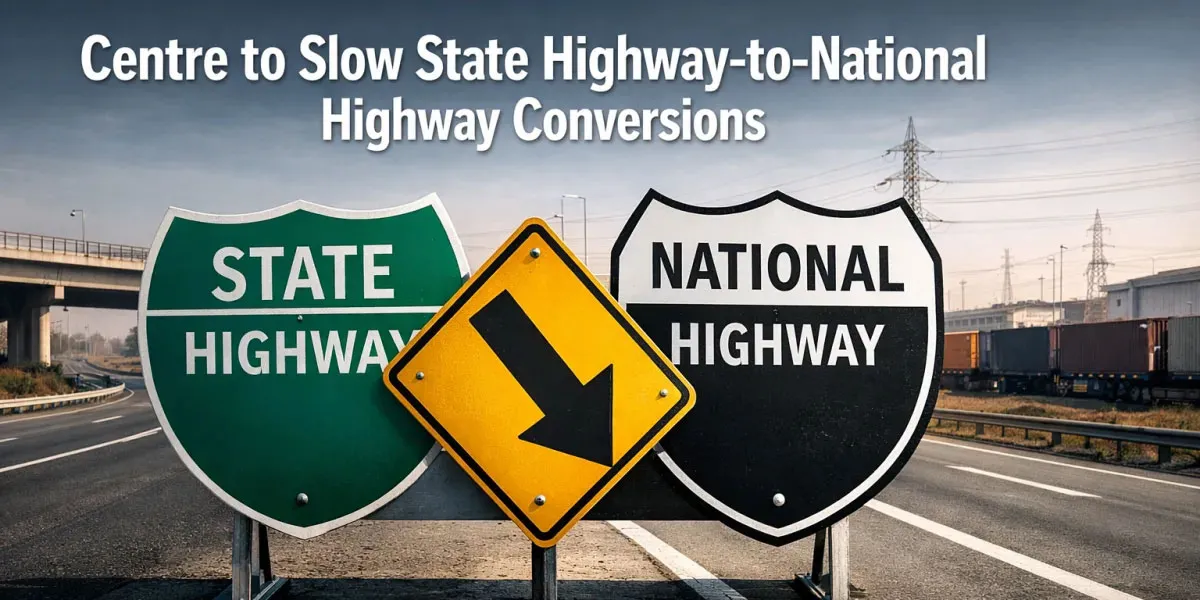
The Union government has decided to slow the routine conversion of state highways into national highways and to pursue an economy-centric infrastructure model that prioritises freight efficiency and industrial connectivity.

The policy shift emerged from a high-level highways sector review chaired by the prime minister and directed the transport ministry to prepare a framework by the end of July that reduces reliance on reclassification of state highways as national highways.

Over the past 11 years nearly 55,000 kilometres of state highways were reclassified as national highways, expanding the national network from about 91,300 kilometres in 2014 to roughly 0.146 million (mn) kilometres today, an increase of around 60 per cent. The conversions were part of an aggressive expansion drive that emphasised extending the national grid of roads across states, but officials now judge that further mileage additions should be guided by economic returns and freight movement patterns.

The transport ministry has been asked to design detailed criteria and dashboard metrics to assess which state highways merit national status and which can be upgraded under state or regional programmes. The framework is expected to include freight tonnage thresholds, connectivity to industrial estates and ports, projected traffic growth and cost benefit benchmarks to prioritise projects. Emphasis will be placed on developing greenfield expressways and dedicated freight corridors to reduce transit times and enhance supply chain reliability.

States will need to align their project pipelines and funding requests with the new economy-driven priorities and demonstrate how proposed conversions will support manufacturing, exports or major logistics nodes. The centre may continue selective conversions where strategic national connectivity is demonstrably justified, but the broad presumption in favour of automatic nationalisation of state highways has been abandoned. The transport ministry will present the framework and implementation plan by the stated deadline.

The Union government has decided to slow the routine conversion of state highways into national highways and to pursue an economy-centric infrastructure model that prioritises freight efficiency and industrial connectivity. The policy shift emerged from a high-level highways sector review chaired by the prime minister and directed the transport ministry to prepare a framework by the end of July that reduces reliance on reclassification of state highways as national highways. Over the past 11 years nearly 55,000 kilometres of state highways were reclassified as national highways, expanding the national network from about 91,300 kilometres in 2014 to roughly 0.146 million (mn) kilometres today, an increase of around 60 per cent. The conversions were part of an aggressive expansion drive that emphasised extending the national grid of roads across states, but officials now judge that further mileage additions should be guided by economic returns and freight movement patterns. The transport ministry has been asked to design detailed criteria and dashboard metrics to assess which state highways merit national status and which can be upgraded under state or regional programmes. The framework is expected to include freight tonnage thresholds, connectivity to industrial estates and ports, projected traffic growth and cost benefit benchmarks to prioritise projects. Emphasis will be placed on developing greenfield expressways and dedicated freight corridors to reduce transit times and enhance supply chain reliability. States will need to align their project pipelines and funding requests with the new economy-driven priorities and demonstrate how proposed conversions will support manufacturing, exports or major logistics nodes. The centre may continue selective conversions where strategic national connectivity is demonstrably justified, but the broad presumption in favour of automatic nationalisation of state highways has been abandoned. The transport ministry will present the framework and implementation plan by the stated deadline.

Next Story
Real Estate

Reliance MET City Launches Metropolis Project In Haryana

Reliance MET City (RMC) has launched Metropolis, an integrated mixed-use project in Haryana that is expected to redefine the regional urban landscape. RMC said the development will combine residential, commercial and leisure components to meet rising demand for organised urban spaces. The project has been positioned to benefit from existing and planned transport links and municipal infrastructure, and aligns with regional plans for sustainable urbanisation. Company representatives framed the initiative as part of a broader expansion strategy in northern India. The Metropolis project will inco..

Next Story
Infrastructure Energy

Radiance Renewables Raises 100 Million Dollars for Expansion

Eversource-backed Radiance Renewables has secured 100 million dollars (100 mn dollars) in funding from Impact Fund Denmark and FMO to support its expansion. The investment will bolster the company's capital base and enable acceleration of project development and deployment. Radiance Renewables is positioning itself to scale its renewable energy portfolio and strengthen operational capabilities. The funding round reflects growing investor appetite for climate-focused infrastructure. Impact Fund Denmark and FMO are established impact investors that channel capital into sustainable energy projec..

Next Story
Infrastructure Energy

Temasek-led Consortium in Talks for Rs 15 bn Pre-IPO Round

A Temasek-led consortium is in advanced talks to invest Rs 15 billion (Rs 15 bn) in Clean Max Enviro Energy in a pre-initial public offering funding round, according to people familiar with the matter. The prospective financing is intended to provide capital for operational expansion and to strengthen the company's balance sheet ahead of a planned public listing. The discussions reflect continued investor appetite for renewable energy platforms in the region. Clean Max Enviro Energy is a renewable energy developer that provides sustainable power solutions to commercial and industrial customer..

Advertisement

Subscribe to Our Newsletter

Get daily newsletters around different themes from Construction world.

STAY CONNECTED

Advertisement

Advertisement

Advertisement

Open In App