+
Varanasi Emerges As Leading Solar City Under PM Surya Ghar Yojana
POWER & RENEWABLE ENERGY

Varanasi Emerges As Leading Solar City Under PM Surya Ghar Yojana

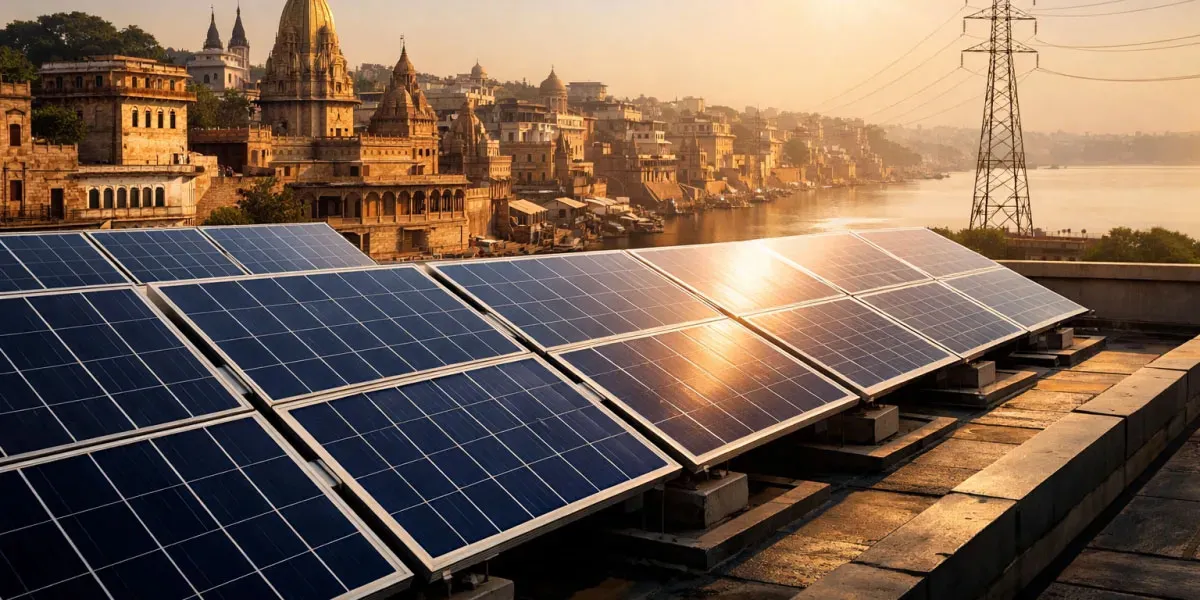
Varanasi has secured the second position in Uttar Pradesh under the Prime Minister's Surya Ghar Yojana (PM Surya Ghar Yojana), reflecting strong adoption of rooftop solar systems across the city. The achievement signals growing public participation in residential clean energy and advances India’s objective to expand household level solar generation while lowering electricity costs and reducing carbon emissions. The result has attracted the attention of policymakers and energy planners as an example of successful grassroots engagement.

The PM Surya Ghar Yojana seeks to encourage residential consumers to install rooftop solar systems by offering financial subsidies and simplified procedures that reduce administrative barriers. The scheme is intended to cut electricity bills, boost energy independence and enable citizens to participate in the national clean energy transition. Local outreach and simplified application processes have been key elements of the scheme's outreach strategy in the city.

High levels of participation from households, institutions and community groups have driven Varanasi's performance, with many consumers motivated by rising electricity costs and the expectation of long term savings. Distribution companies and municipal authorities have supported uptake through awareness campaigns, technical assistance and streamlined approvals that have helped build consumer confidence. The combined effect of incentives and local facilitation has accelerated installations and increased uptake across diverse neighbourhoods.

Beyond direct economic benefits for individual households, rooftop solar deployment has eased pressure on the conventional power grid by reducing peak demand, improving grid stability and lowering transmission losses through decentralised generation. The expansion of installations is also creating local employment opportunities in installation, maintenance and servicing, supporting the growth of a clean energy workforce. Varanasi's ranking under the PM Surya Ghar Yojana therefore positions the city as a replicable model for other urban centres seeking to contribute to national climate goals and to strengthen energy security.

Varanasi has secured the second position in Uttar Pradesh under the Prime Minister's Surya Ghar Yojana (PM Surya Ghar Yojana), reflecting strong adoption of rooftop solar systems across the city. The achievement signals growing public participation in residential clean energy and advances India’s objective to expand household level solar generation while lowering electricity costs and reducing carbon emissions. The result has attracted the attention of policymakers and energy planners as an example of successful grassroots engagement. The PM Surya Ghar Yojana seeks to encourage residential consumers to install rooftop solar systems by offering financial subsidies and simplified procedures that reduce administrative barriers. The scheme is intended to cut electricity bills, boost energy independence and enable citizens to participate in the national clean energy transition. Local outreach and simplified application processes have been key elements of the scheme's outreach strategy in the city. High levels of participation from households, institutions and community groups have driven Varanasi's performance, with many consumers motivated by rising electricity costs and the expectation of long term savings. Distribution companies and municipal authorities have supported uptake through awareness campaigns, technical assistance and streamlined approvals that have helped build consumer confidence. The combined effect of incentives and local facilitation has accelerated installations and increased uptake across diverse neighbourhoods. Beyond direct economic benefits for individual households, rooftop solar deployment has eased pressure on the conventional power grid by reducing peak demand, improving grid stability and lowering transmission losses through decentralised generation. The expansion of installations is also creating local employment opportunities in installation, maintenance and servicing, supporting the growth of a clean energy workforce. Varanasi's ranking under the PM Surya Ghar Yojana therefore positions the city as a replicable model for other urban centres seeking to contribute to national climate goals and to strengthen energy security.

Related Stories

Gold Stories

Next Story
Infrastructure Urban

KONE Opens India's First Digital Experience Centre in Pune

KONE, a global elevator and escalator manufacturer, has inaugurated its first Digital Experience Centre (DEC) in India, located in Pune. The facility aims to showcase how artificial intelligence (AI), connectivity and data-driven technologies can enhance customer experiences and improve building operations.The centre was inaugurated by Jussi Herlin, Executive Vice Chair, KONE Corporation; Philippe Delorme, President and CEO, KONE; and Nandan Nilekani, Co-founder and Chairman of the Board, Infosys.Designed as an interactive customer environment, the facility demonstrates digital solutions cover..

Next Story
Infrastructure Urban

CII GreenCo Launches Circularity Guidelines for Indian Industry

The Confederation of Indian Industry (CII) GreenCo Council has launched the CII GreenCo Circularity Guidelines – Pilot Version at the 17th CII GreenCo Waste & Resource Management Summit 2026 in Chennai. The initiative aims to strengthen resource efficiency, waste reduction and circular economy practices across Indian manufacturing and process industries.The guidelines introduce a structured framework with circularity indices covering raw materials, consumables, packaging and other resource inputs. These indicators will help industries assess existing practices, identify opportunities to ..

Next Story
Infrastructure Energy

Global Electronics Association Launches IPC-1783-CO2E Standard

The Global Electronics Association has introduced IPC-1783-CO2E, a new international standard aimed at improving consistency, transparency and comparability in product carbon footprint reporting across the electronics manufacturing industry.The standard, titled International Standard for Data Collection and Reporting of CO2 Equivalent (CO2e) Emissions for the Electronics Manufacturing Supply Chain, provides industry-specific guidance for collecting, estimating and reporting carbon emissions data.With increasing regulatory requirements and customer expectations, electronics manufacturers face c..

Advertisement

Subscribe to Our Newsletter

Get daily newsletters around different themes from Construction world.

STAY CONNECTED

Advertisement

SPECIAL OFFER
QR Code