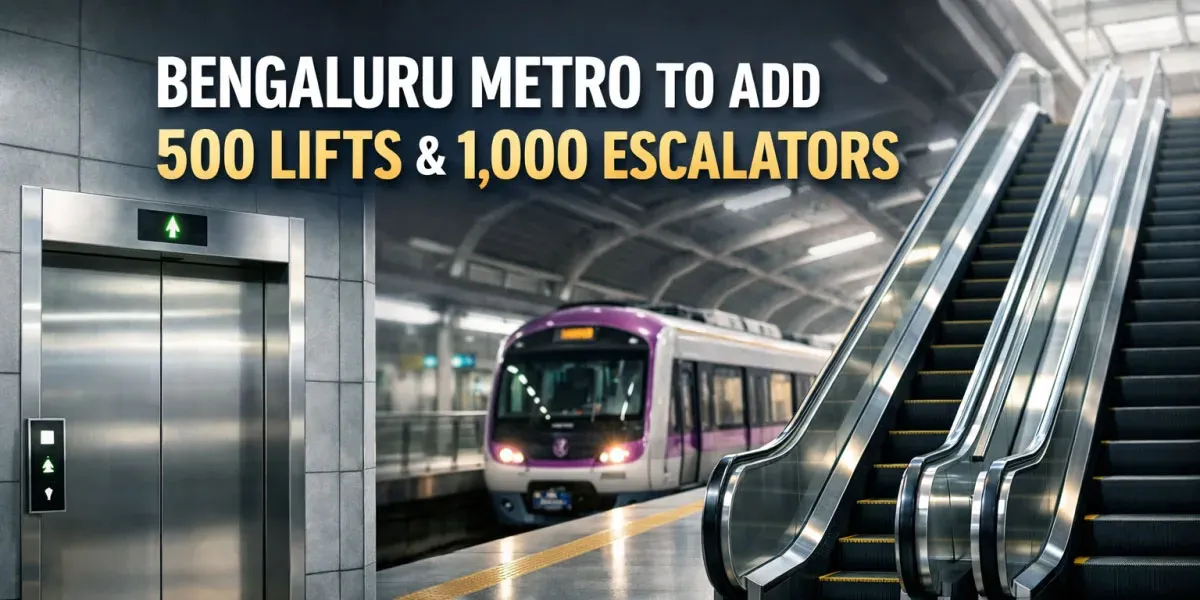
Bengaluru Metro to Add 500 Lifts and 1,000 Escalators
RAILWAYS & METRO RAIL

Bengaluru Metro to Add 500 Lifts and 1,000 Escalators

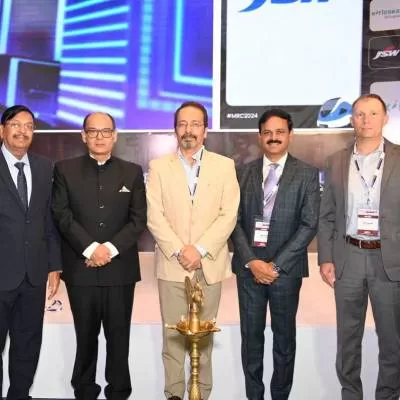
Bangalore Metro Rail Corporation Limited has outlined plans to install 500 lifts and 1,000 escalators as part of a 78 kilometre expansion intended to nearly double the existing network from 96 kilometres to 175 kilometres within the next two years, and to increase the number of stations from 83 to 127. The announcement was made at the second Smart Lift and Mobility World 2026 summit and follows mounting concerns about overcrowding at major interchange stations such as Majestic. The infrastructure additions are intended to ease passenger movement and to complement train operations across an enlarged system.

BMRCL research and development leadership indicated that the requirement for lifts, travelators and related mobility systems will rise in line with network growth, with particular emphasis on major hubs where seamless interchange is critical. Procurement planning has therefore been reoriented to secure large volumes and to incorporate maintenance arrangements for sustained reliability. The authority has bundled supply and service contracts to cover up to a decade to ensure consistent upkeep.

The procurement strategy prioritises local manufacture, reflecting federal norms that mandate at least 60 per cent local content for new infrastructure projects, and aims to reduce dependence on imports to secure cost competitiveness over successive phases of procurement. Officials noted that the scale of Phase Two and Phase Three acquisitions makes localisation essential for long term affordability and supply chain resilience. Suppliers will be expected to meet performance standards while partnering on maintenance commitments.

Communications sector representatives observed that daily ridership touching one million (mn) has elevated mobility systems from optional amenities to core elements of the commuter experience, and that improved vertical and horizontal circulation will be central to accessibility goals. A regulator participating at the summit discussed steps to align real estate development with transport planning to create a future ready urban ecosystem. The expansion is presented as a combined operational and passenger experience initiative to manage growing demand across Bengaluru.

Bangalore Metro Rail Corporation Limited has outlined plans to install 500 lifts and 1,000 escalators as part of a 78 kilometre expansion intended to nearly double the existing network from 96 kilometres to 175 kilometres within the next two years, and to increase the number of stations from 83 to 127. The announcement was made at the second Smart Lift and Mobility World 2026 summit and follows mounting concerns about overcrowding at major interchange stations such as Majestic. The infrastructure additions are intended to ease passenger movement and to complement train operations across an enlarged system. BMRCL research and development leadership indicated that the requirement for lifts, travelators and related mobility systems will rise in line with network growth, with particular emphasis on major hubs where seamless interchange is critical. Procurement planning has therefore been reoriented to secure large volumes and to incorporate maintenance arrangements for sustained reliability. The authority has bundled supply and service contracts to cover up to a decade to ensure consistent upkeep. The procurement strategy prioritises local manufacture, reflecting federal norms that mandate at least 60 per cent local content for new infrastructure projects, and aims to reduce dependence on imports to secure cost competitiveness over successive phases of procurement. Officials noted that the scale of Phase Two and Phase Three acquisitions makes localisation essential for long term affordability and supply chain resilience. Suppliers will be expected to meet performance standards while partnering on maintenance commitments. Communications sector representatives observed that daily ridership touching one million (mn) has elevated mobility systems from optional amenities to core elements of the commuter experience, and that improved vertical and horizontal circulation will be central to accessibility goals. A regulator participating at the summit discussed steps to align real estate development with transport planning to create a future ready urban ecosystem. The expansion is presented as a combined operational and passenger experience initiative to manage growing demand across Bengaluru.

Next Story
Infrastructure Urban

Güntner Showcases Cooling Tech at China Expo

Güntner showcased its latest refrigeration and air conditioning innovations at China Refrigeration 2026, highlighting digital intelligence and carbon-neutral solutions.The company presented its aicore™ Controls and IoT platform, designed to optimise energy consumption, enable remote monitoring and enhance lifecycle management of cooling systems. The solution integrates advanced controllers and cloud-based capabilities to improve operational efficiency and reduce energy use.Güntner also demonstrated advancements in heat pump technologies, including its role in projects such as the Ordos Zer..

Next Story
Real Estate

Superb Realty Ties Up with Praan for AI Air Tech

Superb Realty has partnered with Praan to deploy AI-powered autonomous air infrastructure across over one million sq ft of real estate in Mumbai, marking a significant move towards intelligent indoor environments.The rollout will begin at Superb Altura and expand across upcoming residential and mixed-use developments. The initiative aims to integrate real-time sensing, adaptive purification and AI-led optimisation to improve indoor air quality and occupant experience.Praan’s technology is designed to remove ultrafine particles significantly smaller than conventional systems and eliminate har..

Next Story
Technology

DAAKit Raises $138,000 in Pre-Seed Round

DAAKit has raised $138,000 in a pre-seed funding round led by Inflection Point Ventures to expand its hyperlocal fulfilment network and strengthen technology capabilities.The company plans to use the funds to launch 25 new dark stores across Tier I and Tier II cities, enhance its technology infrastructure, and expand its leadership and operations teams. Currently operational in Delhi, Gurugram, Mumbai, Bengaluru and Kolkata, DAAKit is also piloting expansion into Tier II markets through Lucknow.Built on an asset-light, technology-driven model, the platform enables brands to position inventory ..

Advertisement

Subscribe to Our Newsletter

Get daily newsletters around different themes from Construction world.

STAY CONNECTED

Advertisement

Advertisement

Advertisement