Brahmapur Railway Station Redevelopment To Cost Rs 3 Bn
RAILWAYS & METRO RAIL

Brahmapur Railway Station Redevelopment To Cost Rs 3 Bn

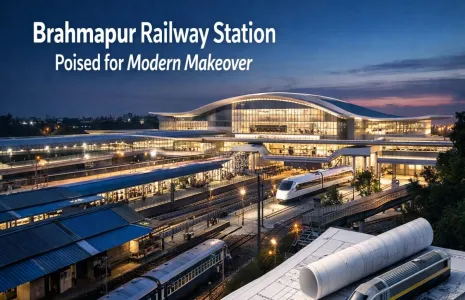
Brahmapur railway station in southern Odisha, which handles over 162 trains and 25,000 passengers every day, will be redeveloped at a cost of Rs 3 billion (Rs 3 bn), East Coast Railway (ECoR) said in a statement. The project is aimed at enhancing capacity and passenger amenities at the key junction serving the region. Officials indicated the redevelopment forms part of wider efforts to modernise transport infrastructure along the route. The funding allocation reflects the scale of planned works and expected operational improvements.

At the heart of the redevelopment is a major capacity expansion that will add three additional railway lines and four new platforms, significantly increasing the station's ability to manage originating, terminating and passing trains. Yard modifications and signalling upgrades are intended to streamline train movements and reduce congestion during peak periods. The scheme is designed to accommodate anticipated traffic growth and improve punctuality of services.

The plan includes construction of a new station building on the second entry side and relocation of the service building and railway quarters to free up space for a more passenger-centric layout. Platform and circulation areas will be reorganised to improve flow and create safer boarding environments. These changes are expected to support operational efficiency and create space for additional passenger facilities.

An elevated integrated passenger movement system will provide seamless connectivity across both sides of the station and all platforms, while the existing foot over bridge will be extended to strengthen accessibility. Infrastructure for Divyang passengers will include tactile pathways and level access facilities to ensure barrier-free movement. The design emphasises inclusive access and continuous passenger flow.

The redevelopment will also incorporate a Quick Watering System (QWS), closed-circuit television surveillance, access control, baggage scanners and passenger information systems alongside integrated electrical and signalling upgrades. These installations are intended to enhance safety, security and convenience for travellers. ECoR stated the works will transform the station into a modern node capable of meeting future demand.

Brahmapur railway station in southern Odisha, which handles over 162 trains and 25,000 passengers every day, will be redeveloped at a cost of Rs 3 billion (Rs 3 bn), East Coast Railway (ECoR) said in a statement. The project is aimed at enhancing capacity and passenger amenities at the key junction serving the region. Officials indicated the redevelopment forms part of wider efforts to modernise transport infrastructure along the route. The funding allocation reflects the scale of planned works and expected operational improvements. At the heart of the redevelopment is a major capacity expansion that will add three additional railway lines and four new platforms, significantly increasing the station's ability to manage originating, terminating and passing trains. Yard modifications and signalling upgrades are intended to streamline train movements and reduce congestion during peak periods. The scheme is designed to accommodate anticipated traffic growth and improve punctuality of services. The plan includes construction of a new station building on the second entry side and relocation of the service building and railway quarters to free up space for a more passenger-centric layout. Platform and circulation areas will be reorganised to improve flow and create safer boarding environments. These changes are expected to support operational efficiency and create space for additional passenger facilities. An elevated integrated passenger movement system will provide seamless connectivity across both sides of the station and all platforms, while the existing foot over bridge will be extended to strengthen accessibility. Infrastructure for Divyang passengers will include tactile pathways and level access facilities to ensure barrier-free movement. The design emphasises inclusive access and continuous passenger flow. The redevelopment will also incorporate a Quick Watering System (QWS), closed-circuit television surveillance, access control, baggage scanners and passenger information systems alongside integrated electrical and signalling upgrades. These installations are intended to enhance safety, security and convenience for travellers. ECoR stated the works will transform the station into a modern node capable of meeting future demand.

Related Stories

Gold Stories

Next Story
Infrastructure Urban

KONE Opens India's First Digital Experience Centre in Pune

KONE, a global elevator and escalator manufacturer, has inaugurated its first Digital Experience Centre (DEC) in India, located in Pune. The facility aims to showcase how artificial intelligence (AI), connectivity and data-driven technologies can enhance customer experiences and improve building operations.The centre was inaugurated by Jussi Herlin, Executive Vice Chair, KONE Corporation; Philippe Delorme, President and CEO, KONE; and Nandan Nilekani, Co-founder and Chairman of the Board, Infosys.Designed as an interactive customer environment, the facility demonstrates digital solutions cover..

Next Story
Infrastructure Urban

CII GreenCo Launches Circularity Guidelines for Indian Industry

The Confederation of Indian Industry (CII) GreenCo Council has launched the CII GreenCo Circularity Guidelines – Pilot Version at the 17th CII GreenCo Waste & Resource Management Summit 2026 in Chennai. The initiative aims to strengthen resource efficiency, waste reduction and circular economy practices across Indian manufacturing and process industries.The guidelines introduce a structured framework with circularity indices covering raw materials, consumables, packaging and other resource inputs. These indicators will help industries assess existing practices, identify opportunities to ..

Next Story
Infrastructure Energy

Global Electronics Association Launches IPC-1783-CO2E Standard

The Global Electronics Association has introduced IPC-1783-CO2E, a new international standard aimed at improving consistency, transparency and comparability in product carbon footprint reporting across the electronics manufacturing industry.The standard, titled International Standard for Data Collection and Reporting of CO2 Equivalent (CO2e) Emissions for the Electronics Manufacturing Supply Chain, provides industry-specific guidance for collecting, estimating and reporting carbon emissions data.With increasing regulatory requirements and customer expectations, electronics manufacturers face c..

Advertisement

Subscribe to Our Newsletter

Get daily newsletters around different themes from Construction world.

STAY CONNECTED

Advertisement

SPECIAL OFFER
QR Code