Bullet Train Project Installs Five Portal Beams Over Ahmedabad
RAILWAYS & METRO RAIL

Bullet Train Project Installs Five Portal Beams Over Ahmedabad

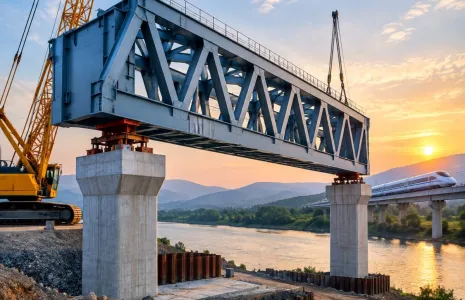
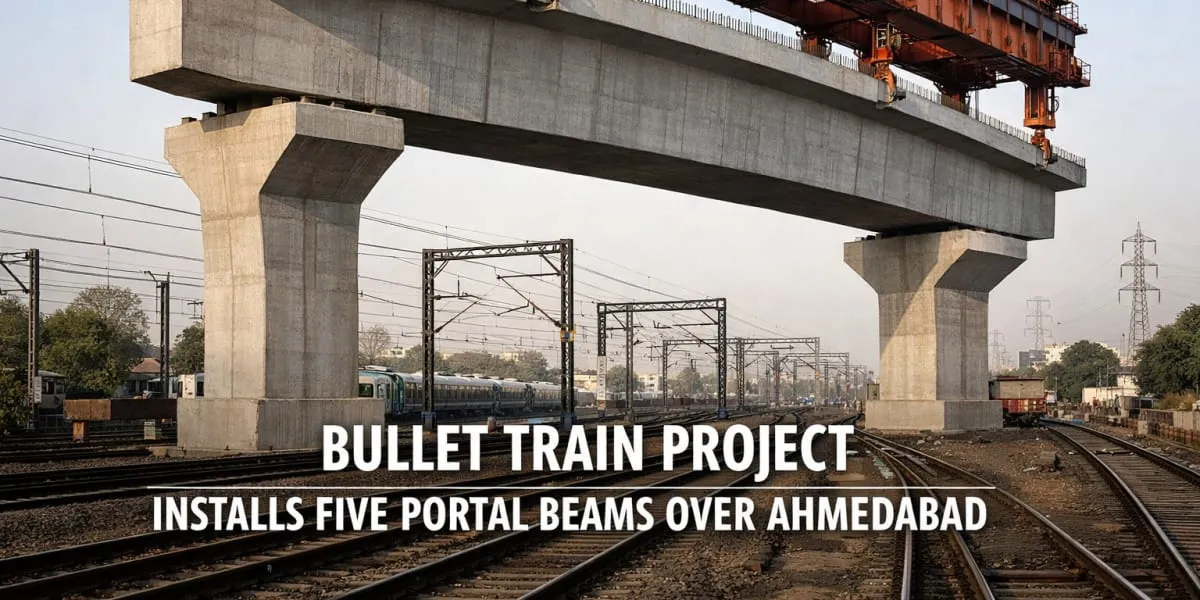
The Mumbai-Ahmedabad bullet train project has completed the installation of five heavy portal beams over active Indian Railways tracks at Maninagar in Ahmedabad within 22 days, marking a key engineering milestone. The precast prestressed portal beams were launched over the Ahmedabad-Vadodara railway line in a phased manner on April eight, 13, 19, 24 and 29, 2026, in close coordination with Indian Railways.

The operation involved the installation of beams weighing between 1170 metric tonnes (t) and 1360 t, the heaviest being lifted on April eight and counted among the heaviest lifts carried out on operational railway tracks in the country. Work was carried out over the Ahmedabad-Vadodara 'Up', 'Down' and third lines and required meticulous planning and coordination with rail traffic control.

The alignment at Maninagar passes above existing railway tracks at a raised level with limited space and spans of approximately 30 to 34 metres between piers, necessitating the use of heavy portal beam structures. These portal beams are designed to provide a strong and rigid support to transfer loads across multiple tracks, ensuring minimal deflection and preserving precise track alignment for safe railway operations.

The launching was carried out using a 2200 t crawler crane, its first deployment on Indian railway tracks, and each beam was installed in approximately three point five hours, significantly reducing the time compared with earlier operations that required up to nine-hour blocks. Despite constraints such as restricted working space, overhead electrification and ongoing train movement, the installation was completed with continuous monitoring and safety checks and adherence to safety protocols.

Each portal beam is a precast concrete structure measuring 34 metres long with a cross section of five point five metres by four point five metres and is installed as an integrated unit to support elevated infrastructure over railway lines. The use of precast prestressed elements allowed controlled factory conditions to ensure quality and consistency while reducing time at site and exposure to operational risks. Project authorities said the successful sequence of lifts will inform similar operations on future sections of the corridor.

The Mumbai-Ahmedabad bullet train project has completed the installation of five heavy portal beams over active Indian Railways tracks at Maninagar in Ahmedabad within 22 days, marking a key engineering milestone. The precast prestressed portal beams were launched over the Ahmedabad-Vadodara railway line in a phased manner on April eight, 13, 19, 24 and 29, 2026, in close coordination with Indian Railways. The operation involved the installation of beams weighing between 1170 metric tonnes (t) and 1360 t, the heaviest being lifted on April eight and counted among the heaviest lifts carried out on operational railway tracks in the country. Work was carried out over the Ahmedabad-Vadodara 'Up', 'Down' and third lines and required meticulous planning and coordination with rail traffic control. The alignment at Maninagar passes above existing railway tracks at a raised level with limited space and spans of approximately 30 to 34 metres between piers, necessitating the use of heavy portal beam structures. These portal beams are designed to provide a strong and rigid support to transfer loads across multiple tracks, ensuring minimal deflection and preserving precise track alignment for safe railway operations. The launching was carried out using a 2200 t crawler crane, its first deployment on Indian railway tracks, and each beam was installed in approximately three point five hours, significantly reducing the time compared with earlier operations that required up to nine-hour blocks. Despite constraints such as restricted working space, overhead electrification and ongoing train movement, the installation was completed with continuous monitoring and safety checks and adherence to safety protocols. Each portal beam is a precast concrete structure measuring 34 metres long with a cross section of five point five metres by four point five metres and is installed as an integrated unit to support elevated infrastructure over railway lines. The use of precast prestressed elements allowed controlled factory conditions to ensure quality and consistency while reducing time at site and exposure to operational risks. Project authorities said the successful sequence of lifts will inform similar operations on future sections of the corridor.

Next Story
Infrastructure Urban

Cabinet Approves Mission For Cotton Productivity

The Union Cabinet has approved Rs 56.59 billion (bn) for the Mission for Cotton Productivity covering the period 2026–27 to 2030–31, with the objective of addressing bottlenecks, reversing declining growth and improving quality in India’s cotton sector. The initiative aligns with the Government of India’s five F vision from farm to foreign and is intended to raise the competitiveness of the textile sector in global markets through coordinated action across ministries and research bodies. The mission will support the development of high-yielding variety (HYV) seeds that are climate resi..

Next Story
Infrastructure Transport

Cabinet Approves Three Rail Multitracking Projects

The Cabinet Committee on Economic Affairs, chaired by the Prime Minister, approved three multitracking projects for the Ministry of Railways at a total cost of Rs 234.37 billion (bn). The projects are Nagda–Mathura third and fourth line, Guntakal–Wadi third and fourth line, and Burhwal–Sitapur third and fourth line. The investment is intended to increase line capacity and improve operational efficiency and service reliability for Indian Railways. The schemes cover 19 districts across Madhya Pradesh, Rajasthan, Uttar Pradesh, Karnataka, Andhra Pradesh and Telangana and will increase the e..

Next Story
Infrastructure Transport

Cabinet Approves Ship Repair Facility At Vadinar

The Cabinet Committee on Economic Affairs has approved the development of a state of the art ship repair facility at Vadinar in Gujarat, to be jointly implemented by Deendayal Port Authority (DPA) and Cochin Shipyard Limited (CSL). The project carries a combined investment of Rs 15.7 billion (Rs 15.7 bn). It is planned as a brownfield facility with a 650 metres jetty, two large floating dry docks, workshops and associated marine infrastructure. Vadinar has a natural deep draft and direct connectivity to major shipping routes and its proximity to ports such as Mundra and Kandla makes it favoura..

Advertisement

Subscribe to Our Newsletter

Get daily newsletters around different themes from Construction world.

STAY CONNECTED

Advertisement

Advertisement

Advertisement