CCEA Approves Rs 90.72 bn Railway Multitracking Projects
RAILWAYS & METRO RAIL

CCEA Approves Rs 90.72 bn Railway Multitracking Projects

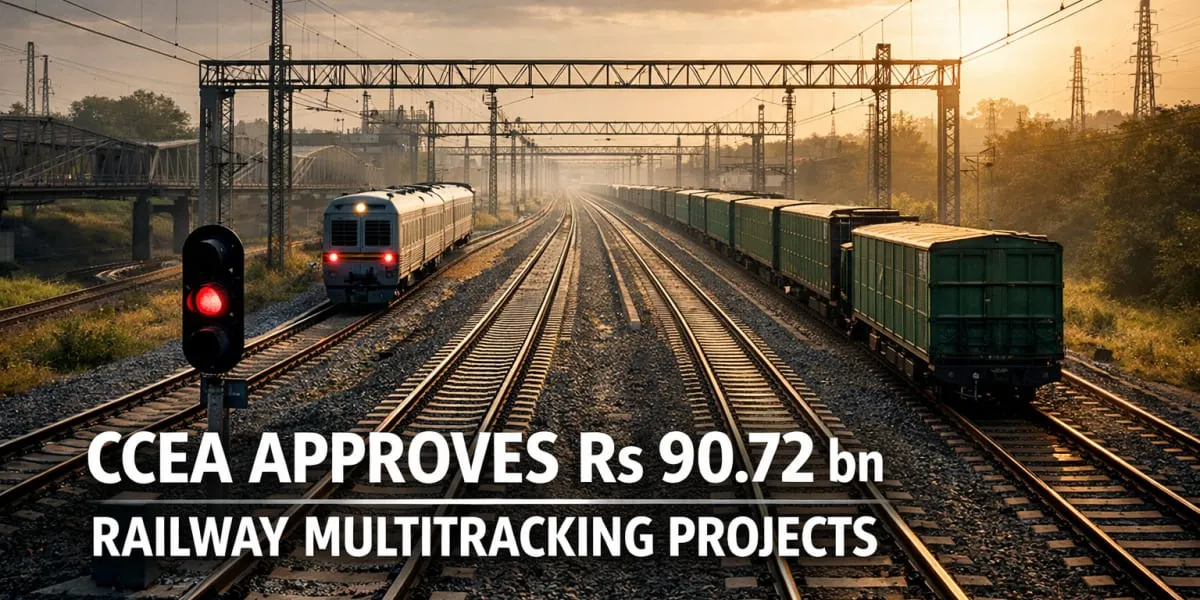
The Cabinet Committee on Economic Affairs approved railway multitracking projects worth Rs 9,072 crore (Rs 90.72 billion (bn)). The approval covers a series of multitracking works intended to augment capacity and operational flexibility across key sections of the national rail network. The decision was taken to address growing traffic demand and to enable more efficient movement of both freight and passenger services. The approvals form part of a broader infrastructure push to ease network bottlenecks.

The aggregate outlay will support track doubling, line augmentations and associated civil works, with priority given to congested corridors. The projects are expected to reduce transit times and enhance reliability by allowing simultaneous movements on parallel tracks. Implementation schedules will be set by the executing agencies in consultation with the ministry overseeing rail infrastructure. Detailed project reports will outline scope, phasing and tendering timelines to ensure timely mobilisation of contractors.

Funding provisions were examined during the appraisal and will follow established budgetary procedures, with allocations reflected in subsequent financial statements. The investment is anticipated to unlock capacity for freight corridors and support modal shift where feasible, improving overall network efficiency. Stakeholders will be engaged to coordinate works and minimise disruption to regular services during construction. Cost efficiencies are expected through standardised designs and coordinated procurement strategies across multiple works.

The ministry will monitor progress and the projects will be subject to standard safeguards for land acquisition and environmental compliance. Expected operational gains include higher throughput, reduced congestion and improved punctuality for long distance services. The approval signals continued focus on strengthening rail infrastructure to meet future demand and to support economic activity across regions. Monitoring arrangements will include periodic reviews and performance benchmarks to track delivery against planned outcomes.

The Cabinet Committee on Economic Affairs approved railway multitracking projects worth Rs 9,072 crore (Rs 90.72 billion (bn)). The approval covers a series of multitracking works intended to augment capacity and operational flexibility across key sections of the national rail network. The decision was taken to address growing traffic demand and to enable more efficient movement of both freight and passenger services. The approvals form part of a broader infrastructure push to ease network bottlenecks. The aggregate outlay will support track doubling, line augmentations and associated civil works, with priority given to congested corridors. The projects are expected to reduce transit times and enhance reliability by allowing simultaneous movements on parallel tracks. Implementation schedules will be set by the executing agencies in consultation with the ministry overseeing rail infrastructure. Detailed project reports will outline scope, phasing and tendering timelines to ensure timely mobilisation of contractors. Funding provisions were examined during the appraisal and will follow established budgetary procedures, with allocations reflected in subsequent financial statements. The investment is anticipated to unlock capacity for freight corridors and support modal shift where feasible, improving overall network efficiency. Stakeholders will be engaged to coordinate works and minimise disruption to regular services during construction. Cost efficiencies are expected through standardised designs and coordinated procurement strategies across multiple works. The ministry will monitor progress and the projects will be subject to standard safeguards for land acquisition and environmental compliance. Expected operational gains include higher throughput, reduced congestion and improved punctuality for long distance services. The approval signals continued focus on strengthening rail infrastructure to meet future demand and to support economic activity across regions. Monitoring arrangements will include periodic reviews and performance benchmarks to track delivery against planned outcomes.

Related Stories

Gold Stories

Next Story
Infrastructure Urban

KONE Opens India's First Digital Experience Centre in Pune

KONE, a global elevator and escalator manufacturer, has inaugurated its first Digital Experience Centre (DEC) in India, located in Pune. The facility aims to showcase how artificial intelligence (AI), connectivity and data-driven technologies can enhance customer experiences and improve building operations.The centre was inaugurated by Jussi Herlin, Executive Vice Chair, KONE Corporation; Philippe Delorme, President and CEO, KONE; and Nandan Nilekani, Co-founder and Chairman of the Board, Infosys.Designed as an interactive customer environment, the facility demonstrates digital solutions cover..

Next Story
Infrastructure Urban

CII GreenCo Launches Circularity Guidelines for Indian Industry

The Confederation of Indian Industry (CII) GreenCo Council has launched the CII GreenCo Circularity Guidelines – Pilot Version at the 17th CII GreenCo Waste & Resource Management Summit 2026 in Chennai. The initiative aims to strengthen resource efficiency, waste reduction and circular economy practices across Indian manufacturing and process industries.The guidelines introduce a structured framework with circularity indices covering raw materials, consumables, packaging and other resource inputs. These indicators will help industries assess existing practices, identify opportunities to ..

Next Story
Infrastructure Energy

Global Electronics Association Launches IPC-1783-CO2E Standard

The Global Electronics Association has introduced IPC-1783-CO2E, a new international standard aimed at improving consistency, transparency and comparability in product carbon footprint reporting across the electronics manufacturing industry.The standard, titled International Standard for Data Collection and Reporting of CO2 Equivalent (CO2e) Emissions for the Electronics Manufacturing Supply Chain, provides industry-specific guidance for collecting, estimating and reporting carbon emissions data.With increasing regulatory requirements and customer expectations, electronics manufacturers face c..

Advertisement

Subscribe to Our Newsletter

Get daily newsletters around different themes from Construction world.

STAY CONNECTED

Advertisement

SPECIAL OFFER
QR Code