
Delhi-Faridabad Metro Extension Flagged Off
RAILWAYS & METRO RAIL

Delhi-Faridabad Metro Extension Flagged Off

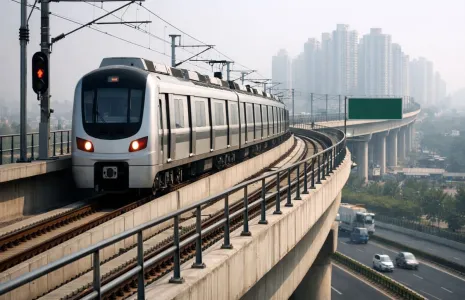
Prime Minister Narendra Modi flagged off the Delhi-Faridabad metro line, which will allow hassle free travel for around 0.2 million (200,000) daily commuters between the national capital and the industrial hub in Haryana. The extension links Badarpur to Escorts Mujesar and is intended to ease peak hour congestion and shorten journey times for commuters travelling between the two cities. Officials said the extension is expected to better integrate travel patterns across commuting corridors and support access to employment centres.\n\nThe total cost of the project from Badarpur to Escorts Mujesar is nearly Rs 25 billion (25 bn). The Haryana government bore Rs 15.57 billion (15.57 bn), the Centre contributed Rs 5.37 billion (5.37 bn), while Delhi Metro provided Rs 4 billion (4 bn). Funding was structured to balance state, central and operator contributions and to expedite completion. The financing mix was presented as a means to spread costs while enabling prompt commissioning of services.\n\nThe nine stations on the section are Sarai, NHPC Chowk, Mewala Maharajpur, Sector 28, Badkal Mor, Old Faridabad, Neelam Chowk Ajronda, Bata Chowk and Escorts Mujesar. All stations are elevated and sit on either side of the Delhi-Mathura Road (National Highway two), and the corridor was reported to have been built with about 95 per cent indigenous inputs. Authorities said the corridor will provide a safe, affordable, quick, comfortable, reliable, environment friendly and sustainable transport facility for daily users. The elevated alignment and station spacing are intended to facilitate swift passenger flows and minimise land acquisition impacts.\n\nHaryana Chief Minister ML Khattar expressed gratitude to the Prime Minister, saying the service would take the city to another level of progress and improve connectivity with other National Capital Region towns. He also indicated that the Prime Minister would be announcing approval to connect Gurgaon with Faridabad by metro, which would further extend regional links and potentially increase ridership across adjoining corridors. Local officials view the project as a step towards broader metropolitan integration and modal shift from road to rail.

Prime Minister Narendra Modi flagged off the Delhi-Faridabad metro line, which will allow hassle free travel for around 0.2 million (200,000) daily commuters between the national capital and the industrial hub in Haryana. The extension links Badarpur to Escorts Mujesar and is intended to ease peak hour congestion and shorten journey times for commuters travelling between the two cities. Officials said the extension is expected to better integrate travel patterns across commuting corridors and support access to employment centres.\n\nThe total cost of the project from Badarpur to Escorts Mujesar is nearly Rs 25 billion (25 bn). The Haryana government bore Rs 15.57 billion (15.57 bn), the Centre contributed Rs 5.37 billion (5.37 bn), while Delhi Metro provided Rs 4 billion (4 bn). Funding was structured to balance state, central and operator contributions and to expedite completion. The financing mix was presented as a means to spread costs while enabling prompt commissioning of services.\n\nThe nine stations on the section are Sarai, NHPC Chowk, Mewala Maharajpur, Sector 28, Badkal Mor, Old Faridabad, Neelam Chowk Ajronda, Bata Chowk and Escorts Mujesar. All stations are elevated and sit on either side of the Delhi-Mathura Road (National Highway two), and the corridor was reported to have been built with about 95 per cent indigenous inputs. Authorities said the corridor will provide a safe, affordable, quick, comfortable, reliable, environment friendly and sustainable transport facility for daily users. The elevated alignment and station spacing are intended to facilitate swift passenger flows and minimise land acquisition impacts.\n\nHaryana Chief Minister ML Khattar expressed gratitude to the Prime Minister, saying the service would take the city to another level of progress and improve connectivity with other National Capital Region towns. He also indicated that the Prime Minister would be announcing approval to connect Gurgaon with Faridabad by metro, which would further extend regional links and potentially increase ridership across adjoining corridors. Local officials view the project as a step towards broader metropolitan integration and modal shift from road to rail.

Related Stories

Gold Stories

Next Story
Infrastructure Urban

KONE Opens India's First Digital Experience Centre in Pune

KONE, a global elevator and escalator manufacturer, has inaugurated its first Digital Experience Centre (DEC) in India, located in Pune. The facility aims to showcase how artificial intelligence (AI), connectivity and data-driven technologies can enhance customer experiences and improve building operations.The centre was inaugurated by Jussi Herlin, Executive Vice Chair, KONE Corporation; Philippe Delorme, President and CEO, KONE; and Nandan Nilekani, Co-founder and Chairman of the Board, Infosys.Designed as an interactive customer environment, the facility demonstrates digital solutions cover..

Next Story
Infrastructure Urban

CII GreenCo Launches Circularity Guidelines for Indian Industry

The Confederation of Indian Industry (CII) GreenCo Council has launched the CII GreenCo Circularity Guidelines – Pilot Version at the 17th CII GreenCo Waste & Resource Management Summit 2026 in Chennai. The initiative aims to strengthen resource efficiency, waste reduction and circular economy practices across Indian manufacturing and process industries.The guidelines introduce a structured framework with circularity indices covering raw materials, consumables, packaging and other resource inputs. These indicators will help industries assess existing practices, identify opportunities to ..

Next Story
Infrastructure Energy

Global Electronics Association Launches IPC-1783-CO2E Standard

The Global Electronics Association has introduced IPC-1783-CO2E, a new international standard aimed at improving consistency, transparency and comparability in product carbon footprint reporting across the electronics manufacturing industry.The standard, titled International Standard for Data Collection and Reporting of CO2 Equivalent (CO2e) Emissions for the Electronics Manufacturing Supply Chain, provides industry-specific guidance for collecting, estimating and reporting carbon emissions data.With increasing regulatory requirements and customer expectations, electronics manufacturers face c..

Advertisement

Subscribe to Our Newsletter

Get daily newsletters around different themes from Construction world.

STAY CONNECTED

Advertisement

SPECIAL OFFER
QR Code