Delhi Metro to Procure 68 Coaches for Red Line Extension to Gurugram
RAILWAYS & METRO RAIL

Delhi Metro to Procure 68 Coaches for Red Line Extension to Gurugram

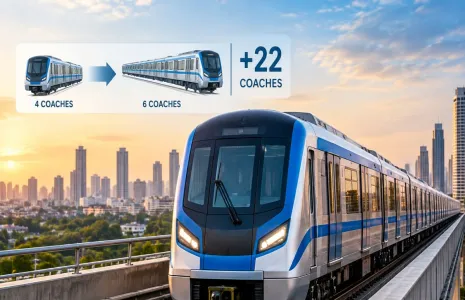
The Delhi Metro Rail Corporation (DMRC) will procure 68 coaches for the Red Line extension to Gurugram, a move intended to bolster capacity and improve commuter experience on the corridor. The decision follows planning for network expansion and is aimed at accommodating growing travel demand between Delhi and its satellite city. The additional coaches will be integrated into the existing operational fleet and subjected to regulatory safety and performance checks before service deployment. Regulatory authorities will oversee safety certification and compliance throughout the commissioning process.

Procurement is planned to proceed through transparent tendering and competitive bidding to ensure technical suitability and value for money. Selected vendors will be required to meet specification standards for compatibility with the Red Line signalling and platform systems. The process will include factory acceptance tests, onsite trials and phased deliveries to align with operational readiness. Staff training and driver familiarisation will accompany delivery schedules to ensure smooth operations.

Officials expect the reinforcement of rolling stock to support higher service frequency and reduce crowding during peak hours, thus improving passenger comfort. Enhanced capacity on the Red Line extension is also expected to strengthen multimodal connectivity by easing interchange with buses and other rapid transit services in Gurugram. The initiative aligns with broader urban mobility objectives to encourage public transport use and reduce road congestion.

DMRC will coordinate with the Gurugram Metropolitan Development Authority and state transport departments to finalise operational plans and station facilities. Maintenance regimes and spare parts logistics will be planned to support reliable service once the coaches enter revenue service. Commuters can expect a phased introduction of the additional units as testing and certification are completed, with the corporation monitoring performance to guide subsequent fleet management decisions. Ridership patterns will be monitored to assess demand and inform future capacity planning.

The Delhi Metro Rail Corporation (DMRC) will procure 68 coaches for the Red Line extension to Gurugram, a move intended to bolster capacity and improve commuter experience on the corridor. The decision follows planning for network expansion and is aimed at accommodating growing travel demand between Delhi and its satellite city. The additional coaches will be integrated into the existing operational fleet and subjected to regulatory safety and performance checks before service deployment. Regulatory authorities will oversee safety certification and compliance throughout the commissioning process. Procurement is planned to proceed through transparent tendering and competitive bidding to ensure technical suitability and value for money. Selected vendors will be required to meet specification standards for compatibility with the Red Line signalling and platform systems. The process will include factory acceptance tests, onsite trials and phased deliveries to align with operational readiness. Staff training and driver familiarisation will accompany delivery schedules to ensure smooth operations. Officials expect the reinforcement of rolling stock to support higher service frequency and reduce crowding during peak hours, thus improving passenger comfort. Enhanced capacity on the Red Line extension is also expected to strengthen multimodal connectivity by easing interchange with buses and other rapid transit services in Gurugram. The initiative aligns with broader urban mobility objectives to encourage public transport use and reduce road congestion. DMRC will coordinate with the Gurugram Metropolitan Development Authority and state transport departments to finalise operational plans and station facilities. Maintenance regimes and spare parts logistics will be planned to support reliable service once the coaches enter revenue service. Commuters can expect a phased introduction of the additional units as testing and certification are completed, with the corporation monitoring performance to guide subsequent fleet management decisions. Ridership patterns will be monitored to assess demand and inform future capacity planning.

Related Stories

Gold Stories
Next Story
Infrastructure Urban

KONE Opens India's First Digital Experience Centre in Pune

KONE, a global elevator and escalator manufacturer, has inaugurated its first Digital Experience Centre (DEC) in India, located in Pune. The facility aims to showcase how artificial intelligence (AI), connectivity and data-driven technologies can enhance customer experiences and improve building operations.The centre was inaugurated by Jussi Herlin, Executive Vice Chair, KONE Corporation; Philippe Delorme, President and CEO, KONE; and Nandan Nilekani, Co-founder and Chairman of the Board, Infosys.Designed as an interactive customer environment, the facility demonstrates digital solutions cover..

Next Story
Infrastructure Urban

CII GreenCo Launches Circularity Guidelines for Indian Industry

The Confederation of Indian Industry (CII) GreenCo Council has launched the CII GreenCo Circularity Guidelines – Pilot Version at the 17th CII GreenCo Waste & Resource Management Summit 2026 in Chennai. The initiative aims to strengthen resource efficiency, waste reduction and circular economy practices across Indian manufacturing and process industries.The guidelines introduce a structured framework with circularity indices covering raw materials, consumables, packaging and other resource inputs. These indicators will help industries assess existing practices, identify opportunities to ..

Next Story
Infrastructure Energy

Global Electronics Association Launches IPC-1783-CO2E Standard

The Global Electronics Association has introduced IPC-1783-CO2E, a new international standard aimed at improving consistency, transparency and comparability in product carbon footprint reporting across the electronics manufacturing industry.The standard, titled International Standard for Data Collection and Reporting of CO2 Equivalent (CO2e) Emissions for the Electronics Manufacturing Supply Chain, provides industry-specific guidance for collecting, estimating and reporting carbon emissions data.With increasing regulatory requirements and customer expectations, electronics manufacturers face c..

Advertisement

Subscribe to Our Newsletter

Get daily newsletters around different themes from Construction world.

STAY CONNECTED

Advertisement

SPECIAL OFFER
QR Code