+
Indian Railways Freight Reforms Boost Bulk Cement Movement
RAILWAYS & METRO RAIL

Indian Railways Freight Reforms Boost Bulk Cement Movement

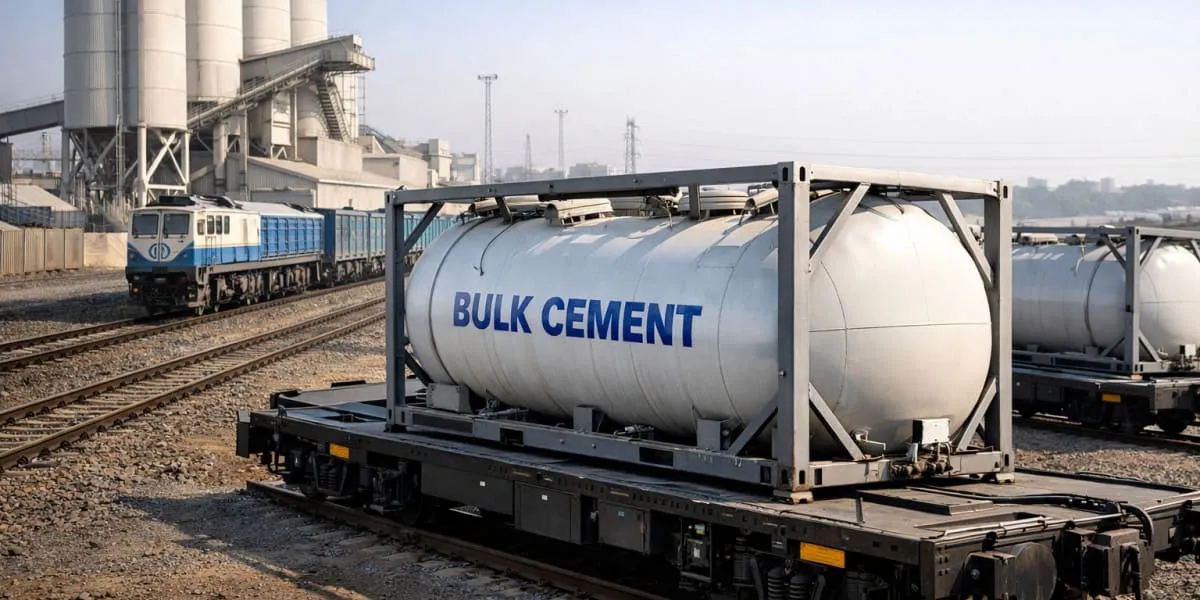
Indian Railways has revised freight charging on a gross tonne kilometre (GTKM) basis and introduced incentives that are encouraging cement companies to shift bulk cement movement to rail. The Container Corporation of India (CONCOR) is facilitating silo infrastructure at its terminals and promoting tank container operations to lower logistics costs and emissions. The Railways reduced charges on a GTKM basis from Rs zero point nine zero to Rs zero point eight five per tonne per kilometre, which has made rail movement more competitive against road transport.

Discounts for empty return movement on a GTKM basis have also been offered to improve economics for users. Trade response to the GTKM charging scheme has been described as encouraging by officials, and several cement producers have approached CONCOR to use tank containers. The reforms are projected to reduce overall freight costs for bulk cement movement, lower fuel consumption and reduce emissions by shifting tonnage from road to rail.

The earlier charging structure had applied haulage on a per TEU basis with distance slabs and offered graded discounts for empty return movement of 50 per cent in the first year, 40 per cent in the second year, 30 per cent in the third year, 20 per cent in the fourth year and 10 per cent in the fifth year, with no discount from the sixth year onwards. That mechanism had been found unattractive by cement producers and had deterred modal shift from road to rail. The new GTKM approach is intended to create a win?win situation for the Railways and its customers.

CONCOR is also supporting terminal investments to enable faster turnaround and reduced handling losses compared with bagged consignments, which should improve plant to market efficiency. The adoption of tank containers and silo handling is expected to shorten transit cycles and lower handling costs while contributing to sustainability goals. Officials indicated that deepening these reforms and marketing the schemes will be central to attracting additional loading onto the rail network.

Indian Railways has revised freight charging on a gross tonne kilometre (GTKM) basis and introduced incentives that are encouraging cement companies to shift bulk cement movement to rail. The Container Corporation of India (CONCOR) is facilitating silo infrastructure at its terminals and promoting tank container operations to lower logistics costs and emissions. The Railways reduced charges on a GTKM basis from Rs zero point nine zero to Rs zero point eight five per tonne per kilometre, which has made rail movement more competitive against road transport. Discounts for empty return movement on a GTKM basis have also been offered to improve economics for users. Trade response to the GTKM charging scheme has been described as encouraging by officials, and several cement producers have approached CONCOR to use tank containers. The reforms are projected to reduce overall freight costs for bulk cement movement, lower fuel consumption and reduce emissions by shifting tonnage from road to rail. The earlier charging structure had applied haulage on a per TEU basis with distance slabs and offered graded discounts for empty return movement of 50 per cent in the first year, 40 per cent in the second year, 30 per cent in the third year, 20 per cent in the fourth year and 10 per cent in the fifth year, with no discount from the sixth year onwards. That mechanism had been found unattractive by cement producers and had deterred modal shift from road to rail. The new GTKM approach is intended to create a win?win situation for the Railways and its customers. CONCOR is also supporting terminal investments to enable faster turnaround and reduced handling losses compared with bagged consignments, which should improve plant to market efficiency. The adoption of tank containers and silo handling is expected to shorten transit cycles and lower handling costs while contributing to sustainability goals. Officials indicated that deepening these reforms and marketing the schemes will be central to attracting additional loading onto the rail network.

Next Story
Infrastructure Energy

Jyoti Structures expands manufacturing capacity in Nashik

The announcement Jyoti Structures (JSL) reported steady operational performance in 2025, supported by stable project execution across its power transmission portfolio. The company commissioned galvanisation operations at its second Nashik manufacturing unit, adding 33,000 MT of annual capacity. This increased aggregate tower manufacturing capability at Nashik to approximately 69,000 MT per annum, aimed at improving fabrication accuracy, scheduling control and delivery predictability. JSL also expanded its workforce to over 750 employees, onboarding more than 70 engineers during the year. C..

Next Story
Infrastructure Energy

TSPL Mega Health Camp Reaches 338 Residents in Mansa

Talwandi Sabo Power (TSPL), Punjab’s largest and North India’s largest private thermal power plant, organised a Mega Health Camp at Village Raipur, Mansa, under its flagship healthcare initiative Project SEHAT. The camp benefitted 338 community members through free consultations and diagnostic services.A team comprising a General Physician, Gynaecologist, Dermatologist and Dentist provided medical advice and treatment. Beneficiaries received free diagnostic tests including BP, HB, blood sugar, malaria, dengue and blood group tests, along with free medicines.The camp was inaugurated by Vill..

Next Story
Infrastructure Transport

Mumbai Coastal Road Musical Path Plays Jai Ho

Mumbai inaugurated India’s first musical path on the Coastal Road that plays the song Jai Ho for motorists. The civic administration said the installation used Hungarian technology and that the intention was to implement the concept of Sangeet Marg in future projects. A senior official suggested implementing a pilot on the Samruddhi Expressway, which connects Mumbai and Nagpur. City officials described the inauguration as a symbolic demonstration of collaboration between municipal authorities and foreign partners. The inauguration was attended by the Consul General of Hungary Ferenc Jari, f..

Advertisement

Subscribe to Our Newsletter

Get daily newsletters around different themes from Construction world.

STAY CONNECTED

Advertisement

Advertisement

Advertisement

Open In App