+
Indian Railways Reforms Boost Bulk Cement Rail Transport
RAILWAYS & METRO RAIL

Indian Railways Reforms Boost Bulk Cement Rail Transport

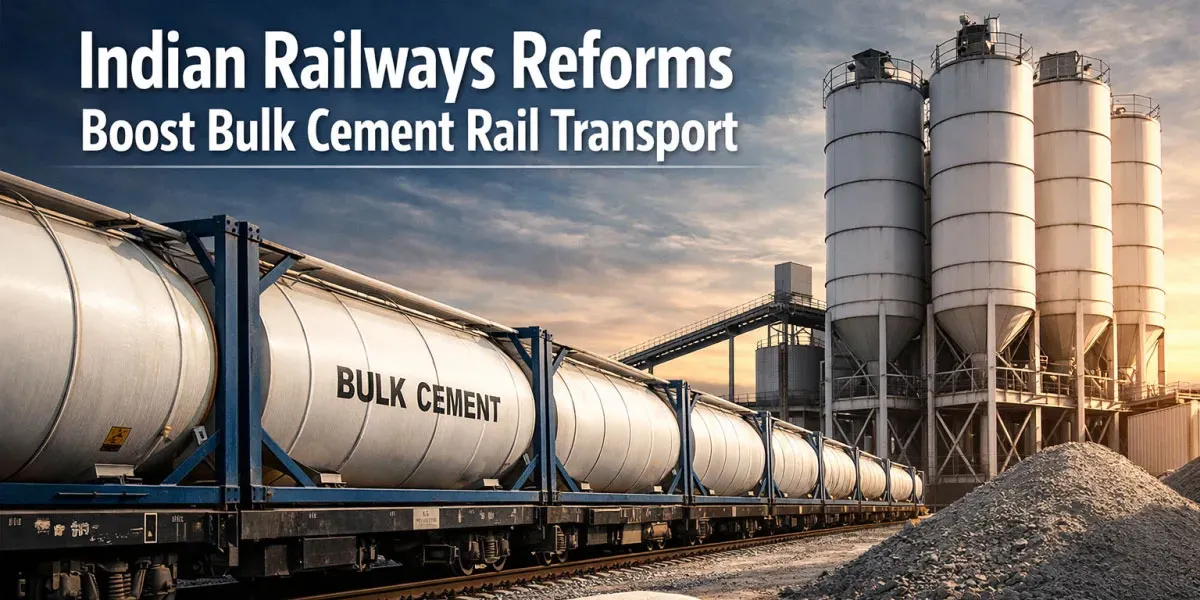
Indian Railways has reported a positive response to reforms aimed at shifting bulk cement movement from road to rail. The measures focus on promoting movement of bulk cement in tank containers and on encouraging set up of silos at container terminals by CONCOR to improve handling and storage. Many cement companies have approached CONCOR to use tank containers for plant to market logistics, reflecting growing interest in rail based solutions.

Railways reduced charging on GTKM basis from 90 paisa to 85 paisa per tonne per kilometre to make schemes more attractive and to boost loading. This change, together with discounts on empty return movement to the originating terminal on GTKM basis, has made movement of bulk cement in tank containers significantly more competitive compared to road. Officials said the innovative charging structure aims to create win win outcomes for Railways and customers.

The reforms are expected to reduce overall freight cost for bulk cement movement, lower fuel consumption and curtail emissions from road transport. Faster turnaround and reduced handling losses compared to bagged cement are likely to improve efficiency and supply chain reliability. Adoption of tank containers and terminal silos is anticipated to support plant to market efficiency and reduce product handling at source and destination.

Earlier, haulage for bulk cement in tank containers was charged on a per TEU basis under a distance slab system with a graded discount on the empty return leg. The discount schedule offered 50 per cent in the first year, 40 per cent in the second year, 30 per cent in the third year, 20 per cent in the fourth year and 10 per cent in the fifth year with no discount from the sixth year onwards. That method was found to be unattractive for cement producers and acted as a deterrent to modal shift from road to rail. The rate reforms and facility enhancements are intended to increase loading and promote rail based bulk cement logistics while balancing commercial interests of Railways and customers.

Indian Railways has reported a positive response to reforms aimed at shifting bulk cement movement from road to rail. The measures focus on promoting movement of bulk cement in tank containers and on encouraging set up of silos at container terminals by CONCOR to improve handling and storage. Many cement companies have approached CONCOR to use tank containers for plant to market logistics, reflecting growing interest in rail based solutions. Railways reduced charging on GTKM basis from 90 paisa to 85 paisa per tonne per kilometre to make schemes more attractive and to boost loading. This change, together with discounts on empty return movement to the originating terminal on GTKM basis, has made movement of bulk cement in tank containers significantly more competitive compared to road. Officials said the innovative charging structure aims to create win win outcomes for Railways and customers. The reforms are expected to reduce overall freight cost for bulk cement movement, lower fuel consumption and curtail emissions from road transport. Faster turnaround and reduced handling losses compared to bagged cement are likely to improve efficiency and supply chain reliability. Adoption of tank containers and terminal silos is anticipated to support plant to market efficiency and reduce product handling at source and destination. Earlier, haulage for bulk cement in tank containers was charged on a per TEU basis under a distance slab system with a graded discount on the empty return leg. The discount schedule offered 50 per cent in the first year, 40 per cent in the second year, 30 per cent in the third year, 20 per cent in the fourth year and 10 per cent in the fifth year with no discount from the sixth year onwards. That method was found to be unattractive for cement producers and acted as a deterrent to modal shift from road to rail. The rate reforms and facility enhancements are intended to increase loading and promote rail based bulk cement logistics while balancing commercial interests of Railways and customers.

Next Story
Infrastructure Urban

Implementation Status of Jal Jeevan Mission

Since August 2019 the Government has implemented Jal Jeevan Mission to provide assured potable water through household tap connections in rural India. At the start of the mission only 32.3 million (mn) rural households, representing 16.7 per cent, were reported to have tap water connections. States and union territories have reported that 125.8 mn additional rural households have since been provided with tap connections. As a result, of about 193.6 mn rural households roughly 158.2 mn, or 81.71 per cent, are reported to have tap water supply at home.\n\nThe State, district and village level st..

Next Story
Infrastructure Urban

Jal Jeevan Mission Reaches Eighty One Per Cent Rural Coverage

The Government reported substantial progress under the Jal Jeevan Mission, launched in August 2019 to provide tap water to every rural household. At launch only 32.3 million (mn) rural households had tap connections and states and Union territories reported provision of 125.8 mn additional households by March 2026. Consequently, out of about 193.6 mn rural households around 158.2 mn, or 81.71 per cent, are reported to have tap water at home. The Finance Minister announced extension of the mission until 2028 in the 2025-26 budget speech. The Swachh Bharat Mission Grameen, launched in October 20..

Next Story
Infrastructure Urban

Empowering Local Governance for Sustainable Rural Water Supply

The Ministry of Jal Shakti has aligned the Jal Jeevan Mission (JJM) with the 73rd Amendment to strengthen village level planning and community ownership of water supply. Gram Panchayats, village water and sanitation committees and Pani Samitis are to plan, implement, manage and maintain piped water systems, with gram sabha processes formalising handover and oversight. Implementation support agencies including non government organisations, community based organisations and self help groups have been empanelled to train local committees and promote women participation. Under JJM, the department ..

Advertisement

Subscribe to Our Newsletter

Get daily newsletters around different themes from Construction world.

STAY CONNECTED

Advertisement

Advertisement

Advertisement