+
Manipur Pledges Support To Fast-Track Jiribam-Imphal Railway By 2028
RAILWAYS & METRO RAIL

Manipur Pledges Support To Fast-Track Jiribam-Imphal Railway By 2028

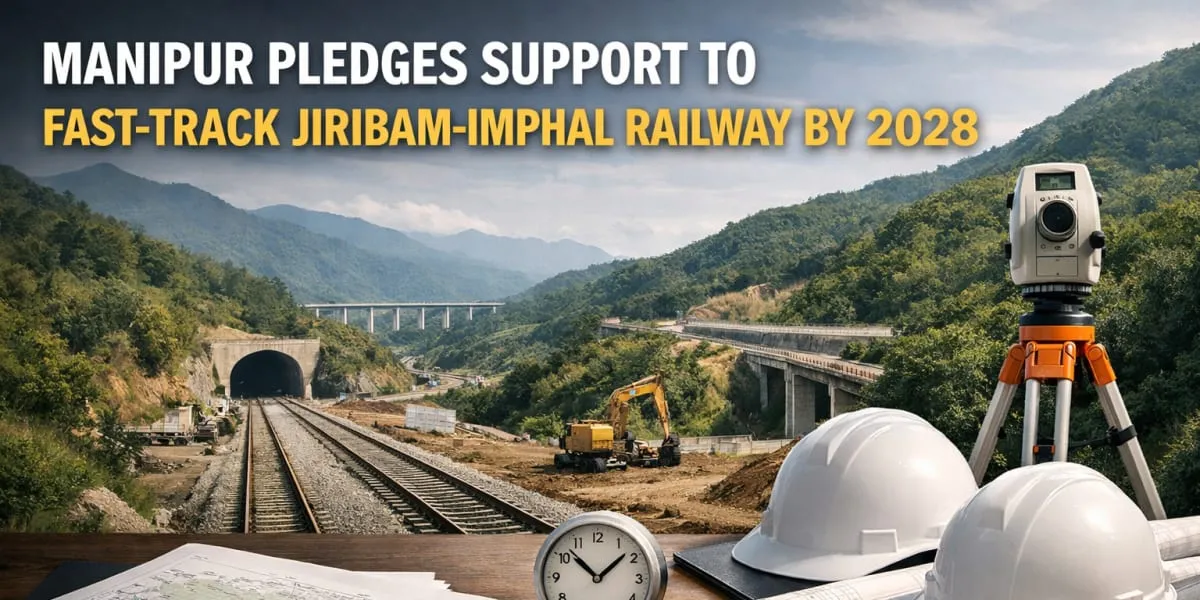
Manipur Chief Minister Yumnam Khemchand Singh held discussions with Ashish Bansal, the newly appointed General Manager of the Northeast Frontier Railway Construction Organisation in Maligaon, on the Jiribam-Imphal rail link at the Chief Minister's Secretariat. Officials reported that the meeting reviewed progress on the line that will connect Imphal with Assam's Silchar and that the Northeast Frontier Railway plans to reach the state capital by the end of 2028. The exchange focused on timelines, land and logistical support needed to accelerate work.

The Chief Minister assured that the state government would provide all possible assistance to ensure early completion and expressed support for measures to resolve local constraints. Officials described the project as critical for regional integration and economic access for remote areas of Manipur. The administration underlined coordination with central agencies to synchronise resources and clearances.

Work on the Noney Bridge continues; the structure stands at 141 metres high and extends 703 metres and is being built at a cost of Rs six and a half billion (Rs 6.5 bn). The bridge forms part of the Rs 218.85 billion (Rs 218.85 bn) Jiribam-Imphal railway line and is expected to be completed by March 2026, while the entire line is slated for completion by December 2028. Engineers described the bridge as an engineering landmark intended to strengthen connectivity across challenging terrain.

The project is projected to cut travel time between Jiribam and Imphal to two and a half hours, improving access for passengers and freight and enhancing economic opportunities across the region. On February 27, 2026, the Union Minister of State for Heavy Industries and Steel inspected the Noney site, accompanied by the local district administration, according to officials. Authorities said the scheme will firmly place Manipur on India's railway map and transform regional accessibility.

The state government reiterated commitment to facilitate land acquisition, security arrangements and local engagement to keep work on schedule. Officials indicated that continued cooperation between state and central agencies will be essential to meet the remaining milestones.

Manipur Chief Minister Yumnam Khemchand Singh held discussions with Ashish Bansal, the newly appointed General Manager of the Northeast Frontier Railway Construction Organisation in Maligaon, on the Jiribam-Imphal rail link at the Chief Minister's Secretariat. Officials reported that the meeting reviewed progress on the line that will connect Imphal with Assam's Silchar and that the Northeast Frontier Railway plans to reach the state capital by the end of 2028. The exchange focused on timelines, land and logistical support needed to accelerate work. The Chief Minister assured that the state government would provide all possible assistance to ensure early completion and expressed support for measures to resolve local constraints. Officials described the project as critical for regional integration and economic access for remote areas of Manipur. The administration underlined coordination with central agencies to synchronise resources and clearances. Work on the Noney Bridge continues; the structure stands at 141 metres high and extends 703 metres and is being built at a cost of Rs six and a half billion (Rs 6.5 bn). The bridge forms part of the Rs 218.85 billion (Rs 218.85 bn) Jiribam-Imphal railway line and is expected to be completed by March 2026, while the entire line is slated for completion by December 2028. Engineers described the bridge as an engineering landmark intended to strengthen connectivity across challenging terrain. The project is projected to cut travel time between Jiribam and Imphal to two and a half hours, improving access for passengers and freight and enhancing economic opportunities across the region. On February 27, 2026, the Union Minister of State for Heavy Industries and Steel inspected the Noney site, accompanied by the local district administration, according to officials. Authorities said the scheme will firmly place Manipur on India's railway map and transform regional accessibility. The state government reiterated commitment to facilitate land acquisition, security arrangements and local engagement to keep work on schedule. Officials indicated that continued cooperation between state and central agencies will be essential to meet the remaining milestones.

Next Story
Infrastructure Urban

Implementation Status of Jal Jeevan Mission

Since August 2019 the Government has implemented Jal Jeevan Mission to provide assured potable water through household tap connections in rural India. At the start of the mission only 32.3 million (mn) rural households, representing 16.7 per cent, were reported to have tap water connections. States and union territories have reported that 125.8 mn additional rural households have since been provided with tap connections. As a result, of about 193.6 mn rural households roughly 158.2 mn, or 81.71 per cent, are reported to have tap water supply at home.\n\nThe State, district and village level st..

Next Story
Infrastructure Urban

Jal Jeevan Mission Reaches Eighty One Per Cent Rural Coverage

The Government reported substantial progress under the Jal Jeevan Mission, launched in August 2019 to provide tap water to every rural household. At launch only 32.3 million (mn) rural households had tap connections and states and Union territories reported provision of 125.8 mn additional households by March 2026. Consequently, out of about 193.6 mn rural households around 158.2 mn, or 81.71 per cent, are reported to have tap water at home. The Finance Minister announced extension of the mission until 2028 in the 2025-26 budget speech. The Swachh Bharat Mission Grameen, launched in October 20..

Next Story
Infrastructure Urban

Empowering Local Governance for Sustainable Rural Water Supply

The Ministry of Jal Shakti has aligned the Jal Jeevan Mission (JJM) with the 73rd Amendment to strengthen village level planning and community ownership of water supply. Gram Panchayats, village water and sanitation committees and Pani Samitis are to plan, implement, manage and maintain piped water systems, with gram sabha processes formalising handover and oversight. Implementation support agencies including non government organisations, community based organisations and self help groups have been empanelled to train local committees and promote women participation. Under JJM, the department ..

Advertisement

Subscribe to Our Newsletter

Get daily newsletters around different themes from Construction world.

STAY CONNECTED

Advertisement

Advertisement

Advertisement