+
Pune Metro Corridors Get Revised State Approval After Centre Nod
RAILWAYS & METRO RAIL

Pune Metro Corridors Get Revised State Approval After Centre Nod

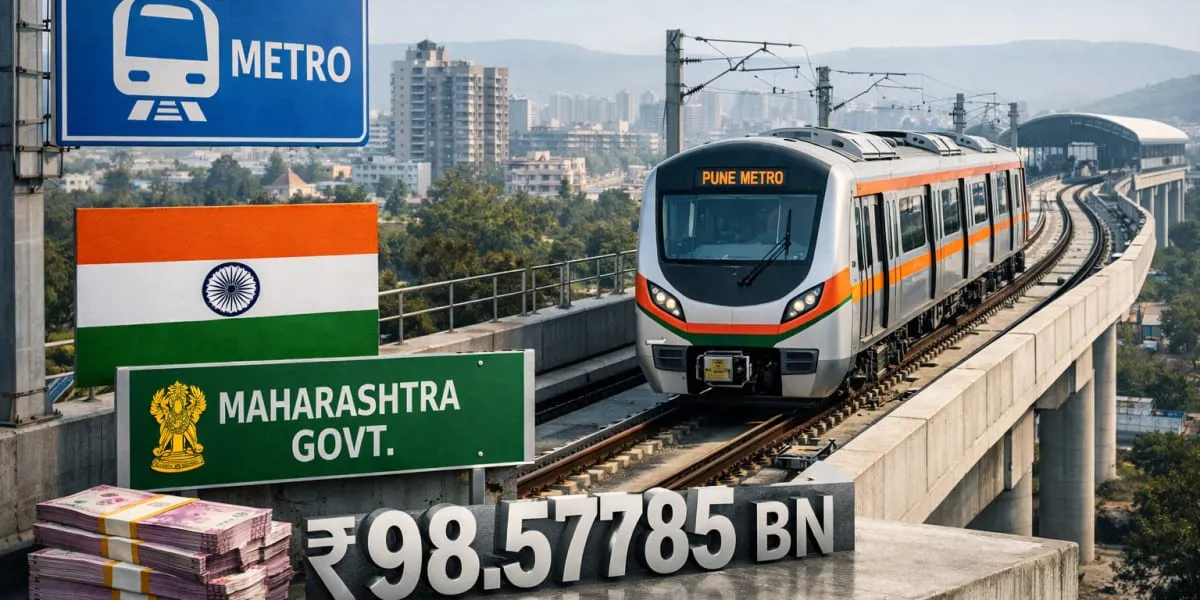
The Maharashtra government has granted revised administrative approval for two key metro corridors in Pune, covering the Kharadi–Swargate–Khadakwasla line and the Nal Stop–Warje route following earlier clearances from the Union government. The combined project spans 31.6 km and will comprise 28 elevated stations, with an estimated cost of Rs 98.5785 billion (bn). The state resolution updates previous approvals and aligns with the Centre's nod to proceed.

Under the approved funding structure, both the Union and state governments will each contribute Rs 12.12 billion (bn), with the remaining cost to be met through loans and other sources. A government resolution issued on 17 February authorises the signing of a memorandum of understanding (MOU) between the state, the Union government and Maharashtra Metro Rail Corporation Limited (Maha Metro). Maha Metro will be responsible for executing the project and coordinating detailed design, procurement and construction phases.

The project is entirely elevated and the station count and alignment are intended to improve connectivity between key residential, commercial and industrial hubs across eastern and southern Pune. Officials expect the corridors to relieve traffic on arterial roads and support more reliable public transport options for daily commuters. The works will link Kharadi, Swargate, Khadakwasla, Nal Stop and Warje and integrate with the wider metro network.

Funding finalisation, loan agreements and detailed project reports will precede major construction activity and the MOU will set out roles, risk sharing and timelines between stakeholders. The revised state approval is presented as a step to expedite clearances and enable Maha Metro to move into the implementation phase. Observers noted the scale of investment reflects continuing emphasis on urban rail to address growing mobility demands in Pune.

The Maharashtra government has granted revised administrative approval for two key metro corridors in Pune, covering the Kharadi–Swargate–Khadakwasla line and the Nal Stop–Warje route following earlier clearances from the Union government. The combined project spans 31.6 km and will comprise 28 elevated stations, with an estimated cost of Rs 98.5785 billion (bn). The state resolution updates previous approvals and aligns with the Centre's nod to proceed. Under the approved funding structure, both the Union and state governments will each contribute Rs 12.12 billion (bn), with the remaining cost to be met through loans and other sources. A government resolution issued on 17 February authorises the signing of a memorandum of understanding (MOU) between the state, the Union government and Maharashtra Metro Rail Corporation Limited (Maha Metro). Maha Metro will be responsible for executing the project and coordinating detailed design, procurement and construction phases. The project is entirely elevated and the station count and alignment are intended to improve connectivity between key residential, commercial and industrial hubs across eastern and southern Pune. Officials expect the corridors to relieve traffic on arterial roads and support more reliable public transport options for daily commuters. The works will link Kharadi, Swargate, Khadakwasla, Nal Stop and Warje and integrate with the wider metro network. Funding finalisation, loan agreements and detailed project reports will precede major construction activity and the MOU will set out roles, risk sharing and timelines between stakeholders. The revised state approval is presented as a step to expedite clearances and enable Maha Metro to move into the implementation phase. Observers noted the scale of investment reflects continuing emphasis on urban rail to address growing mobility demands in Pune.

Next Story
Building Material

NITI Aayog Unveils Cement Decarbonisation Roadmap

NITI Aayog has released a sector-specific decarbonisation roadmap for cement as part of three green transition reports covering cement, aluminium and MSMEs. The report projects cement production rising to around 2,100 million tonnes by 2070 from 391 million tonnes in 2023, while targeting a reduction in carbon intensity to 0.09–0.13 tCO₂e per tonne. It recommends clinker substitution, refuse-derived fuels, CCUS adoption and carbon trading mechanisms to enable deep decarbonisation. ..

Next Story
Technology

Genesys Launches Advanced GeoRadar System

Genesys International Corporation has launched an advanced Ground Penetrating Radar (GPR) solution from IDS GeoRadar for underground utility mapping in India. The system uses patented Equalised Scrambling Technology (EST) and Wide/Multi-Array Antenna Technology to deliver high-resolution three-dimensional imaging of subsurface infrastructure. The technology enables the detection and mapping of buried assets such as water pipelines, sewer networks, telecom cables and power lines. By providing detailed subsurface insights, the system aims to help urban authorities and infrastructure developers ..

Next Story
Infrastructure Urban

Hindustan Zinc Partners Virginia Tech to Boost Silver Recovery

Hindustan Zinc Limited recently signed a Memorandum of Understanding (MoU) with Virginia Tech to advance research aimed at improving silver recovery across its lead–zinc (Pb–Zn) concentrators. The collaboration will focus on refining flotation techniques and optimising reagent usage to improve concentrate quality and operational efficiency at processing plants.Virginia Tech, based in Blacksburg, Virginia, is globally recognised for its expertise in mining engineering, mineral processing and applied metallurgical research. Through this partnership, Hindustan Zinc will leverage global resear..

Advertisement

Subscribe to Our Newsletter

Get daily newsletters around different themes from Construction world.

STAY CONNECTED

Advertisement

Advertisement

Advertisement

Open In App