+
Railways Launch Reforms For On-Board Services And Cargo Terminals
RAILWAYS & METRO RAIL

Railways Launch Reforms For On-Board Services And Cargo Terminals

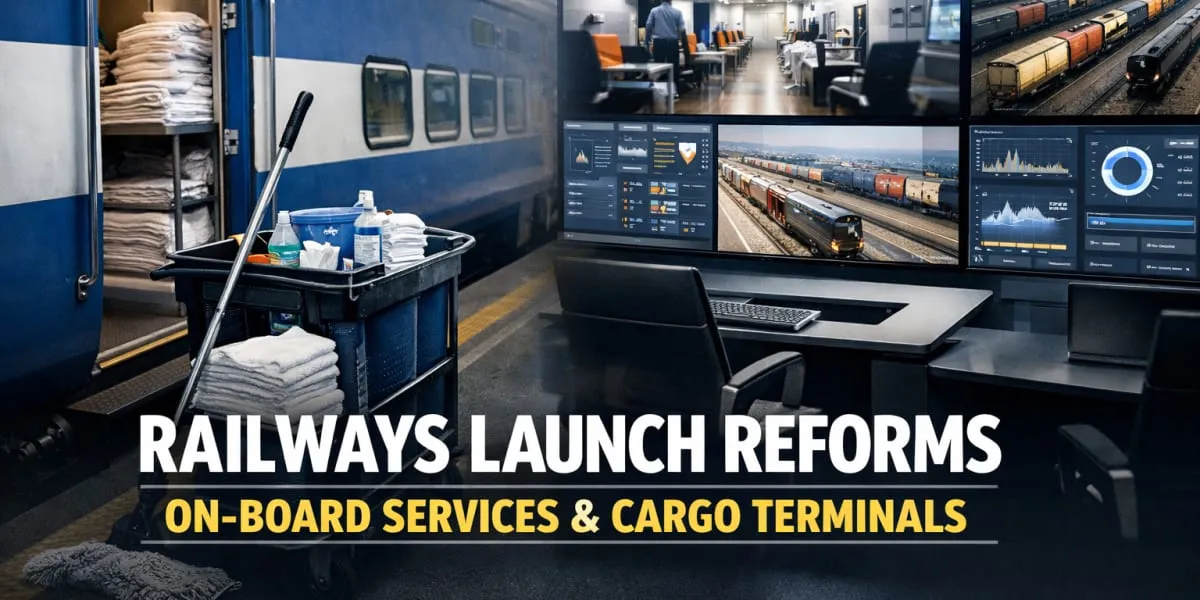
The Union Minister for Railways announced two reforms to be implemented immediately under a year-long programme. The measures will introduce continuous end-to-end cleaning of trains, extend services to general coaches and integrate linen handling under single contracts. Technology-enabled teams will be hired under service level agreements with AI monitoring from war room control centres to verify cleaning and trigger corrective action.

An initial roll-out will cover four to five trains per zone, focusing on high-footfall services, with 80 trains identified in the first phase and full implementation planned over a three-year period. Route-specific multi-tasking teams will address minor mechanical and electrical defects in addition to cleaning, and staff deployed at designated stations will move between reserved and general coaches to maintain consistent standards. Peak-hour cleaning will be more frequent while non-peak services will receive lower frequency as specified in contractual terms.

The second reform builds on the Gati Shakti Cargo Terminal (GCT) policy and aims to scale 124 multi-modal terminals to over 500 terminals over next five years, transforming terminals into cargo-plus-processing hubs where value addition such as cement grinding, bagging and food grain processing can occur on site. Contract tenures for GCTs and cargo-related facilities have been extended to 50 years to encourage long-term investment, and standard layouts will enable automatic approvals. Railways will also offer optional maintenance for short connecting stretches to improve safety and clarify responsibility.

Officials estimate the reforms could generate approximately Rs 300 bn in additional revenue over a three-year period and that existing terminals have an estimated traffic potential of around 200 mn t and revenue potential of Rs 200 bn annually. The Minister noted that bulk cement tonnage more than doubled, with January figures reaching around 95,000 t compared to around 40,000 t a year earlier, and that railway-based bulk cement transportation reduced costs by up to 30 per cent in some regions and by nearly half in another while reducing pollution. Further reforms are scheduled in the coming weeks as part of the 52 reforms in 52 weeks initiative.

The Union Minister for Railways announced two reforms to be implemented immediately under a year-long programme. The measures will introduce continuous end-to-end cleaning of trains, extend services to general coaches and integrate linen handling under single contracts. Technology-enabled teams will be hired under service level agreements with AI monitoring from war room control centres to verify cleaning and trigger corrective action. An initial roll-out will cover four to five trains per zone, focusing on high-footfall services, with 80 trains identified in the first phase and full implementation planned over a three-year period. Route-specific multi-tasking teams will address minor mechanical and electrical defects in addition to cleaning, and staff deployed at designated stations will move between reserved and general coaches to maintain consistent standards. Peak-hour cleaning will be more frequent while non-peak services will receive lower frequency as specified in contractual terms. The second reform builds on the Gati Shakti Cargo Terminal (GCT) policy and aims to scale 124 multi-modal terminals to over 500 terminals over next five years, transforming terminals into cargo-plus-processing hubs where value addition such as cement grinding, bagging and food grain processing can occur on site. Contract tenures for GCTs and cargo-related facilities have been extended to 50 years to encourage long-term investment, and standard layouts will enable automatic approvals. Railways will also offer optional maintenance for short connecting stretches to improve safety and clarify responsibility. Officials estimate the reforms could generate approximately Rs 300 bn in additional revenue over a three-year period and that existing terminals have an estimated traffic potential of around 200 mn t and revenue potential of Rs 200 bn annually. The Minister noted that bulk cement tonnage more than doubled, with January figures reaching around 95,000 t compared to around 40,000 t a year earlier, and that railway-based bulk cement transportation reduced costs by up to 30 per cent in some regions and by nearly half in another while reducing pollution. Further reforms are scheduled in the coming weeks as part of the 52 reforms in 52 weeks initiative.

Next Story
Equipment

Kabelschlepp India Installs Robotic VMC in Bengaluru

Kabelschlepp India, part of the Tsubaki Group, has installed a state-of-the-art Vertical Machining Center (VMC) integrated with robotic automation at its Bengaluru facility. The inauguration was held in the presence of Henning Preis, President & CEO, Kabelschlepp Group, Jörg Schulz, Vice President – Production, and Srinivas P. Kamisetty, Managing Director, Kabelschlepp India.The high-precision CNC VMC is designed for advanced milling, drilling, tapping and multi-axis machining. Equipped with a vertical spindle orientation, automatic tool changer and intelligent CNC control system, it en..

Next Story
Infrastructure Transport

Highway Delivery Reset!

Project delays and inefficiencies continue to bedevil the progress of India’s National Highways network. A multi-pronged reform agenda is needed to inject greater transparency and accountability at every stage – from planning and procurement to execution, maintenance and oversight. This article offers key recommendations and reform strategies that government stakeholders – from the Ministry of Road Transport & Highways (MoRTH) and the National Highways Authority of India (NHAI) to state agencies and oversight bodies – should pursue to put highway development on a better track.Decen..

Next Story
Infrastructure Transport

MSIDC Executes ₹37,000 Crore Road Programme

With Rs 37,000 crore worth of road projects under execution across Maharashtra, Maharashtra State Infrastructure Development Corporation (MSIDC) is driving one of the state’s largest infrastructure programmes. Dr Brijesh Dixit, Managing Director, discusses the institutional reforms, execution frameworks, financing strategies and technology adoption enabling timely, high-quality delivery, in conversation with PRATAP PADODE, Editor-in-Chief, CW.With over Rs 37,000 crore worth of road projects underway across districts – many under tight timelines – what institutional and executio..

Advertisement

Subscribe to Our Newsletter

Get daily newsletters around different themes from Construction world.

STAY CONNECTED

Advertisement

Advertisement

Advertisement

Open In App