+
Skywalk to Metro Station Key Feature of Rs 3.27 Billion Redevelopment
RAILWAYS & METRO RAIL

Skywalk to Metro Station Key Feature of Rs 3.27 Billion Redevelopment

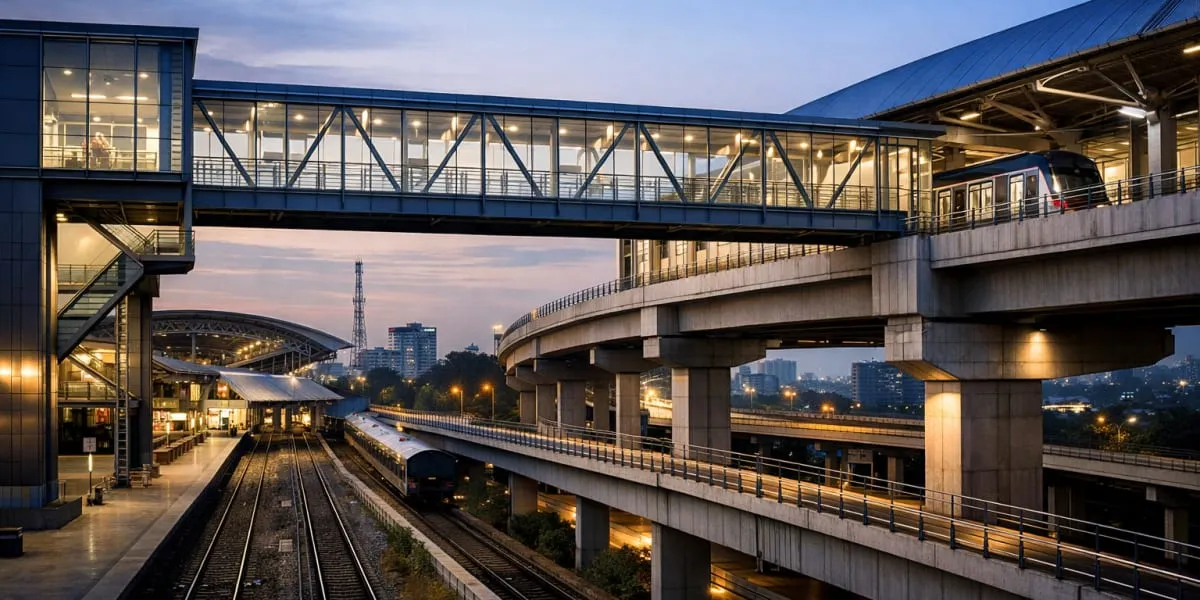
The redevelopment of Nampally railway station will proceed with a focus on passenger convenience and multimodal integration, with a key element being a skywalk linking the station to the city metro. The project has been sanctioned at Rs 3.27 billion (bn) and will rework station circulation to ease transfers between rail and rapid transit. Authorities described the scheme as aimed at reducing congestion on approaches and at platform areas while improving the commuter experience. Design work will prioritise accessibility for elderly and differently abled passengers.

Planned upgrades will include modernised circulation pathways, improved lighting and shelter, enhanced signage and measures to streamline entry and exit. The skywalk will form an elevated pedestrian artery and will be integrated with station concourses to allow seamless movement. Project planners expect the link to encourage use of public transport and to reduce short distance vehicular trips to the station precinct. The redevelopment will also consider landscaping and public realm improvements to create a safer walk to nearby transit nodes.

Funding and project management arrangements aim to deliver the works with minimal disruption to services, with phasing to maintain routine operations during construction. The scheme will be coordinated with the metro authority to align timings and facilitate construction of the pedestrian link. Passenger amenities are expected to be upgraded in stages to keep facilities available throughout the programme. Safety provisions such as surveillance and improved crowd management will be integral to the redesign.

The redevelopment of Nampally station forms part of wider efforts to modernise urban rail nodes and to promote integrated public transport solutions in the city. Once complete the intervention is expected to improve commuter throughput and to create a more legible transport interchange. Authorities will monitor usage patterns and make further adjustments to optimise pedestrian flows and operational efficiency. The project cost and integration of the skywalk underline a shift towards planning that links rail and metro as a cohesive urban mobility system.

The redevelopment of Nampally railway station will proceed with a focus on passenger convenience and multimodal integration, with a key element being a skywalk linking the station to the city metro. The project has been sanctioned at Rs 3.27 billion (bn) and will rework station circulation to ease transfers between rail and rapid transit. Authorities described the scheme as aimed at reducing congestion on approaches and at platform areas while improving the commuter experience. Design work will prioritise accessibility for elderly and differently abled passengers. Planned upgrades will include modernised circulation pathways, improved lighting and shelter, enhanced signage and measures to streamline entry and exit. The skywalk will form an elevated pedestrian artery and will be integrated with station concourses to allow seamless movement. Project planners expect the link to encourage use of public transport and to reduce short distance vehicular trips to the station precinct. The redevelopment will also consider landscaping and public realm improvements to create a safer walk to nearby transit nodes. Funding and project management arrangements aim to deliver the works with minimal disruption to services, with phasing to maintain routine operations during construction. The scheme will be coordinated with the metro authority to align timings and facilitate construction of the pedestrian link. Passenger amenities are expected to be upgraded in stages to keep facilities available throughout the programme. Safety provisions such as surveillance and improved crowd management will be integral to the redesign. The redevelopment of Nampally station forms part of wider efforts to modernise urban rail nodes and to promote integrated public transport solutions in the city. Once complete the intervention is expected to improve commuter throughput and to create a more legible transport interchange. Authorities will monitor usage patterns and make further adjustments to optimise pedestrian flows and operational efficiency. The project cost and integration of the skywalk underline a shift towards planning that links rail and metro as a cohesive urban mobility system.

Next Story
Infrastructure Urban

Implementation Status of Jal Jeevan Mission

Since August 2019 the Government has implemented Jal Jeevan Mission to provide assured potable water through household tap connections in rural India. At the start of the mission only 32.3 million (mn) rural households, representing 16.7 per cent, were reported to have tap water connections. States and union territories have reported that 125.8 mn additional rural households have since been provided with tap connections. As a result, of about 193.6 mn rural households roughly 158.2 mn, or 81.71 per cent, are reported to have tap water supply at home.\n\nThe State, district and village level st..

Next Story
Infrastructure Urban

Jal Jeevan Mission Reaches Eighty One Per Cent Rural Coverage

The Government reported substantial progress under the Jal Jeevan Mission, launched in August 2019 to provide tap water to every rural household. At launch only 32.3 million (mn) rural households had tap connections and states and Union territories reported provision of 125.8 mn additional households by March 2026. Consequently, out of about 193.6 mn rural households around 158.2 mn, or 81.71 per cent, are reported to have tap water at home. The Finance Minister announced extension of the mission until 2028 in the 2025-26 budget speech. The Swachh Bharat Mission Grameen, launched in October 20..

Next Story
Infrastructure Urban

Empowering Local Governance for Sustainable Rural Water Supply

The Ministry of Jal Shakti has aligned the Jal Jeevan Mission (JJM) with the 73rd Amendment to strengthen village level planning and community ownership of water supply. Gram Panchayats, village water and sanitation committees and Pani Samitis are to plan, implement, manage and maintain piped water systems, with gram sabha processes formalising handover and oversight. Implementation support agencies including non government organisations, community based organisations and self help groups have been empanelled to train local committees and promote women participation. Under JJM, the department ..

Advertisement

Subscribe to Our Newsletter

Get daily newsletters around different themes from Construction world.

STAY CONNECTED

Advertisement

Advertisement

Advertisement