+
Tamil Nadu Rail Allocation Jumps Since 2014 To Rs 76.11 Billion
RAILWAYS & METRO RAIL

Tamil Nadu Rail Allocation Jumps Since 2014 To Rs 76.11 Billion

Budget allocation to Tamil Nadu for railways has increased more than eight and a half times since 2014, reaching Rs 76.11 billion (Rs 76,110 mn) for 2026–27, the Union Minister for Railways said in posts on X. The allocation marks a significant rise in central spending aimed at expanding rail infrastructure across the State. The minister noted that the increase reflects planned investments in new lines, capacity enhancement and station redevelopment.

For ongoing projects only 24 per cent of required land has been handed over, amounting to 1,052 hectares out of 4,326 hectares, and Rs 14.65 bn has already been paid to the Tamil Nadu Government for land acquisition. Several critical projects are delayed due to pending land acquisition with the State Government. The ministry reported that persistent land issues are restricting timely implementation despite available funds.

Land acquisition remains particularly acute on the Madurai–Tuticorin new line via Aruppukkotai where 91 per cent of land remains to be acquired and on the Tindivanam–Gingee–Tiruvannamalai new line where 86 per cent is pending. The foundation stone for the Rameswaram–Dhanushkodi new line project was laid in 2019 but land acquisition has not yet begun. The Centre has nevertheless sanctioned multiple new lines, doublings and third and fourth lines, and detailed project reports have been prepared for further capacity expansion to support the State's economic and industrial growth.

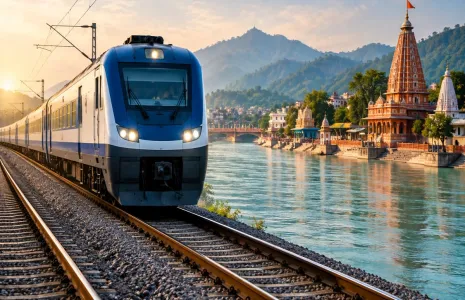
A total of 77 Amrit stations have been identified for complete redevelopment in Tamil Nadu, with work completed at 18 stations so far. Since 2014 approximately 1,350 km of track has been constructed and Indian Railways in the State has achieved 97 per cent electrification, equating to 2,386 km of rail lines electrified during the period. Modern trains built under national manufacturing schemes are operating to improve affordable travel, with nine pairs each of Vande Bharat Express and Amrit Bharat Express services currently running. Officials indicated that these measures are intended to enhance connectivity and support regional mobility.

Budget allocation to Tamil Nadu for railways has increased more than eight and a half times since 2014, reaching Rs 76.11 billion (Rs 76,110 mn) for 2026–27, the Union Minister for Railways said in posts on X. The allocation marks a significant rise in central spending aimed at expanding rail infrastructure across the State. The minister noted that the increase reflects planned investments in new lines, capacity enhancement and station redevelopment. For ongoing projects only 24 per cent of required land has been handed over, amounting to 1,052 hectares out of 4,326 hectares, and Rs 14.65 bn has already been paid to the Tamil Nadu Government for land acquisition. Several critical projects are delayed due to pending land acquisition with the State Government. The ministry reported that persistent land issues are restricting timely implementation despite available funds. Land acquisition remains particularly acute on the Madurai–Tuticorin new line via Aruppukkotai where 91 per cent of land remains to be acquired and on the Tindivanam–Gingee–Tiruvannamalai new line where 86 per cent is pending. The foundation stone for the Rameswaram–Dhanushkodi new line project was laid in 2019 but land acquisition has not yet begun. The Centre has nevertheless sanctioned multiple new lines, doublings and third and fourth lines, and detailed project reports have been prepared for further capacity expansion to support the State's economic and industrial growth. A total of 77 Amrit stations have been identified for complete redevelopment in Tamil Nadu, with work completed at 18 stations so far. Since 2014 approximately 1,350 km of track has been constructed and Indian Railways in the State has achieved 97 per cent electrification, equating to 2,386 km of rail lines electrified during the period. Modern trains built under national manufacturing schemes are operating to improve affordable travel, with nine pairs each of Vande Bharat Express and Amrit Bharat Express services currently running. Officials indicated that these measures are intended to enhance connectivity and support regional mobility.

Next Story
Infrastructure Urban

Implementation Status of Jal Jeevan Mission

Since August 2019 the Government has implemented Jal Jeevan Mission to provide assured potable water through household tap connections in rural India. At the start of the mission only 32.3 million (mn) rural households, representing 16.7 per cent, were reported to have tap water connections. States and union territories have reported that 125.8 mn additional rural households have since been provided with tap connections. As a result, of about 193.6 mn rural households roughly 158.2 mn, or 81.71 per cent, are reported to have tap water supply at home.\n\nThe State, district and village level st..

Next Story
Infrastructure Urban

Jal Jeevan Mission Reaches Eighty One Per Cent Rural Coverage

The Government reported substantial progress under the Jal Jeevan Mission, launched in August 2019 to provide tap water to every rural household. At launch only 32.3 million (mn) rural households had tap connections and states and Union territories reported provision of 125.8 mn additional households by March 2026. Consequently, out of about 193.6 mn rural households around 158.2 mn, or 81.71 per cent, are reported to have tap water at home. The Finance Minister announced extension of the mission until 2028 in the 2025-26 budget speech. The Swachh Bharat Mission Grameen, launched in October 20..

Next Story
Infrastructure Urban

Empowering Local Governance for Sustainable Rural Water Supply

The Ministry of Jal Shakti has aligned the Jal Jeevan Mission (JJM) with the 73rd Amendment to strengthen village level planning and community ownership of water supply. Gram Panchayats, village water and sanitation committees and Pani Samitis are to plan, implement, manage and maintain piped water systems, with gram sabha processes formalising handover and oversight. Implementation support agencies including non government organisations, community based organisations and self help groups have been empanelled to train local committees and promote women participation. Under JJM, the department ..

Advertisement

Subscribe to Our Newsletter

Get daily newsletters around different themes from Construction world.

STAY CONNECTED

Advertisement

Advertisement

Advertisement