+
Kolkata Port, East Horizon Sign Rs 260 Crore FSRU Pact At Haldia
PORTS & SHIPPING

Kolkata Port, East Horizon Sign Rs 260 Crore FSRU Pact At Haldia

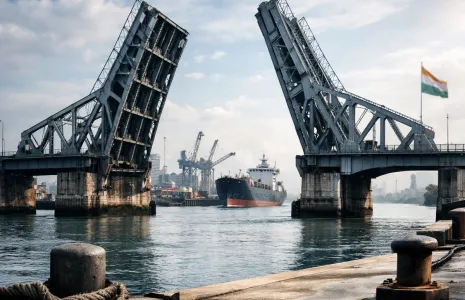
Kolkata Port Authority has signed an agreement with East Horizon to develop a floating storage and regasification unit for the Haldia terminal. The project is valued at Rs 260 crore, equivalent to Rs two point six billion (Rs two point six bn), and will involve deployment of a floating storage and regasification unit. The move is intended to expand the port's capacity to handle liquefied natural gas imports.

The floating storage and regasification unit will enable the direct offloading of LNG carriers and regasification of cargoes for onward supply to users in the region. The arrangement is expected to reduce logistical constraints associated with land based infrastructure and to provide greater flexibility in scheduling import cargoes. Port and company officials framed the project as part of efforts to enhance energy security and support industrial and commercial consumers.

The agreement covers responsibilities for berthing, mooring and connections to the shore based pipeline systems and will set out operational protocols and safety measures. Environmental clearances and technical approvals will be pursued as required under applicable regulations before commissioning. The parties will also address local employment and supply chain opportunities during construction and operation.

Stakeholders said the initiative could position Haldia as a strategic energy node in east India and help stabilise gas supplies for power generation and industrial use. The project financing and commercial terms were agreed between Kolkata Port Authority and East Horizon as part of the implementation pact. The port will continue to seek complementary investments to improve handling and storage facilities and to integrate the FSRU with existing terminal operations.

Officials indicated that the project will include capacity building for local personnel and training in operational and safety procedures to ensure effective management. Monitoring arrangements will be put in place to ensure compliance with environmental and maritime regulations. The port will report progress to stakeholders as the project advances.

Kolkata Port Authority has signed an agreement with East Horizon to develop a floating storage and regasification unit for the Haldia terminal. The project is valued at Rs 260 crore, equivalent to Rs two point six billion (Rs two point six bn), and will involve deployment of a floating storage and regasification unit. The move is intended to expand the port's capacity to handle liquefied natural gas imports. The floating storage and regasification unit will enable the direct offloading of LNG carriers and regasification of cargoes for onward supply to users in the region. The arrangement is expected to reduce logistical constraints associated with land based infrastructure and to provide greater flexibility in scheduling import cargoes. Port and company officials framed the project as part of efforts to enhance energy security and support industrial and commercial consumers. The agreement covers responsibilities for berthing, mooring and connections to the shore based pipeline systems and will set out operational protocols and safety measures. Environmental clearances and technical approvals will be pursued as required under applicable regulations before commissioning. The parties will also address local employment and supply chain opportunities during construction and operation. Stakeholders said the initiative could position Haldia as a strategic energy node in east India and help stabilise gas supplies for power generation and industrial use. The project financing and commercial terms were agreed between Kolkata Port Authority and East Horizon as part of the implementation pact. The port will continue to seek complementary investments to improve handling and storage facilities and to integrate the FSRU with existing terminal operations. Officials indicated that the project will include capacity building for local personnel and training in operational and safety procedures to ensure effective management. Monitoring arrangements will be put in place to ensure compliance with environmental and maritime regulations. The port will report progress to stakeholders as the project advances.

Next Story
Infrastructure Urban

Implementation Status of Jal Jeevan Mission

Since August 2019 the Government has implemented Jal Jeevan Mission to provide assured potable water through household tap connections in rural India. At the start of the mission only 32.3 million (mn) rural households, representing 16.7 per cent, were reported to have tap water connections. States and union territories have reported that 125.8 mn additional rural households have since been provided with tap connections. As a result, of about 193.6 mn rural households roughly 158.2 mn, or 81.71 per cent, are reported to have tap water supply at home.\n\nThe State, district and village level st..

Next Story
Infrastructure Urban

Jal Jeevan Mission Reaches Eighty One Per Cent Rural Coverage

The Government reported substantial progress under the Jal Jeevan Mission, launched in August 2019 to provide tap water to every rural household. At launch only 32.3 million (mn) rural households had tap connections and states and Union territories reported provision of 125.8 mn additional households by March 2026. Consequently, out of about 193.6 mn rural households around 158.2 mn, or 81.71 per cent, are reported to have tap water at home. The Finance Minister announced extension of the mission until 2028 in the 2025-26 budget speech. The Swachh Bharat Mission Grameen, launched in October 20..

Next Story
Infrastructure Urban

Empowering Local Governance for Sustainable Rural Water Supply

The Ministry of Jal Shakti has aligned the Jal Jeevan Mission (JJM) with the 73rd Amendment to strengthen village level planning and community ownership of water supply. Gram Panchayats, village water and sanitation committees and Pani Samitis are to plan, implement, manage and maintain piped water systems, with gram sabha processes formalising handover and oversight. Implementation support agencies including non government organisations, community based organisations and self help groups have been empanelled to train local committees and promote women participation. Under JJM, the department ..

Advertisement

Subscribe to Our Newsletter

Get daily newsletters around different themes from Construction world.

STAY CONNECTED

Advertisement

Advertisement

Advertisement