SECI Signs MoU With Mumbai Port Authority For Solar Power
PORTS & SHIPPING

SECI Signs MoU With Mumbai Port Authority For Solar Power

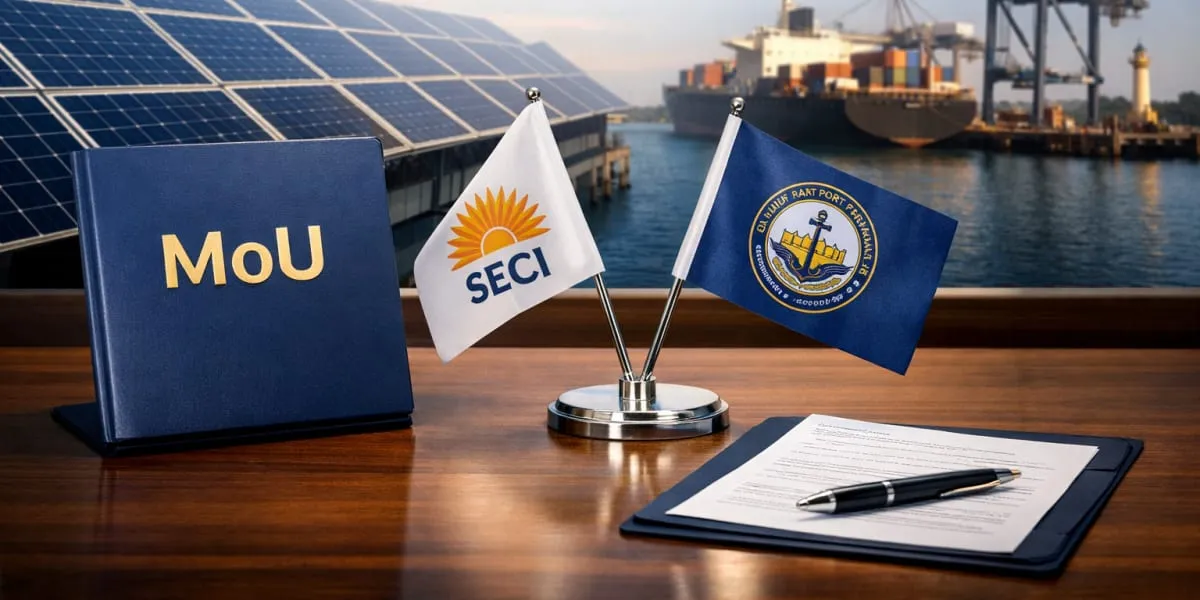
The Solar Energy Corporation of India (SECI) has signed a memorandum of understanding with the Mumbai Port Authority (MPA) to provide solar power across the authority's building infrastructure. The agreement sets out a framework for co-operation on assessments, project development and deployment of rooftop and other distributed solar installations on port properties. The arrangement aims to strengthen energy security and support the port's sustainability objectives.

Under the pact, SECI will lead technical studies and feasibility evaluations while the MPA will facilitate access to sites and regulatory clearances. The partners will explore models for project financing, including third party and captive arrangements, and will define responsibilities for procurement, installation and ongoing operation and maintenance. The collaboration is intended to reduce reliance on grid supplied fossil power and to demonstrate replicable delivery models for other port and maritime infrastructure. A joint steering committee will oversee implementation, set milestones and coordinate stakeholder consultation.

Officials said the initiative is expected to deliver cost benefits through reduced energy bills and to contribute to emissions mitigation at the port. The programme will also aim to enhance resilience by diversifying energy sources and by promoting local generation close to points of consumption. Capacity building and knowledge sharing are planned to enable maintenance and long term sustainability of installed systems.

The agreement provides for initial surveys and prioritisation of sites, followed by phased implementation and monitoring to ensure performance and compliance. Stakeholders will be engaged to align technical standards and to explore opportunities for scaling across other government owned maritime and logistics facilities. The partners expect initial pilots to inform broader rollouts and to attract investment suitable for faster realisation of renewable energy targets. The partners will publish progress updates to ensure transparency and to facilitate replication by other authorities.

The Solar Energy Corporation of India (SECI) has signed a memorandum of understanding with the Mumbai Port Authority (MPA) to provide solar power across the authority's building infrastructure. The agreement sets out a framework for co-operation on assessments, project development and deployment of rooftop and other distributed solar installations on port properties. The arrangement aims to strengthen energy security and support the port's sustainability objectives. Under the pact, SECI will lead technical studies and feasibility evaluations while the MPA will facilitate access to sites and regulatory clearances. The partners will explore models for project financing, including third party and captive arrangements, and will define responsibilities for procurement, installation and ongoing operation and maintenance. The collaboration is intended to reduce reliance on grid supplied fossil power and to demonstrate replicable delivery models for other port and maritime infrastructure. A joint steering committee will oversee implementation, set milestones and coordinate stakeholder consultation. Officials said the initiative is expected to deliver cost benefits through reduced energy bills and to contribute to emissions mitigation at the port. The programme will also aim to enhance resilience by diversifying energy sources and by promoting local generation close to points of consumption. Capacity building and knowledge sharing are planned to enable maintenance and long term sustainability of installed systems. The agreement provides for initial surveys and prioritisation of sites, followed by phased implementation and monitoring to ensure performance and compliance. Stakeholders will be engaged to align technical standards and to explore opportunities for scaling across other government owned maritime and logistics facilities. The partners expect initial pilots to inform broader rollouts and to attract investment suitable for faster realisation of renewable energy targets. The partners will publish progress updates to ensure transparency and to facilitate replication by other authorities.

Next Story
Equipment

MYCRANE Crosses 1,000 Customers in India

MYCRANE, the global platform for crane rental and purchase, has achieved major commercial milestones in India, reinforcing the country’s position as one of its fastest-growing strategic markets. The company has surpassed 1,000 registered customers and 1,000 crane suppliers nationwide, while completing more than 100 paid orders.The growth reflects rising adoption of digital procurement solutions across India’s construction, infrastructure, energy and industrial sectors. Equipment sourced through the platform is supporting projects across the country, with several leading contractors and EPC..

Next Story
Infrastructure Urban

AMTOE 2026 Opens Global Machine Tool Sourcing Hub

The Asian Machine Tool Online Exhibition 2026 (AMTOE 2026) has officially opened as a B2B sourcing platform connecting global buyers with verified Asian suppliers across the machine tool and manufacturing sector. The exhibition will run until 31 October 2026 through a hybrid online and offline model, offering extended sourcing and business networking opportunities.Co-organised by AsianNet and TradeAsia, the event aims to strengthen links between Asian manufacturers and international importers while improving cross-border procurement efficiency and supplier matching.Since launching in 2022, AMT..

Next Story
Infrastructure Energy

Vedanta Lifts Renewable Energy Use by Over 50%

On World Earth Day, Vedanta Limited announced that its renewable energy usage rose by over 50 per cent year on year to 3.97 billion units in FY26, helping avoid 3 million tonnes of carbon dioxide emissions.The company said its portfolio of metals, minerals, power, and oil & gas continues to support advanced manufacturing, electrification, energy transition and clean technology. Aluminium, copper and silver remain critical for applications such as mobility, power transmission, renewable infrastructure and solar photovoltaics, while iron, steel and zinc continue to support energy infrastruct..

Advertisement

Subscribe to Our Newsletter

Get daily newsletters around different themes from Construction world.

STAY CONNECTED

Advertisement

Advertisement

Advertisement