




CDS Inaugurates Two-Day CBRN Conclave in New Delhi
DEFENSE

CDS Inaugurates Two-Day CBRN Conclave in New Delhi

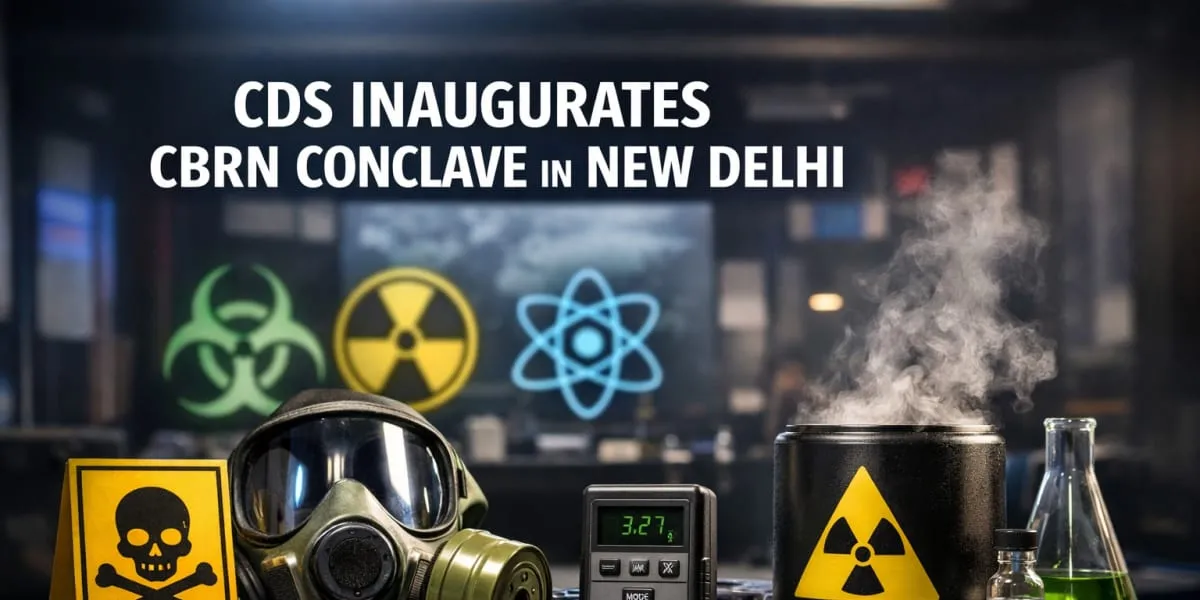
Defence Research and Development Organisation (DRDO) is organising a two-day Chemical, Biological, Radiological and Nuclear (CBRN) Conclave at Manekshaw Centre in New Delhi on February 26 and 27, 2026. The conference was inaugurated by the Chief of Defence Staff, General Anil Chauhan, and brings together experts and policymakers from the Armed Forces, central armed police forces and the National Disaster Response Force. The event aims to strengthen the national response to CBRN threats through exchange of operational experience and policy perspectives.

The Chief of Defence Staff commended the Defence Research and Development Organisation for progress towards self-reliance in technologies for defence against chemical, biological, radiological and nuclear hazards and said India will not be deterred by nuclear coercion. He emphasised that CBRN should be viewed as an environment in which forces must learn to operate and adapt. He underlined the need for indigenous early warning systems, lightweight individual protective equipment and well researched standard operating procedures to enable coordinated military and civilian operations.

Dr Samir V Kamat, Secretary, Department of Defence Research and Development and Chairman of the Defence Research and Development Organisation, reiterated the organisation's commitment to build national resilience through specialised laboratories and centres that develop advanced CBRN technologies. He urged participants to use the conclave for peer learning and to contribute to research that advances preparedness. The guest of honour, Director General of Armed Forces Medical Services, highlighted a joint training initiative between DRDO and the medical services which has enhanced capacity for medical management of radiological incidents. That initiative was described as improving availability of trained manpower across the services.

The Director General responsible for soldier support outlined the conclave's scope and urged stakeholders to develop operational scenarios that inform technology prioritisation. He stressed preparing comprehensive plans to guide product development at a pace relevant to emerging threats. The two-day meeting focused on enhancing national resilience by integrating user perspectives into training and promoting the infusion of sensors, artificial intelligence and machine learning into a network centric command and control framework for CBRN security and defence.

Defence Research and Development Organisation (DRDO) is organising a two-day Chemical, Biological, Radiological and Nuclear (CBRN) Conclave at Manekshaw Centre in New Delhi on February 26 and 27, 2026. The conference was inaugurated by the Chief of Defence Staff, General Anil Chauhan, and brings together experts and policymakers from the Armed Forces, central armed police forces and the National Disaster Response Force. The event aims to strengthen the national response to CBRN threats through exchange of operational experience and policy perspectives. The Chief of Defence Staff commended the Defence Research and Development Organisation for progress towards self-reliance in technologies for defence against chemical, biological, radiological and nuclear hazards and said India will not be deterred by nuclear coercion. He emphasised that CBRN should be viewed as an environment in which forces must learn to operate and adapt. He underlined the need for indigenous early warning systems, lightweight individual protective equipment and well researched standard operating procedures to enable coordinated military and civilian operations. Dr Samir V Kamat, Secretary, Department of Defence Research and Development and Chairman of the Defence Research and Development Organisation, reiterated the organisation's commitment to build national resilience through specialised laboratories and centres that develop advanced CBRN technologies. He urged participants to use the conclave for peer learning and to contribute to research that advances preparedness. The guest of honour, Director General of Armed Forces Medical Services, highlighted a joint training initiative between DRDO and the medical services which has enhanced capacity for medical management of radiological incidents. That initiative was described as improving availability of trained manpower across the services. The Director General responsible for soldier support outlined the conclave's scope and urged stakeholders to develop operational scenarios that inform technology prioritisation. He stressed preparing comprehensive plans to guide product development at a pace relevant to emerging threats. The two-day meeting focused on enhancing national resilience by integrating user perspectives into training and promoting the infusion of sensors, artificial intelligence and machine learning into a network centric command and control framework for CBRN security and defence.

Next Story
Infrastructure Urban

Häfele Unveils MatrixBox Premium+ Drawer System

Häfele has introduced the MatrixBox Premium+ Drawer System, a new solution designed to deliver hassle-free installation alongside reliable long-term performance. Developed with a focus on installer convenience and functionality, the system aims to streamline assembly while maintaining high standards of design and durability.A key feature of the MatrixBox Premium+ is the use of counter-sunk head screws for mounting runners, eliminating the need for pre-drilled cabinets. This enables a faster and cleaner installation process, with screws sitting flush against the runners to ensure a neat finish..

Next Story
Infrastructure Urban

BASF Expands Ultrason® P for EU food-contact Compliance

BASF has expanded its Ultrason® P portfolio to help manufacturers comply with the European Union’s Regulation 2024/3190, which restricts bisphenols in food-contact materials. The updated range of polyphenylsulfone (PPSU) grades is free from Bisphenol A (BPA) and Bisphenol S (BPS), enabling producers to re-qualify applications affected by the regulation within the defined transition timelines.The regulation, which came into force in January 2025, prohibits hazardous bisphenols and their derivatives in food-contact articles, with transition periods extending up to January 2028 depending on th..

Next Story
Infrastructure Urban

IIT (ISM)–OMC Partner for Sustainable Mining

IIT (ISM) Dhanbad, through the TEXMiN Foundation, has signed an MoU with Odisha Mining Corporation (OMC) to advance capacity building, research, and innovation in the mining sector. The collaboration aims to promote safe, sustainable, and digitally enabled mining practices while strengthening institutional capabilities.The partnership will focus on developing a continuous learning ecosystem, enhancing managerial capabilities, and driving research-led innovation. It also includes policy and compliance training, along with collaborative projects and case studies.As part of the initiative, Manage..

Advertisement

Subscribe to Our Newsletter

Get daily newsletters around different themes from Construction world.

STAY CONNECTED

Advertisement

Advertisement

Advertisement