





DRDO And Navy Complete Maiden Salvo Launch Of NASM-SR
DEFENSE

DRDO And Navy Complete Maiden Salvo Launch Of NASM-SR

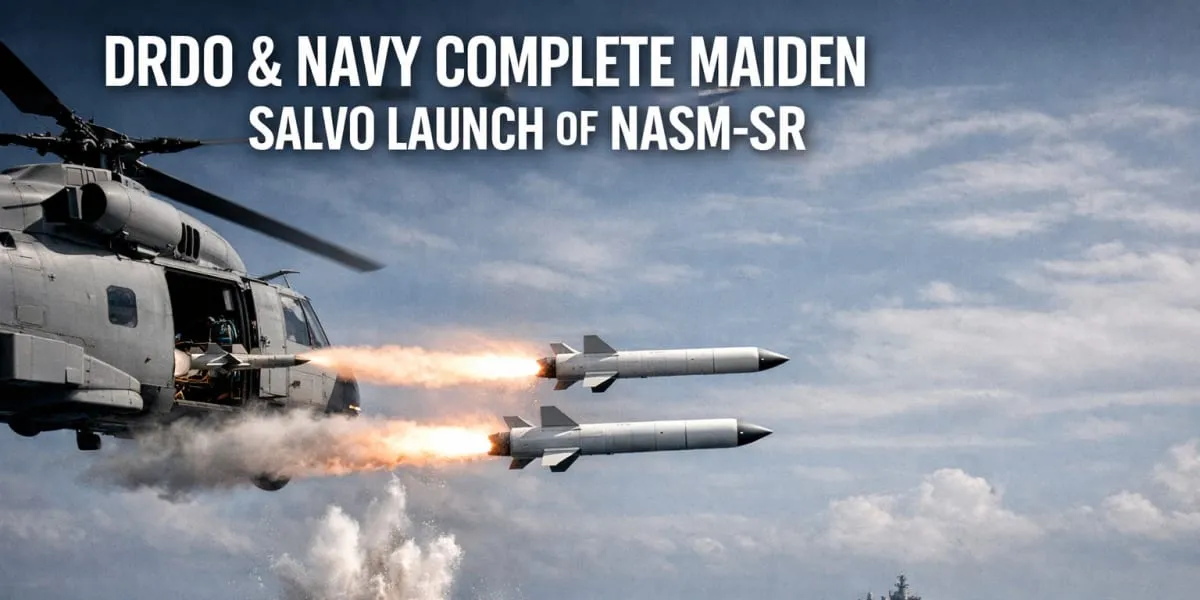
Defence Research and Development Organisation (DRDO) and the Indian Navy have successfully conducted the maiden salvo launch of the Naval Anti-ship Missile-Short Range (NASM-SR) from a naval helicopter off the coast of Odisha in the Bay of Bengal. During the trial two missiles were launched in quick succession from the same helicopter, marking the first salvo launch of an advanced air-launched anti-ship missile system. All test objectives were fully met according to data captured by range tracking instruments such as radar, electro-optical systems and telemetry deployed by the Integrated Test Range (ITR), Chandipur. The trial demonstrated both salvo launch capability and waterline hit performance under instrumented test conditions.

The launches were witnessed by senior scientists from DRDO, users' representatives from the Indian Navy and the Indian Air Force and Development-cum-Production Partners (DcPP). Test monitoring employed multiple tracking and measurement systems to corroborate performance parameters and trajectory data, with telemetry providing real-time mission diagnostics and recovery of post-flight data for analysis. The integrated instrumentation suite enabled validation of guidance, control and seeker performance across flight phases.

The NASM-SR employs a solid propulsion booster and a long-burn sustainer to achieve the required flight profile. Critical subsystems developed indigenously include the seeker, an integrated avionics module, advanced navigation and guidance using a fibre-optic gyroscope-based Inertial Navigation System (INS) and a radio-altimeter, together with control and guidance algorithms, a high-bandwidth two-way data link and jet-vane control. These elements were developed by multiple DRDO laboratories and Indian industry partners to meet mission reliability and accuracy requirements.

The missile system was led by Research Centre Imarat in Hyderabad in collaboration with Defence Research and Development Laboratory, Hyderabad; High Energy Materials Research Laboratory, Pune; Terminal Ballistics Research Laboratory, Chandigarh; and ITR Chandipur. Production is underway through DcPP with support from Indian industries and start-ups. Raksha Mantri Rajnath Singh complimented DRDO, the armed services and industry partners for the successful validation and indicated the development will further enhance defence capabilities, while the Secretary Department of Defence R&D and Chairman DRDO congratulated the teams involved.

Defence Research and Development Organisation (DRDO) and the Indian Navy have successfully conducted the maiden salvo launch of the Naval Anti-ship Missile-Short Range (NASM-SR) from a naval helicopter off the coast of Odisha in the Bay of Bengal. During the trial two missiles were launched in quick succession from the same helicopter, marking the first salvo launch of an advanced air-launched anti-ship missile system. All test objectives were fully met according to data captured by range tracking instruments such as radar, electro-optical systems and telemetry deployed by the Integrated Test Range (ITR), Chandipur. The trial demonstrated both salvo launch capability and waterline hit performance under instrumented test conditions. The launches were witnessed by senior scientists from DRDO, users' representatives from the Indian Navy and the Indian Air Force and Development-cum-Production Partners (DcPP). Test monitoring employed multiple tracking and measurement systems to corroborate performance parameters and trajectory data, with telemetry providing real-time mission diagnostics and recovery of post-flight data for analysis. The integrated instrumentation suite enabled validation of guidance, control and seeker performance across flight phases. The NASM-SR employs a solid propulsion booster and a long-burn sustainer to achieve the required flight profile. Critical subsystems developed indigenously include the seeker, an integrated avionics module, advanced navigation and guidance using a fibre-optic gyroscope-based Inertial Navigation System (INS) and a radio-altimeter, together with control and guidance algorithms, a high-bandwidth two-way data link and jet-vane control. These elements were developed by multiple DRDO laboratories and Indian industry partners to meet mission reliability and accuracy requirements. The missile system was led by Research Centre Imarat in Hyderabad in collaboration with Defence Research and Development Laboratory, Hyderabad; High Energy Materials Research Laboratory, Pune; Terminal Ballistics Research Laboratory, Chandigarh; and ITR Chandipur. Production is underway through DcPP with support from Indian industries and start-ups. Raksha Mantri Rajnath Singh complimented DRDO, the armed services and industry partners for the successful validation and indicated the development will further enhance defence capabilities, while the Secretary Department of Defence R&D and Chairman DRDO congratulated the teams involved.

Next Story
Infrastructure Urban

Meghalaya And Assam Hold Talks To End Transport Stoppages In Garo Hills

Meghalaya and Assam have opened talks aimed at ending recent stoppages of commodity transport in the Garo Hills, officials said. The deputy chief minister, in charge of home affairs, reported that both state governments are coordinating to resolve disruptions and to restore normal movement of goods. He acknowledged that misunderstandings may have contributed to the incidents and that clarification between administrative units is under way. The discussions are intended to produce practical arrangements that will allow consignments to move without hindrance while respecting local procedures. The..

Next Story
Infrastructure Transport

Kochi Metro Records 1.375 mn Rise In Passengers In FY26

Kochi Metro recorded a marginal rise in ridership in the financial year 2025-26, carrying 1.375 mn more passengers than in the previous year. The service carried 36.8 million (mn) passengers in 2025-26 compared with 35.5 mn in 2024-25, representing a year-on-year increase of 3.9 per cent. The growth was described as distributed rather than concentrated in isolated spikes. A month-wise analysis shows steady gains across quarters. In the first quarter, ridership increased from 8.57 mn to 8.84 mn, while the second quarter rose from 9.13 mn to 9.51 mn. These trends indicated broad-based improvemen..

Next Story
Infrastructure Transport

Ghaziabad Plans 16km Metro Link To Delhi Via Hindon Airport

Ghaziabad authorities are pursuing a 16 km metro link to Delhi that will run via Hindon Airport, and a detailed project report is under way. The plan is intended to improve connectivity between Ghaziabad and the national capital and to provide an interchange with the airport. Officials said the project is being studied to assess alignments, station locations and cost estimates ahead of formal approvals and tendering. The announcement follows the inauguration of the Delhi?Faridabad metro extension, which will offer hassle free travel for around 0.2 mn daily commuters between the national capita..

Advertisement

Subscribe to Our Newsletter

Get daily newsletters around different themes from Construction world.

STAY CONNECTED

Advertisement

Advertisement

Advertisement











