


Indigenous Stealth Frigate Dunagiri Delivered to Indian Navy
DEFENSE

Indigenous Stealth Frigate Dunagiri Delivered to Indian Navy

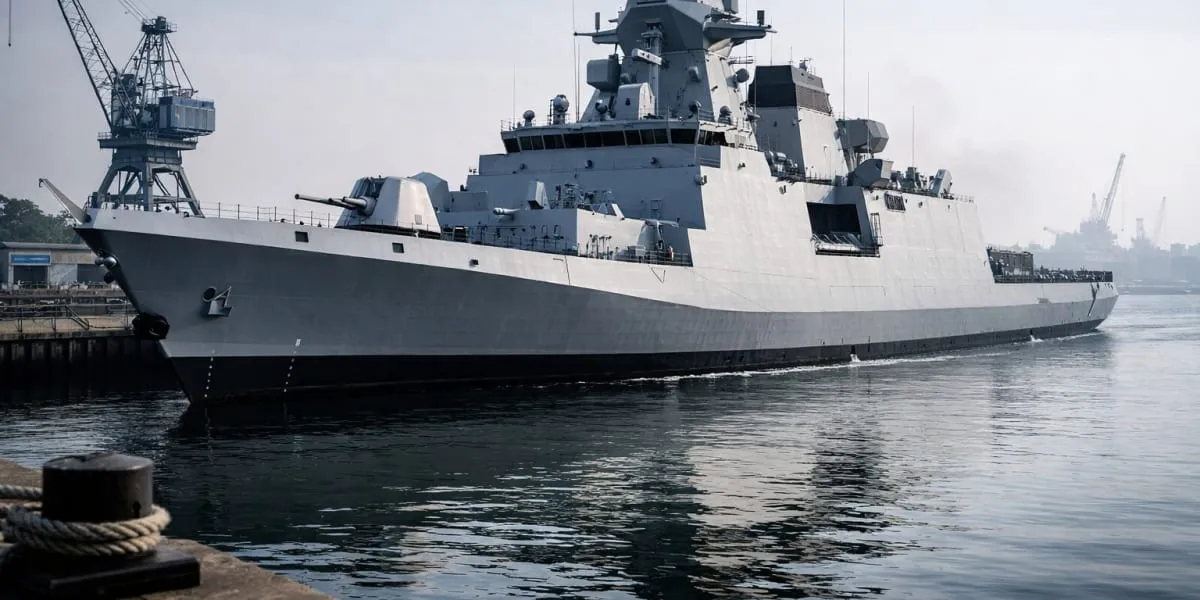
The Indian Navy took delivery of the indigenous stealth frigate Dunagiri, the fifth Nilgiri class ship of Project 17A (P17A) and the second of the class built at Garden Reach Shipbuilding and Engineers Ltd (GRSE), on 30 March 2026 at GRSE. The ship was presented by officials as a major milestone in achieving self?reliance in warship design and construction. Project 17A frigates are versatile multi?mission platforms designed to address current and future challenges in the maritime domain.

Dunagiri is a reincarnation of the erstwhile INS Dunagiri, a Leander class frigate that served from five May 1977 to 10 October 2010, rendering 33 years of service to the nation. The state?of?the?art frigate reflects a generational leap in naval design, stealth, firepower, automation and survivability and is cited as an admirable symbol of Aatmanirbharta in warship building. The design was produced by the Warship Design Bureau (WDB) and its construction was overseen by the Warship Overseeing Team following the philosophy of Integrated Construction.

P17A ships have an advanced weapons and sensors suite compared with the P17 Shivalik class and use Combined Diesel or Gas (CODOG) propulsion, with a diesel engine and a gas turbine driving a Controllable Pitch Propeller (CPP) on each shaft and a state?of?the?art Integrated Platform Management System (IPMS). The weapons and sensors include the BrahMos surface?to?surface missile, the MFSTAR radar and the MRSAM complex, a 76 mm gun, a combination of 30 mm and 12.7 mm close?in weapons systems, and rockets and torpedoes for anti?submarine warfare. These capabilities enhance survivability and combat effectiveness in maritime environments.

Dunagiri is the fifth P17A ship delivered to the Navy in the last 16 months, with lessons from the first four ships reducing the build period to 80 months from 93 for the lead ship Nilgiri. The project has an indigenisation content of 75 per cent, involved over 200 micro, small and medium enterprises (MSMEs) and generated about 4,000 jobs directly and more than 10,000 indirectly. The delivery showcases the nation’s design and shipbuilding prowess and reflects the Navy’s focus on Aatmanirbharta.

The Indian Navy took delivery of the indigenous stealth frigate Dunagiri, the fifth Nilgiri class ship of Project 17A (P17A) and the second of the class built at Garden Reach Shipbuilding and Engineers Ltd (GRSE), on 30 March 2026 at GRSE. The ship was presented by officials as a major milestone in achieving self?reliance in warship design and construction. Project 17A frigates are versatile multi?mission platforms designed to address current and future challenges in the maritime domain. Dunagiri is a reincarnation of the erstwhile INS Dunagiri, a Leander class frigate that served from five May 1977 to 10 October 2010, rendering 33 years of service to the nation. The state?of?the?art frigate reflects a generational leap in naval design, stealth, firepower, automation and survivability and is cited as an admirable symbol of Aatmanirbharta in warship building. The design was produced by the Warship Design Bureau (WDB) and its construction was overseen by the Warship Overseeing Team following the philosophy of Integrated Construction. P17A ships have an advanced weapons and sensors suite compared with the P17 Shivalik class and use Combined Diesel or Gas (CODOG) propulsion, with a diesel engine and a gas turbine driving a Controllable Pitch Propeller (CPP) on each shaft and a state?of?the?art Integrated Platform Management System (IPMS). The weapons and sensors include the BrahMos surface?to?surface missile, the MFSTAR radar and the MRSAM complex, a 76 mm gun, a combination of 30 mm and 12.7 mm close?in weapons systems, and rockets and torpedoes for anti?submarine warfare. These capabilities enhance survivability and combat effectiveness in maritime environments. Dunagiri is the fifth P17A ship delivered to the Navy in the last 16 months, with lessons from the first four ships reducing the build period to 80 months from 93 for the lead ship Nilgiri. The project has an indigenisation content of 75 per cent, involved over 200 micro, small and medium enterprises (MSMEs) and generated about 4,000 jobs directly and more than 10,000 indirectly. The delivery showcases the nation’s design and shipbuilding prowess and reflects the Navy’s focus on Aatmanirbharta.

Next Story
Infrastructure Transport

Sector 51-52 Metro skywalk in Noida remains shut despite being ready for over a year

Thousands of commuters travelling between Delhi Metro Rail Corporation’s (DMRC) Sector 52 station and Noida Metro Rail Corporation’s (NMRC) Sector 51 station continue to face daily inconvenience as the 300-metre air-conditioned skywalk connecting the two stations remains closed, despite being completed over a year ago, according to a report.The Noida Metro Rail Corporation built the foot overbridge to enable a seamless interchange between the Delhi Metro and Noida Metro networks. However, pending finishing work and a structural obstruction have delayed its opening.Krishna Karunesh, Chief E..

Next Story
Infrastructure Transport

Maharashtra clears Metro Line 5A, expansion of Mumbai Metro Line 5

The Maharashtra government has approved the expansion of Mumbai Metro Line 5 along with a new integrated corridor, Metro Line 5A, forming a combined 34.2-km metro network across the Thane-Bhiwandi-Kalyan-Ulhasnagar belt. The integrated project has been cleared at an estimated cost of ₹18,130.55 crore, according to a government resolution (GR).Metro Line 5 was originally approved in October 2017 as a 24.9-km fully elevated corridor with 17 stations connecting Thane, Bhiwandi and Kalyan, with an initial project cost of ₹8,416.51 crore. The corridor is being developed in two phases.The first ..

Next Story
Infrastructure Transport

Bengaluru Metro expansion seen driving office demand

Bengaluru’s expanding metro network is expected to emerge as a major catalyst for real estate growth, with the Yellow and Pink Lines likely to boost both office demand and residential prices across key micro-markets, according to a report by Colliers India.The report estimates that over the next two years, Bengaluru could witness an additional 5–7 million sq ft of Grade A office space demand across the Central Business District (CBD), Secondary Business District (SBD) and Electronic City. Improved metro connectivity and reduced commute times are expected to drive higher occupier interest a..

Advertisement

Subscribe to Our Newsletter

Get daily newsletters around different themes from Construction world.

STAY CONNECTED

Advertisement

Advertisement

Advertisement