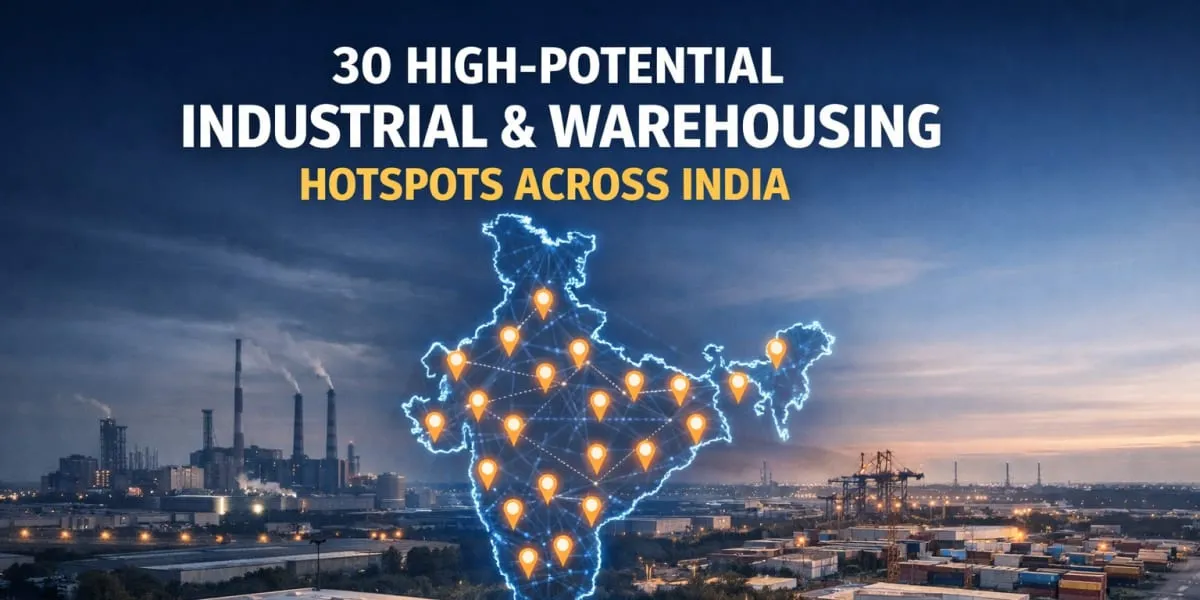
30 High-Potential Industrial And Warehousing Hotspots Across India
WAREHOUSING & LOGISTICS

30 High-Potential Industrial And Warehousing Hotspots Across India

A new report identified 30 high-potential industrial and warehousing hotspots across India driven by infrastructure expansion, manufacturing growth and a policy push. Colliers India found that eight out of 30 cities are established markets and identified 22 additional emerging and nascent hubs. The selection used an in-house analytical framework built around five key parameters and mapped government-recognised industrial hubs. The study said the distribution aims to disperse economic activity beyond traditional centres.

The framework prioritised enhanced connectivity along industrial and freight corridors, upcoming smart industrial cities, proposed Multi-Modal Logistics Parks (MMLPs), sea and airport linkages and large integrated textile hubs. These enablers were assessed for their potential to unlock land, reduce logistics lead times and attract manufacturing investment. The report noted that multimodal projects and corridor linkages can create concentrated demand for modern warehouse stock.

Manufacturing currently contributes 17 per cent of gross domestic product and is projected to rise to about 25 per cent by 2035, which is expected to drive long-term warehousing demand. Colliers India said institutional investors are showing strong interest in modern, efficient warehouses as an asset class. The managing director for industrial and logistics services at Colliers India indicated that the next wave of growth will be strengthened by expanding corridors, MMLPs, smart industrial cities and major sea–airport projects. The recent budget focus on dispersing growth and an allocation of Rs 50,000 mn per City Economic Regions (CER) were identified as supportive measures.

The hotspots span northern, southern, western, eastern and central regions, reflecting an equitable geographic spread. The eight prime hubs are expected to consolidate their lead and absorb new capacity rapidly, with demand across the top eight cities able to cross 50 mn square feet by 2030. The 12 emerging hubs are likely to gain momentum as infrastructure comes online, while the 10 nascent hubs will depend on infrastructure adequacy, policy support and investor readiness before momentum builds.

A new report identified 30 high-potential industrial and warehousing hotspots across India driven by infrastructure expansion, manufacturing growth and a policy push. Colliers India found that eight out of 30 cities are established markets and identified 22 additional emerging and nascent hubs. The selection used an in-house analytical framework built around five key parameters and mapped government-recognised industrial hubs. The study said the distribution aims to disperse economic activity beyond traditional centres. The framework prioritised enhanced connectivity along industrial and freight corridors, upcoming smart industrial cities, proposed Multi-Modal Logistics Parks (MMLPs), sea and airport linkages and large integrated textile hubs. These enablers were assessed for their potential to unlock land, reduce logistics lead times and attract manufacturing investment. The report noted that multimodal projects and corridor linkages can create concentrated demand for modern warehouse stock. Manufacturing currently contributes 17 per cent of gross domestic product and is projected to rise to about 25 per cent by 2035, which is expected to drive long-term warehousing demand. Colliers India said institutional investors are showing strong interest in modern, efficient warehouses as an asset class. The managing director for industrial and logistics services at Colliers India indicated that the next wave of growth will be strengthened by expanding corridors, MMLPs, smart industrial cities and major sea–airport projects. The recent budget focus on dispersing growth and an allocation of Rs 50,000 mn per City Economic Regions (CER) were identified as supportive measures. The hotspots span northern, southern, western, eastern and central regions, reflecting an equitable geographic spread. The eight prime hubs are expected to consolidate their lead and absorb new capacity rapidly, with demand across the top eight cities able to cross 50 mn square feet by 2030. The 12 emerging hubs are likely to gain momentum as infrastructure comes online, while the 10 nascent hubs will depend on infrastructure adequacy, policy support and investor readiness before momentum builds.

Next Story
Real Estate

Housing Sales Dip 7 per cent QoQ Across Top Cities

India’s housing market saw a 7 per cent quarter-on-quarter decline in sales across the top seven cities in Q1 2026, with approximately 1,01,675 units sold compared to 1,08,970 units in Q4 2025, according to ANAROCK Group. However, on a yearly basis, sales rose 9 per cent, indicating continued underlying demand.The total sales value stood at around Rs 1.51 trillion, reflecting a 5 per cent quarterly drop but a 6 per cent annual increase. Mumbai Metropolitan Region and Bengaluru together accounted for nearly 48 per cent of total sales, while Chennai recorded the highest quarterly decline at 18..

Next Story
Real Estate

Birla Estates Enters Mumbai Redevelopment

Birla Estates has announced its entry into Mumbai’s redevelopment segment with a luxury residential project in Khar West, developed in partnership with Parinee Real Estate Builders. The project will redevelop Anmol Co-operative Housing Society and Bhartiya Bhavan Co-operative Housing Society, marking the company’s first redevelopment initiative in the Mumbai Metropolitan Region.Spread across 1.3 acres, the development will offer a saleable area of 2.9 lakh sq ft with an estimated revenue potential of Rs 17 billion. Positioned in one of Mumbai’s prime residential micro-markets, the projec..

Next Story
Infrastructure Urban

Hitachi, MUFG Expand EV Financing Model

Hitachi and MUFG Bank have expanded their NextGen business co-creation model to accelerate decarbonised mobility by financing electric vehicles and charging infrastructure. The renewed collaboration aims to address key barriers to electrification, including limited access to capital and the need for integrated energy solutions.Building on earlier partnerships, the expanded model extends beyond battery-focused solutions to include electric mobility assets, charging systems and energy management infrastructure across global markets. The initiative will leverage structured financing through speci..

Advertisement

Subscribe to Our Newsletter

Get daily newsletters around different themes from Construction world.

STAY CONNECTED

Advertisement

Advertisement

Advertisement