+
North East Logistics Policy Alignment Under PM GatiShakti
WAREHOUSING & LOGISTICS

North East Logistics Policy Alignment Under PM GatiShakti

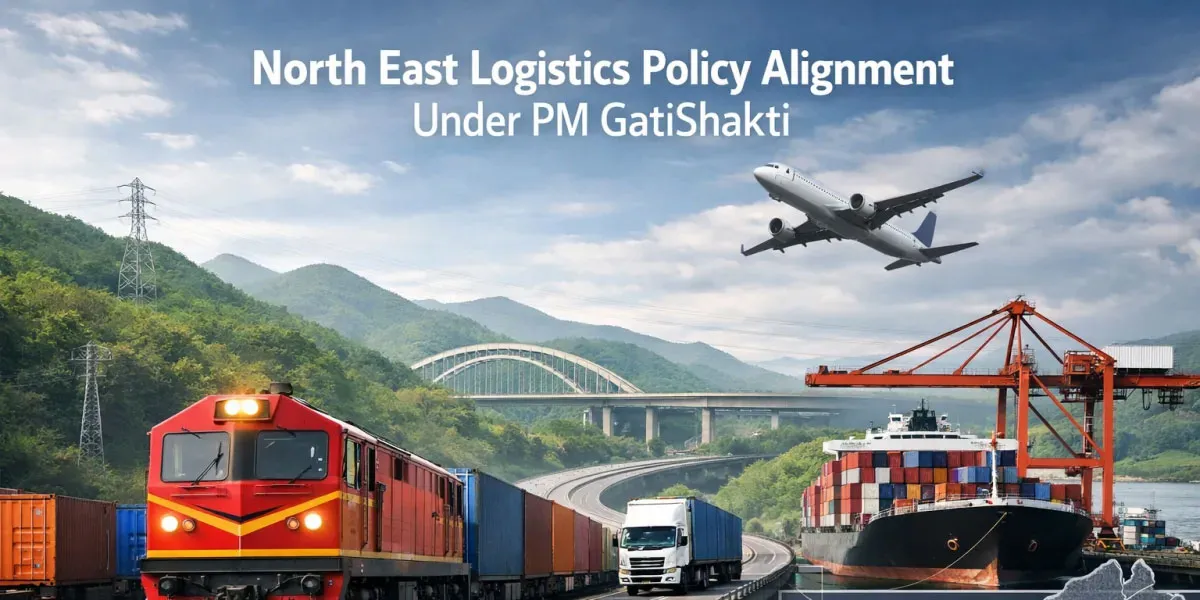
The Department for Promotion of Industry and Internal Trade (DPIIT) is mandated to develop the logistics sector nationally and leads an inter?ministerial coordination mechanism to align initiatives in the North Eastern Region with connectivity, trade and industrial policy. The framework is anchored in the Prime Minister GatiShakti National Master Plan (PM GatiShakti), launched in October 2021, which enables integrated planning. The approach seeks to harmonise logistics initiatives with wider economic and connectivity objectives.

An Inter?Ministerial Committee (IMC) was constituted by the Ministry of Development of North Eastern Region (MDoNER) in July 2024 after the 71st Plenary of the North Eastern Council to assess the logistics ecosystem and recommend measures. A Steering Group under MDoNER monitors implementation and includes representatives of DPIIT (Logistics Division), concerned line ministries and the eight North Eastern states. The mechanism aims to improve coordination of planning and project delivery across jurisdictions.

The Ministry of External Affairs (MEA) has noted that, under India’s Act East and Neighbourhood First policies, two connectivity projects through Myanmar are under implementation to improve access to Association of Southeast Asian Nations markets: the Kaladan Multi Modal Transit Transport and the India?Myanmar?Thailand Trilateral Highway. Improved rail, road and inland waterway links with Bangladesh are cited as enhancing connectivity for the North Eastern Region and supporting sub?regional integration. Institutional arrangements such as joint working groups on trade, sub?groups on land customs stations and integrated check post infrastructure, and joint committees on border haats facilitate coordination with Bangladesh.

The roadmap aims to position the North Eastern Region as a logistics and trade gateway through coordinated policy planning, institutional mechanisms and strengthened physical connectivity. PM GatiShakti?based planning supports integrated geospatial mapping of multimodal connectivity, industrial clusters, logistics parks, border infrastructure and economic assets, while line ministries implement priority projects to address gaps. The Minister of State in MDoNER provided this information in a written reply to a question in the Lok Sabha.

The Department for Promotion of Industry and Internal Trade (DPIIT) is mandated to develop the logistics sector nationally and leads an inter?ministerial coordination mechanism to align initiatives in the North Eastern Region with connectivity, trade and industrial policy. The framework is anchored in the Prime Minister GatiShakti National Master Plan (PM GatiShakti), launched in October 2021, which enables integrated planning. The approach seeks to harmonise logistics initiatives with wider economic and connectivity objectives. An Inter?Ministerial Committee (IMC) was constituted by the Ministry of Development of North Eastern Region (MDoNER) in July 2024 after the 71st Plenary of the North Eastern Council to assess the logistics ecosystem and recommend measures. A Steering Group under MDoNER monitors implementation and includes representatives of DPIIT (Logistics Division), concerned line ministries and the eight North Eastern states. The mechanism aims to improve coordination of planning and project delivery across jurisdictions. The Ministry of External Affairs (MEA) has noted that, under India’s Act East and Neighbourhood First policies, two connectivity projects through Myanmar are under implementation to improve access to Association of Southeast Asian Nations markets: the Kaladan Multi Modal Transit Transport and the India?Myanmar?Thailand Trilateral Highway. Improved rail, road and inland waterway links with Bangladesh are cited as enhancing connectivity for the North Eastern Region and supporting sub?regional integration. Institutional arrangements such as joint working groups on trade, sub?groups on land customs stations and integrated check post infrastructure, and joint committees on border haats facilitate coordination with Bangladesh. The roadmap aims to position the North Eastern Region as a logistics and trade gateway through coordinated policy planning, institutional mechanisms and strengthened physical connectivity. PM GatiShakti?based planning supports integrated geospatial mapping of multimodal connectivity, industrial clusters, logistics parks, border infrastructure and economic assets, while line ministries implement priority projects to address gaps. The Minister of State in MDoNER provided this information in a written reply to a question in the Lok Sabha.

Next Story
Infrastructure Urban

Implementation Status of Jal Jeevan Mission

Since August 2019 the Government has implemented Jal Jeevan Mission to provide assured potable water through household tap connections in rural India. At the start of the mission only 32.3 million (mn) rural households, representing 16.7 per cent, were reported to have tap water connections. States and union territories have reported that 125.8 mn additional rural households have since been provided with tap connections. As a result, of about 193.6 mn rural households roughly 158.2 mn, or 81.71 per cent, are reported to have tap water supply at home.\n\nThe State, district and village level st..

Next Story
Infrastructure Urban

Jal Jeevan Mission Reaches Eighty One Per Cent Rural Coverage

The Government reported substantial progress under the Jal Jeevan Mission, launched in August 2019 to provide tap water to every rural household. At launch only 32.3 million (mn) rural households had tap connections and states and Union territories reported provision of 125.8 mn additional households by March 2026. Consequently, out of about 193.6 mn rural households around 158.2 mn, or 81.71 per cent, are reported to have tap water at home. The Finance Minister announced extension of the mission until 2028 in the 2025-26 budget speech. The Swachh Bharat Mission Grameen, launched in October 20..

Next Story
Infrastructure Urban

Empowering Local Governance for Sustainable Rural Water Supply

The Ministry of Jal Shakti has aligned the Jal Jeevan Mission (JJM) with the 73rd Amendment to strengthen village level planning and community ownership of water supply. Gram Panchayats, village water and sanitation committees and Pani Samitis are to plan, implement, manage and maintain piped water systems, with gram sabha processes formalising handover and oversight. Implementation support agencies including non government organisations, community based organisations and self help groups have been empanelled to train local committees and promote women participation. Under JJM, the department ..

Advertisement

Subscribe to Our Newsletter

Get daily newsletters around different themes from Construction world.

STAY CONNECTED

Advertisement

Advertisement

Advertisement