CAQM Reviews Air Quality Measures, GRAP And Enforcement
WATER & WASTE

CAQM Reviews Air Quality Measures, GRAP And Enforcement

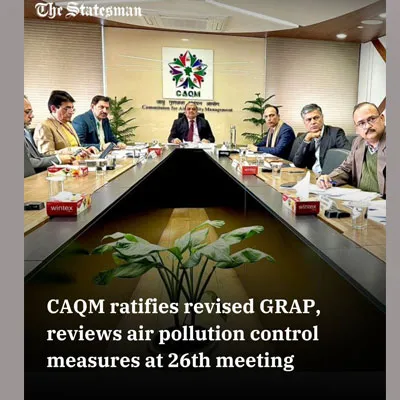
The Commission for Air Quality Management held its 26th full meeting on 22 December 2025 under the chairmanship of Rajesh Verma, reviewing key regulatory, enforcement and planning measures to curb air pollution across Delhi-NCR. The Commission adopted its Annual Report and audited accounts for 2024–25, along with the separate audit report and associated action points.

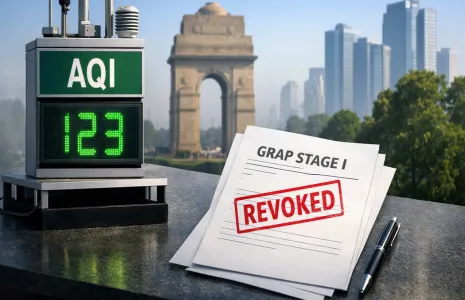
The meeting ratified the revised Graded Response Action Plan dated 21 November 2025, modified in line with Supreme Court directions, ensuring that higher GRAP stages subsume actions under earlier stages. The Commission reviewed GRAP implementation during the current season, including measures across stages and additional actions under Stages I and II such as uninterrupted power supply, traffic decongestion, public advisories and augmentation of public transport.

Members approved the constitution of an expert committee on vehicular emissions under the chairmanship of Prof Ashok Jhunjhunwala of IIT Madras, with terms of reference covering emissions assessment, health impacts, clean mobility pathways, electric vehicle readiness and regulatory measures. The Commission also discussed amendments to Direction No. 94 dated 3 June 2025 to accelerate adoption of zero-emission vehicles by motor vehicle aggregators, delivery service providers and e-commerce entities. Transitional provisions were considered to allow induction of BS-VI petrol two-wheelers into existing fleets up to 31 December 2026, while maintaining restrictions on conventional internal combustion engine vehicles in other categories from 1 January 2026.

Reviewing the status of paddy stubble burning in 2025, the Commission noted a significant reduction of about 92 per cent across the NCR compared with 2021, attributed to integrated monitoring and enforcement. Punjab, Haryana and Uttar Pradesh were directed to prepare state action plans for monitoring and enforcement of wheat residue burning for the 2026 harvesting season, based on which statutory directions will be issued.

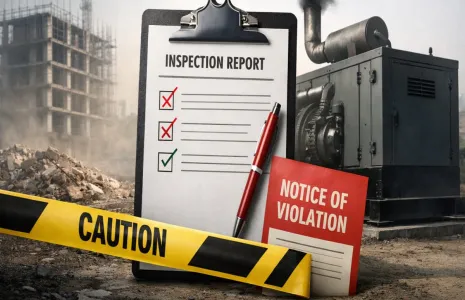
The Commission examined enforcement actions by the Enforcement Task Force, including closures and resumptions of industrial units and the status of complaints and prosecutions. It also reviewed construction and demolition waste management, noting that dust from such activities remains a major contributor to PM10 and PM2.5 levels. Municipal bodies and development authorities were urged to strengthen supervision, establish collection, storage and processing facilities, verify waste disposal prior to granting construction permissions and ensure robust environmental management of C&D waste.

On end-of-life vehicles, the Commission took note of the Supreme Court order dated 17 December 2025, under which protection against coercive action continues for BS-IV and later vehicles, while restrictions on action against highly polluting BS-III and lower-standard vehicles have been lifted. Enforcement agencies were directed to ensure strict compliance.

The Commission reiterated the need for continued vigilance, coordinated enforcement and effective implementation of statutory directions across sectors, particularly during winter, with agencies committing to regular reviews and strict action, including under GRAP.

The Commission for Air Quality Management held its 26th full meeting on 22 December 2025 under the chairmanship of Rajesh Verma, reviewing key regulatory, enforcement and planning measures to curb air pollution across Delhi-NCR. The Commission adopted its Annual Report and audited accounts for 2024–25, along with the separate audit report and associated action points. The meeting ratified the revised Graded Response Action Plan dated 21 November 2025, modified in line with Supreme Court directions, ensuring that higher GRAP stages subsume actions under earlier stages. The Commission reviewed GRAP implementation during the current season, including measures across stages and additional actions under Stages I and II such as uninterrupted power supply, traffic decongestion, public advisories and augmentation of public transport. Members approved the constitution of an expert committee on vehicular emissions under the chairmanship of Prof Ashok Jhunjhunwala of IIT Madras, with terms of reference covering emissions assessment, health impacts, clean mobility pathways, electric vehicle readiness and regulatory measures. The Commission also discussed amendments to Direction No. 94 dated 3 June 2025 to accelerate adoption of zero-emission vehicles by motor vehicle aggregators, delivery service providers and e-commerce entities. Transitional provisions were considered to allow induction of BS-VI petrol two-wheelers into existing fleets up to 31 December 2026, while maintaining restrictions on conventional internal combustion engine vehicles in other categories from 1 January 2026. Reviewing the status of paddy stubble burning in 2025, the Commission noted a significant reduction of about 92 per cent across the NCR compared with 2021, attributed to integrated monitoring and enforcement. Punjab, Haryana and Uttar Pradesh were directed to prepare state action plans for monitoring and enforcement of wheat residue burning for the 2026 harvesting season, based on which statutory directions will be issued. The Commission examined enforcement actions by the Enforcement Task Force, including closures and resumptions of industrial units and the status of complaints and prosecutions. It also reviewed construction and demolition waste management, noting that dust from such activities remains a major contributor to PM10 and PM2.5 levels. Municipal bodies and development authorities were urged to strengthen supervision, establish collection, storage and processing facilities, verify waste disposal prior to granting construction permissions and ensure robust environmental management of C&D waste. On end-of-life vehicles, the Commission took note of the Supreme Court order dated 17 December 2025, under which protection against coercive action continues for BS-IV and later vehicles, while restrictions on action against highly polluting BS-III and lower-standard vehicles have been lifted. Enforcement agencies were directed to ensure strict compliance. The Commission reiterated the need for continued vigilance, coordinated enforcement and effective implementation of statutory directions across sectors, particularly during winter, with agencies committing to regular reviews and strict action, including under GRAP.

Next Story
Real Estate

Modon, Related, Panepinto form JV for Harborside 4 in Jersey City

Abu Dhabi-based Modon Holding PSC has formed a joint venture with US real estate major Related Companies and Jersey City-based Panepinto Properties to develop Harborside 4, a 54-storey luxury residential tower on a prime waterfront site in downtown Jersey City, New Jersey.Under the partnership, Modon will hold a majority equity stake alongside Related and Panepinto, marking another step in the group’s strategy to scale and diversify its global real estate portfolio. The project will be developed on one of the last remaining premium waterfront parcels in the city.Designed by Handel Architects..

Next Story
Infrastructure Urban

P+Ex and Post-Tensioning Institute partner to drive sustainability

P+Ex, the Center of Excellence for Concrete Preservation and Service Life Extension, has announced a strategic partnership with the Post-Tensioning Institute (PTI) aimed at advancing sustainability, durability, and resilience in the built environment.The collaboration brings together P+Ex’s expertise in concrete preservation, repair, and service life extension with PTI’s global leadership in post-tensioning technology. Through this alliance, the two organisations will work to advance best practices in durability-focused design for new structures, while also promoting effective repair, reha..

Next Story
Infrastructure Energy

India’s Largest 2,000 MW Subansiri Hydro Project Turns Operational

India’s largest hydropower project, the 2,000 MW Subansiri Lower Hydroelectric Project, has finally become operational with the commissioning of its first unit, marking a major milestone after nearly 20 years of development marked by delays, protests and cost escalation.The 250 MW Unit-2 of the project, located on the Subansiri River at Gerukamukh on the Assam–Arunachal Pradesh border, was virtually inaugurated from New Delhi by Union Minister of Power Manohar Lal Khattar. The event was attended by Pankaj Agarwal, Secretary (Power), and Bhupender Gupta, Chairman and Managing Director, Nati..

Advertisement

Subscribe to Our Newsletter

Get daily newsletters around different themes from Construction world.

STAY CONNECTED

Advertisement

Advertisement

Advertisement

Advertisement

Open In App