CSMC Secures Rs 8.2 Billion Loan For City Water Supply Project
WATER & WASTE

CSMC Secures Rs 8.2 Billion Loan For City Water Supply Project

The Chhatrapati Sambhajinagar Municipal Corporation (CSMC) has received approval for a Rs 8.2 billion loan as its contribution towards the city’s Rs 27.4 billion water supply scheme, marking a crucial milestone in the long-awaited project.

CSMC Commissioner and Administrator G. Sreekanth signed the loan agreement with the Maharashtra Urban Infrastructure Development Company in Mumbai on Thursday, paving the way for the completion of the city’s ambitious water supply plan under the Amrut-2 scheme.

The project, valued at Rs 27.4 billion, is being implemented by the Maharashtra Jeevan Pradhikaran (MJP), which has appointed GVPR Company, Hyderabad, as the contractor. The work is currently in its final stages.

Under the funding structure, the central government will contribute 25 per cent, the state government 45 per cent, and CSMC 30 per cent. Initially, the civic administration had requested the state to cover its share, but the government instead decided to extend it as a loan. The approval process for this loan has been ongoing for nearly nine months.

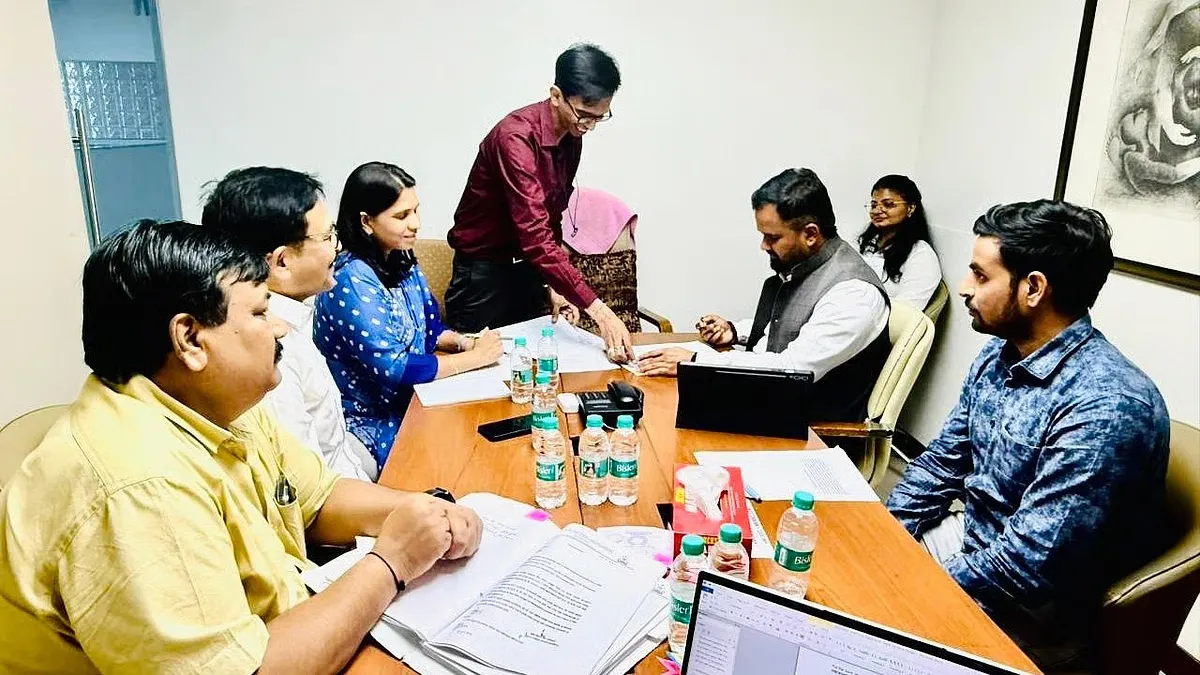
The loan agreement was signed in the presence of Sunayana Kumbhare, Chief Operating Officer of the Maharashtra Urban Infrastructure Development Company; Tejas Joshi; Sanjay Kolte, Accounts Officer; Kiran Dhande, Executive Engineer (Water Supply); Abhishek Dhekle; and Ankush Bhantalwad, Branch Manager, Bank of Maharashtra.

CSMC has been granted a 20-year repayment period, with instalments to begin after two years, though interest payments will commence immediately.

Commissioner Sreekanth stated that Chief Minister Devendra Fadnavis has set a firm deadline for completing the project. “The loan approval has removed the most critical obstacle in the water supply scheme. The focus now is on strengthening the corporation’s financial position to ensure smooth repayment of the loan,” he said.

The upgraded water supply system is expected to significantly improve access to clean drinking water across the city, enhance distribution efficiency, and support sustainable urban development in Chhatrapati Sambhajinagar.

The Chhatrapati Sambhajinagar Municipal Corporation (CSMC) has received approval for a Rs 8.2 billion loan as its contribution towards the city’s Rs 27.4 billion water supply scheme, marking a crucial milestone in the long-awaited project. CSMC Commissioner and Administrator G. Sreekanth signed the loan agreement with the Maharashtra Urban Infrastructure Development Company in Mumbai on Thursday, paving the way for the completion of the city’s ambitious water supply plan under the Amrut-2 scheme. The project, valued at Rs 27.4 billion, is being implemented by the Maharashtra Jeevan Pradhikaran (MJP), which has appointed GVPR Company, Hyderabad, as the contractor. The work is currently in its final stages. Under the funding structure, the central government will contribute 25 per cent, the state government 45 per cent, and CSMC 30 per cent. Initially, the civic administration had requested the state to cover its share, but the government instead decided to extend it as a loan. The approval process for this loan has been ongoing for nearly nine months. The loan agreement was signed in the presence of Sunayana Kumbhare, Chief Operating Officer of the Maharashtra Urban Infrastructure Development Company; Tejas Joshi; Sanjay Kolte, Accounts Officer; Kiran Dhande, Executive Engineer (Water Supply); Abhishek Dhekle; and Ankush Bhantalwad, Branch Manager, Bank of Maharashtra. CSMC has been granted a 20-year repayment period, with instalments to begin after two years, though interest payments will commence immediately. Commissioner Sreekanth stated that Chief Minister Devendra Fadnavis has set a firm deadline for completing the project. “The loan approval has removed the most critical obstacle in the water supply scheme. The focus now is on strengthening the corporation’s financial position to ensure smooth repayment of the loan,” he said. The upgraded water supply system is expected to significantly improve access to clean drinking water across the city, enhance distribution efficiency, and support sustainable urban development in Chhatrapati Sambhajinagar.

Next Story
Real Estate

RBI Rate Cut Boosts Confidence Across Housing Market

Industry Context and Market DynamicsThe real estate industry has welcomed the RBI’s rate cut as a timely boost to affordability and demand. With home prices having risen steadily across major markets, even a marginal reduction in interest rates meaningfully strengthens purchasing power, especially for first-time and mid-income buyers.Ashish Jerath, President – Sales & Marketing, Smartworld Developers, observes:“The RBI’s 25-basis-point cut, bringing the repo rate down to 5.25%, is a timely boost for the real estate sector. Lower interest rates reduce borrowing costs, enabling homeb..

Next Story
Infrastructure Transport

BMC Resumes Rs 170 Billion Road Works, Targets 80 per cent By Jan 2026

Following the withdrawal of the southwest monsoon in October, the Brihanmumbai Municipal Corporation (BMC) has restarted work on 645 roads—covering 297.49 kilometres—under its large-scale concretisation programme. Data shows that more than 60 per cent of the resumed works are located in the western suburbs. Officials said the civic body aims to complete concretisation on 80 per cent of the roads where fresh work has begun by January 2026. Launched in 2022, the Rs 170 billion project seeks to concretise 700 kilometres of roads across Mumbai. All civil works were halted during the monsoon ..

Next Story
Infrastructure Urban

India Pushes Digital Shift In Urban Land Mapping

The Department of Land Resources (DoLR) under the Ministry of Rural Development has convened a National Symposium on NAKSHA – the National Geospatial Knowledge-based Land Survey of Urban Habitations – to advance India’s transition to modern, technology-driven land mapping. Speaking at the inaugural session, Secretary Manoj Joshi underscored the urgent need to move revenue departments away from outdated, tape-based methods and rough hand-drawn sketches. He stressed that adopting latitude–longitude-based digital mapping and GIS-linked registration systems is essential for economic stabi..

Advertisement

Subscribe to Our Newsletter

Get daily newsletters around different themes from Construction world.

STAY CONNECTED

Advertisement

Advertisement

Advertisement

Advertisement

Open In App