+
DDWS Organises Fourth Sujal Gram Samvad Across Six Panchayats
WATER & WASTE

DDWS Organises Fourth Sujal Gram Samvad Across Six Panchayats

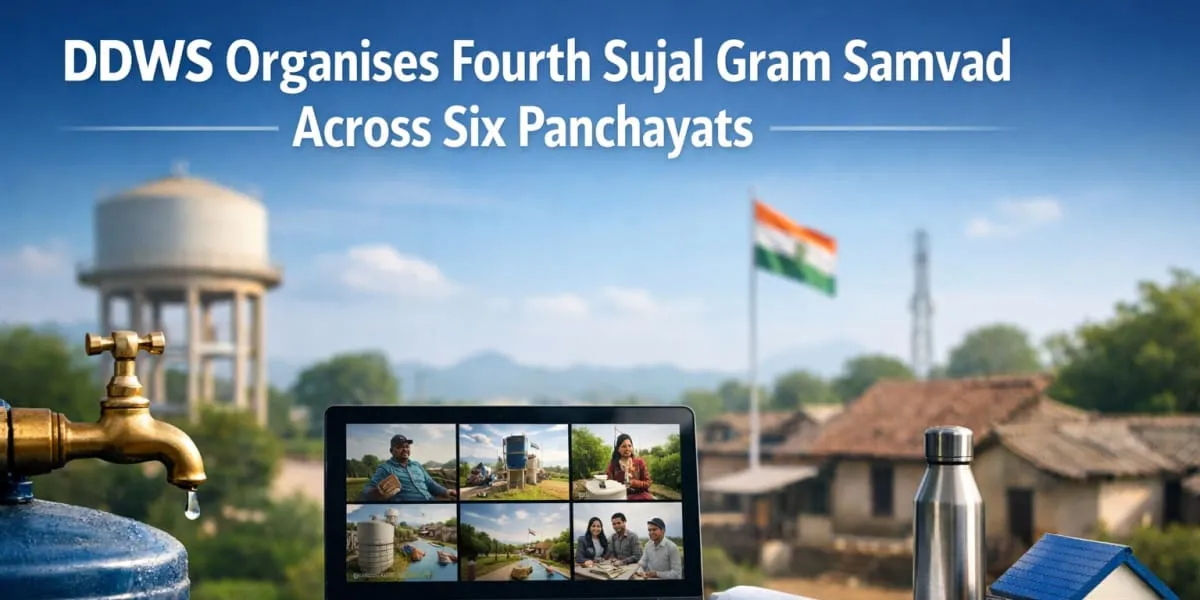
The Department of Drinking Water and Sanitation (DDWS) of the Ministry of Jal Shakti organised the fourth edition of Sujal Gram Samvad, convening village representatives from six Gram Panchayat headquarter villages across five states and one Union Territory in a virtual interaction. The event provided a forum for Gram Panchayat representatives, Village Water and Sanitation Committee (VWSC) members, women self?help groups, students and frontline functionaries to share local practices and peer learning. The edition recorded around 2,000 attendees and with extensive local participation beyond the registered count.

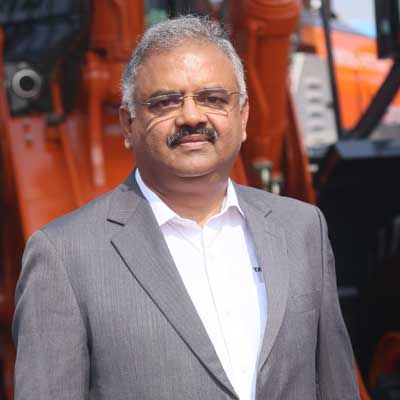
DDWS Secretary Ashok K.K. Meena underlined that while the Jal Jeevan Mission (JJM) has established drinking water infrastructure, the priority now is ensuring sustainability through strong operation and maintenance systems. He advocated transferring water supply assets to Gram Panchayats with supportive institutional arrangements and strengthening District Technical Units (DTUs) for technical and operational assistance. He stressed transparency and accountability through the Jal Seva Aankalan, with many Panchayats already completing annual evaluations before the Gram Sabha.

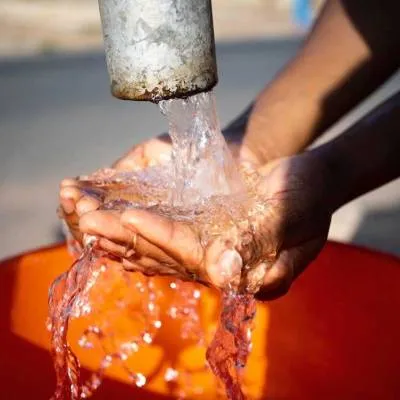
Village reports highlighted tangible improvements in service delivery and public health. In Sederapet, Puducherry, the Panchayat achieved 100 per cent functional household tap connections covering 1,248 households and a population of nearly 6,700, supported by a 5,000-litre tank and seven borewells. In Pulimamidi, Telangana, complete tap coverage was reported across households, schools and Anganwadi centres, while Ngopok Pokdum, Arunachal Pradesh, reached all 330 households through a gravity-based system and reported continuous 24x7 supply with a monthly tariff of Rs50 and Rs200 for commercial units.

The exchange also showcased community practices such as regular field-level water quality testing, local grievance redressal mechanisms and community-led operation and maintenance by trained volunteers. A nationwide Jal Mahotsav scheduled from eight to 22 March will focus on formal handover of assets through Jal Arpan Diwas, strengthening water quality monitoring, and institutional capacity building at village and district levels. Senior officials from the National Jal Jeevan Mission (NJJM) acknowledged the participatory approach and encouraged wider replication of transparent community governance models. Participants were urged to use the festival to consolidate ownership and service delivery.

The Department of Drinking Water and Sanitation (DDWS) of the Ministry of Jal Shakti organised the fourth edition of Sujal Gram Samvad, convening village representatives from six Gram Panchayat headquarter villages across five states and one Union Territory in a virtual interaction. The event provided a forum for Gram Panchayat representatives, Village Water and Sanitation Committee (VWSC) members, women self?help groups, students and frontline functionaries to share local practices and peer learning. The edition recorded around 2,000 attendees and with extensive local participation beyond the registered count. DDWS Secretary Ashok K.K. Meena underlined that while the Jal Jeevan Mission (JJM) has established drinking water infrastructure, the priority now is ensuring sustainability through strong operation and maintenance systems. He advocated transferring water supply assets to Gram Panchayats with supportive institutional arrangements and strengthening District Technical Units (DTUs) for technical and operational assistance. He stressed transparency and accountability through the Jal Seva Aankalan, with many Panchayats already completing annual evaluations before the Gram Sabha. Village reports highlighted tangible improvements in service delivery and public health. In Sederapet, Puducherry, the Panchayat achieved 100 per cent functional household tap connections covering 1,248 households and a population of nearly 6,700, supported by a 5,000-litre tank and seven borewells. In Pulimamidi, Telangana, complete tap coverage was reported across households, schools and Anganwadi centres, while Ngopok Pokdum, Arunachal Pradesh, reached all 330 households through a gravity-based system and reported continuous 24x7 supply with a monthly tariff of Rs50 and Rs200 for commercial units. The exchange also showcased community practices such as regular field-level water quality testing, local grievance redressal mechanisms and community-led operation and maintenance by trained volunteers. A nationwide Jal Mahotsav scheduled from eight to 22 March will focus on formal handover of assets through Jal Arpan Diwas, strengthening water quality monitoring, and institutional capacity building at village and district levels. Senior officials from the National Jal Jeevan Mission (NJJM) acknowledged the participatory approach and encouraged wider replication of transparent community governance models. Participants were urged to use the festival to consolidate ownership and service delivery.

Next Story
Infrastructure Urban

We’ve cut 50,000 tonnes of carbon emmissions since 2019

MatchLog is challenging a decades-old logistics norm and empty container miles by directly matching import flows with export demand. Indeed, the platform is unlocking measurable cost savings, cutting emissions and driving structural change in landside operations. Dhruv Taneja, Founder and Global CEO, outlines the quantified impact, adoption  journey and the evolving future of container reuse in an exclusive interview with Construction World. MatchLog has partnered with carriers such as Maersk, ONE and HMM in India. Could you share quantified outcomes from one specific corri..

Next Story
Infrastructure Transport

Airports: Capacity is Key

A lotus-inspired terminal design in Navi Mumbai International Airport. A terminal in a garden in Bengaluru’s Kempegowda International Airport. A peacock-inspired canopy in Chhatrapati Shivaji Maharaj International Airport. A nature-inspired terminal in Guwahati’s Lokpriya Gopinath Bordoloi International Airport.Truly, “India’s airports are no longer constrained by architectural ambition,” avers Ravikanth Mididhodi, Chief Technical Officer, J&F, a German-based engineering firm with over 25 years of global legacy in delivering advanced engineering and BIM services for air..

Next Story
Real Estate

In 2025, Amaravati attracted ₹ 28,075 crore in investments

In an exclusive interview with Construction World, Kanna Babu, IAS, Commissioner, Andhra Pradesh Capital Region Development Authority (APCRDA), reveals how Amaravati is entering a decisive new phase of capital city development. With 36 MoUs worth ₹ 45,589 crore, a ₹ 58,000 crore tender pipeline, and rising institutional investments, he explains the strategic execution, infrastructure rollout, and governance framework driving Amaravati’s emergence as a structured, investment-ready, and future-focused capital.APCRDA has recently secured major financial tie-ups, including loans from NA..

Advertisement

Subscribe to Our Newsletter

Get daily newsletters around different themes from Construction world.

STAY CONNECTED

Advertisement

Advertisement

Advertisement

Open In App