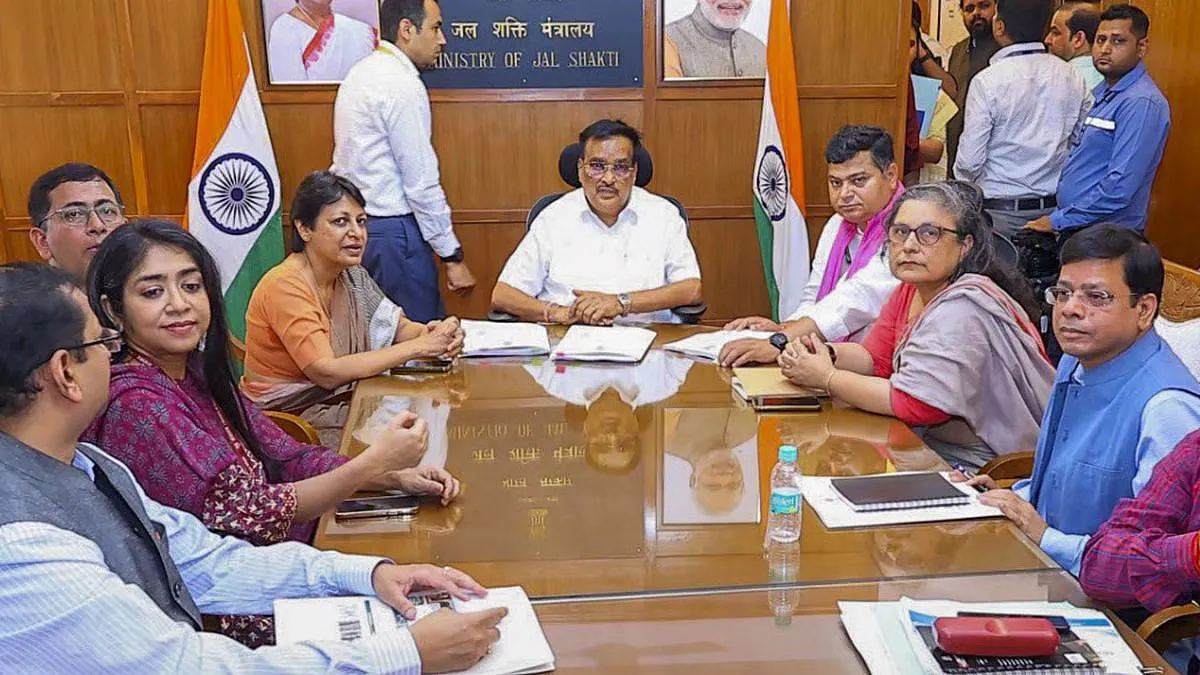
India Launches Digital Registry For Rural Water Supply Schemes
WATER & WASTE

India Launches Digital Registry For Rural Water Supply Schemes

Since August 2019, the Government of India, in partnership with States and Union Territories, has been implementing the Jal Jeevan Mission (JJM) – Har Ghar Jal to provide tap water supply to every rural household. As water is a State subject, the responsibility for planning, approving, implementing and maintaining piped water supply schemes rests with State and UT Governments. The Union Government supplements these efforts by offering technical and financial support under JJM.

To strengthen transparency and accountability in the programme, the Department of Drinking Water and Sanitation has introduced the nationwide Rural Piped Water Supply Scheme (RPWSS) module. This system assigns a unique identification number to every integrated piped water supply scheme and digitally maps all components — including water sources, treatment units, transmission networks, distribution systems and service areas.

The RPWSS module forms a key layer of Digital Public Infrastructure for the rural water sector. It establishes a comprehensive GIS-based registry of assets and links all components of each scheme to their respective service zones. The system enforces mandatory geo-tagging and geo-referencing of assets, whether classified as Not Started, Ongoing or Completed, ensuring full traceability from source to household.

Each asset is also linked to the corresponding capital expenditure scheme ID, creating a transparent record of financial flows and enabling more accurate monitoring across the entire rural water supply ecosystem.

The information was provided by the Minister of State for Jal Shakti, Shri V. Somanna, in a written reply in the Rajya Sabha.

Since August 2019, the Government of India, in partnership with States and Union Territories, has been implementing the Jal Jeevan Mission (JJM) – Har Ghar Jal to provide tap water supply to every rural household. As water is a State subject, the responsibility for planning, approving, implementing and maintaining piped water supply schemes rests with State and UT Governments. The Union Government supplements these efforts by offering technical and financial support under JJM. To strengthen transparency and accountability in the programme, the Department of Drinking Water and Sanitation has introduced the nationwide Rural Piped Water Supply Scheme (RPWSS) module. This system assigns a unique identification number to every integrated piped water supply scheme and digitally maps all components — including water sources, treatment units, transmission networks, distribution systems and service areas. The RPWSS module forms a key layer of Digital Public Infrastructure for the rural water sector. It establishes a comprehensive GIS-based registry of assets and links all components of each scheme to their respective service zones. The system enforces mandatory geo-tagging and geo-referencing of assets, whether classified as Not Started, Ongoing or Completed, ensuring full traceability from source to household. Each asset is also linked to the corresponding capital expenditure scheme ID, creating a transparent record of financial flows and enabling more accurate monitoring across the entire rural water supply ecosystem. The information was provided by the Minister of State for Jal Shakti, Shri V. Somanna, in a written reply in the Rajya Sabha.

Next Story
Infrastructure Urban

Rosatom Delivers Nuclear Fuel for Kudankulam Unit 3

Rosatom has recently supplied nuclear fuel for the initial loading of the VVER-1000 reactor core at Unit 3 of the Kudankulam Nuclear Power Plant, marking a key milestone in the second stage of the Russian-designed nuclear power project in southern India.The fuel was supplied by Rosatom’s Nuclear Fuel Division, managed by TVEL, and manufactured at the Novosibirsk Chemical Concentrates Plant. The delivery includes the initial reactor load along with reserve fuel assemblies and is part of a long-term contract covering the entire operational life of Units 3 and 4.Building on operational experien..

Next Story
Infrastructure Transport

CBL International Enables First LNG Bunkering at Xiaomo Port

CBL International recently completed the first-ever LNG bunkering operation at Xiaomo Port, supplying liquefied natural gas to vessels operated by BYD in support of its maritime decarbonisation strategy. The operation was facilitated through a physical supplier in collaboration with China National Offshore Oil Corporation (CNOOC), which supported the port’s inaugural LNG bunkering activity. The milestone represents a strategic expansion of CBL International's sustainable fuel offerings beyond biofuels, while also diversifying revenue streams. As global shipping intensifies efforts to cut em..

Next Story
Infrastructure Urban

Aimtron, Aurassure Partner for IoT Weather Systems

Aimtron Electronics has recently entered into an OEM manufacturing engagement with Aurassure to produce new-age, IoT-enabled weather and environmental monitoring systems in India. The collaboration supports the growing demand for real-time environmental intelligence across urban, industrial and infrastructure applications. The engagement comes as global focus on climate-risk management and data-driven planning accelerates. The global weather monitoring systems market, valued at around USD 2.1 billion in 2024, is projected to reach nearly USD 4.8 billion by 2034, driven by the rapid adoption o..

Advertisement

Subscribe to Our Newsletter

Get daily newsletters around different themes from Construction world.

STAY CONNECTED

Advertisement

Advertisement

Advertisement

Advertisement

Open In App