Legacy Waste Clearance Gains Momentum Across Kashmir
WATER & WASTE

Legacy Waste Clearance Gains Momentum Across Kashmir

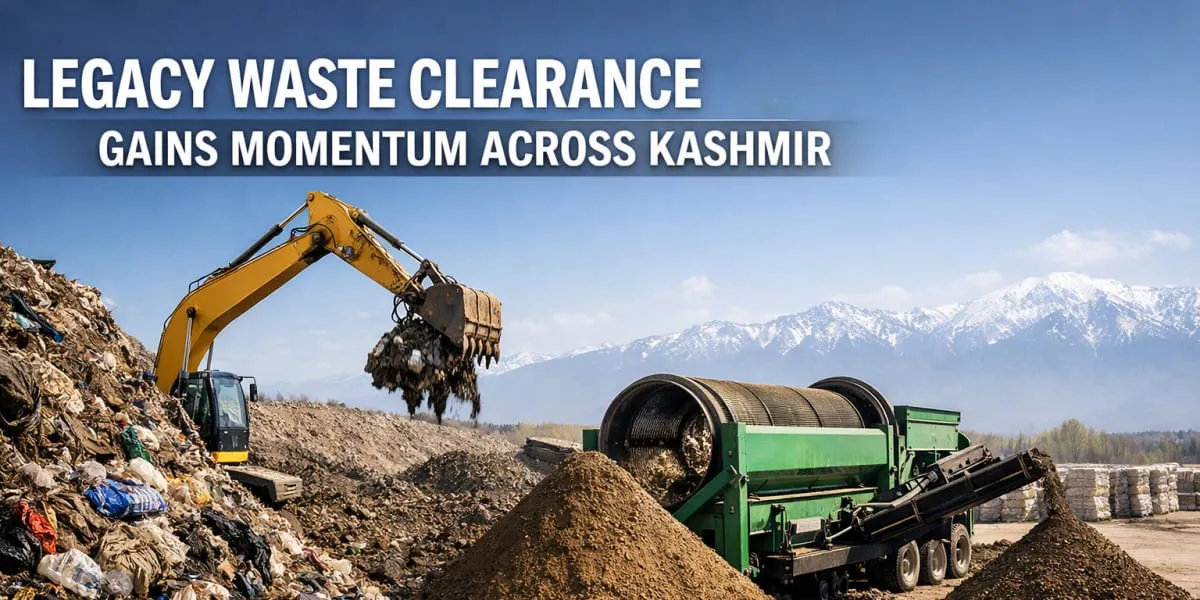
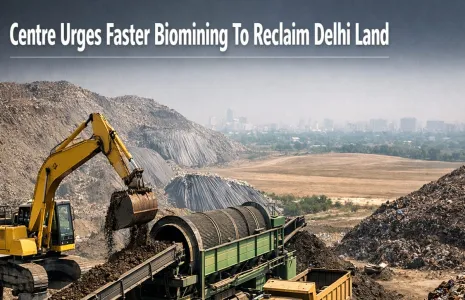
The Urban Local Bodies (ULB) Kashmir has completed the bio-mining of 0.079 mn metric tonnes (t) of legacy waste at five municipal dumping sites, marking a significant step towards scientific solid waste management and the reclamation of old dumping grounds across the Valley. The department has undertaken large-scale bio-remediation of 0.298 mn t of legacy waste in 18 municipalities, with 0.158 mn t remediated by the executing agency and remediation of the remainder currently under way. Officials described the effort as part of a wider push to eliminate decades-old dumps and improve environmental conditions.

Twelve Solid Waste Management (SWM) Centres are now operational in different municipalities, providing scientific segregation and processing of municipal waste. Municipal committees have ceased using open dumping sites following the commissioning of the SWM Centres, and household waste is being channelled to these facilities for systematic handling. Wet waste is processed through compost pits while dry waste is directed to Material Recovery Facility (MRF) plants for treatment.

To strengthen door-to-door collection, the department procured 245 garbage hoppers which have been distributed among municipal committees across the Valley. The collected waste is segregated at the SWM Centres before being routed to appropriate processing streams, and this logistical support has been credited with improving collection efficiency. The executing agency continues to work on remaining legacy waste at municipal sites while monitoring operational SWM Centres and MRF units.

The campaign is presented as complementing municipal efforts to modernise solid waste services and reclaim land previously occupied by informal dumps. Continued operation of SWM Centres and the roll-out of waste collection infrastructure are expected to reduce environmental hazards and enhance public health outcomes across the Valley. Authorities indicated that work will proceed until legacy waste targets are met and municipal practices fully transition to scientific solid waste management.

The Urban Local Bodies (ULB) Kashmir has completed the bio-mining of 0.079 mn metric tonnes (t) of legacy waste at five municipal dumping sites, marking a significant step towards scientific solid waste management and the reclamation of old dumping grounds across the Valley. The department has undertaken large-scale bio-remediation of 0.298 mn t of legacy waste in 18 municipalities, with 0.158 mn t remediated by the executing agency and remediation of the remainder currently under way. Officials described the effort as part of a wider push to eliminate decades-old dumps and improve environmental conditions. Twelve Solid Waste Management (SWM) Centres are now operational in different municipalities, providing scientific segregation and processing of municipal waste. Municipal committees have ceased using open dumping sites following the commissioning of the SWM Centres, and household waste is being channelled to these facilities for systematic handling. Wet waste is processed through compost pits while dry waste is directed to Material Recovery Facility (MRF) plants for treatment. To strengthen door-to-door collection, the department procured 245 garbage hoppers which have been distributed among municipal committees across the Valley. The collected waste is segregated at the SWM Centres before being routed to appropriate processing streams, and this logistical support has been credited with improving collection efficiency. The executing agency continues to work on remaining legacy waste at municipal sites while monitoring operational SWM Centres and MRF units. The campaign is presented as complementing municipal efforts to modernise solid waste services and reclaim land previously occupied by informal dumps. Continued operation of SWM Centres and the roll-out of waste collection infrastructure are expected to reduce environmental hazards and enhance public health outcomes across the Valley. Authorities indicated that work will proceed until legacy waste targets are met and municipal practices fully transition to scientific solid waste management.

Next Story
Infrastructure Transport

Surya Roshni delivers customised lighting for NCRTC RRTS stations

Surya Roshni has supplied customised indoor lighting solutions for 18 elevated stations on the National Capital Region Transport Corporation's (NCRTC) Rapid Rail Transit System (RRTS), strengthening its presence in India's infrastructure lighting segment.The project involved the design and deployment of lighting systems for platforms, concourses, foot overbridges (FOBs) and back-of-house (BOH) areas. According to the company, the luminaires were developed specifically to meet NCRTC's design, operational and performance requirements rather than using standard products.Surya introduced two custo..

Next Story
Real Estate

Hilton debuts Tapestry Collection brand in Vietnam

Hilton has opened NHAAN Resort & Spa Hoi An, Tapestry Collection by Hilton, marking the debut of the Tapestry Collection brand in Vietnam and expanding its lifestyle hospitality portfolio in Southeast Asia.Located along the Co Co River in Cam Thanh village, the 174-key resort provides access to Hoi An Ancient Town, Cua Dai Beach and the Cam Thanh Nipa Forest. The property has been designed by Vietnamese architect Vo Trong Nghia, incorporating biophilic architecture, locally sourced materials and riverfront landscapes.The resort offers a mix of guest rooms and suites, including family-frien..

Next Story
Building Material

Electrent expands lithium energy storage system portfolio

Electrent Energy has expanded its lithium-based energy storage portfolio with the launch of the ESS 850 and ESS 1050, targeting compact and maintenance-free power backup solutions for Indian homes.The new systems integrate a Home UPS and a LiFePO4 lithium battery into a single unit, extending the company's product range following the launch of its ESS 1350 and ESS 2500 models.Designed for apartments and smaller homes, the ESS 850 provides up to 1 hour 15 minutes of backup, while the ESS 1050 offers up to 1 hour 45 minutes on a typical 400 W household load. The systems can power essential appli..

Advertisement

Subscribe to Our Newsletter

Get daily newsletters around different themes from Construction world.

STAY CONNECTED

Advertisement

Advertisement

Advertisement