Rajasthan’s JJM Push Prioritises Difficult Terrains And Full Coverage
WATER & WASTE

Rajasthan’s JJM Push Prioritises Difficult Terrains And Full Coverage

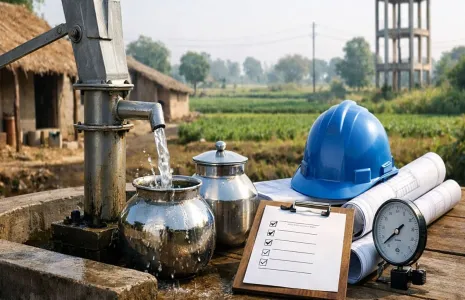
Since August 2019, the Government of India, in partnership with States and Union Territories including Rajasthan, has been implementing the Jal Jeevan Mission (JJM) to provide every rural household with a functional tap water connection. As drinking water is a State subject, the planning, approval, implementation and operation and maintenance of rural water supply schemes fall under State and UT governments, while the Centre supports these efforts with technical and financial assistance.

Under JJM’s operational guidelines, 30 per cent weightage is assigned to difficult terrains when allocating funds, ensuring priority for regions covered under the Desert Development Programme and the Drought Prone Area Programme. This approach aims to accelerate piped water supply in geographies that face greater implementation challenges.

To achieve universal coverage with durable and citizen-centric water services, the Finance Minister announced in the 2025 Budget an extension of JJM until 2028, accompanied by an enhanced total outlay. The extended period will focus on the quality of infrastructure and improved operations and maintenance for long-term sustainability.

A series of measures have been adopted to expedite JJM implementation nationwide. These include joint reviews, finalisation of saturation plans and annual action plans, regular monitoring, capacity-building programmes, workshops, field visits by multidisciplinary teams and intensive technical support. A comprehensive digital monitoring system has also been established through the JJM Integrated Management Information System and the JJM Dashboard. Financial transparency has been strengthened through the Public Financial Management System.

The Department has also held review meetings with 729 District Collectors, District Magistrates and Collectors across India to assess progress at the district level. They have been encouraged to lead monitoring efforts via the District Water and Sanitation Mission dashboard and to resolve bottlenecks swiftly. Priority has been placed on improving coverage in Particularly Vulnerable Tribal Group habitations, drought-prone areas, Aspirational Districts and other critical regions.

The information was provided by the Minister of State for Jal Shakti, Shri V. Somanna, in a written reply in the Rajya Sabha.

Since August 2019, the Government of India, in partnership with States and Union Territories including Rajasthan, has been implementing the Jal Jeevan Mission (JJM) to provide every rural household with a functional tap water connection. As drinking water is a State subject, the planning, approval, implementation and operation and maintenance of rural water supply schemes fall under State and UT governments, while the Centre supports these efforts with technical and financial assistance. Under JJM’s operational guidelines, 30 per cent weightage is assigned to difficult terrains when allocating funds, ensuring priority for regions covered under the Desert Development Programme and the Drought Prone Area Programme. This approach aims to accelerate piped water supply in geographies that face greater implementation challenges. To achieve universal coverage with durable and citizen-centric water services, the Finance Minister announced in the 2025 Budget an extension of JJM until 2028, accompanied by an enhanced total outlay. The extended period will focus on the quality of infrastructure and improved operations and maintenance for long-term sustainability. A series of measures have been adopted to expedite JJM implementation nationwide. These include joint reviews, finalisation of saturation plans and annual action plans, regular monitoring, capacity-building programmes, workshops, field visits by multidisciplinary teams and intensive technical support. A comprehensive digital monitoring system has also been established through the JJM Integrated Management Information System and the JJM Dashboard. Financial transparency has been strengthened through the Public Financial Management System. The Department has also held review meetings with 729 District Collectors, District Magistrates and Collectors across India to assess progress at the district level. They have been encouraged to lead monitoring efforts via the District Water and Sanitation Mission dashboard and to resolve bottlenecks swiftly. Priority has been placed on improving coverage in Particularly Vulnerable Tribal Group habitations, drought-prone areas, Aspirational Districts and other critical regions. The information was provided by the Minister of State for Jal Shakti, Shri V. Somanna, in a written reply in the Rajya Sabha.

Next Story
Real Estate

Modon, Related, Panepinto form JV for Harborside 4 in Jersey City

Abu Dhabi-based Modon Holding PSC has formed a joint venture with US real estate major Related Companies and Jersey City-based Panepinto Properties to develop Harborside 4, a 54-storey luxury residential tower on a prime waterfront site in downtown Jersey City, New Jersey.Under the partnership, Modon will hold a majority equity stake alongside Related and Panepinto, marking another step in the group’s strategy to scale and diversify its global real estate portfolio. The project will be developed on one of the last remaining premium waterfront parcels in the city.Designed by Handel Architects..

Next Story
Infrastructure Urban

P+Ex and Post-Tensioning Institute partner to drive sustainability

P+Ex, the Center of Excellence for Concrete Preservation and Service Life Extension, has announced a strategic partnership with the Post-Tensioning Institute (PTI) aimed at advancing sustainability, durability, and resilience in the built environment.The collaboration brings together P+Ex’s expertise in concrete preservation, repair, and service life extension with PTI’s global leadership in post-tensioning technology. Through this alliance, the two organisations will work to advance best practices in durability-focused design for new structures, while also promoting effective repair, reha..

Next Story
Infrastructure Energy

India’s Largest 2,000 MW Subansiri Hydro Project Turns Operational

India’s largest hydropower project, the 2,000 MW Subansiri Lower Hydroelectric Project, has finally become operational with the commissioning of its first unit, marking a major milestone after nearly 20 years of development marked by delays, protests and cost escalation.The 250 MW Unit-2 of the project, located on the Subansiri River at Gerukamukh on the Assam–Arunachal Pradesh border, was virtually inaugurated from New Delhi by Union Minister of Power Manohar Lal Khattar. The event was attended by Pankaj Agarwal, Secretary (Power), and Bhupender Gupta, Chairman and Managing Director, Nati..

Advertisement

Subscribe to Our Newsletter

Get daily newsletters around different themes from Construction world.

STAY CONNECTED

Advertisement

Advertisement

Advertisement

Advertisement

Open In App