


Centre Tables Bill To Bar State Levies On Mining
COAL & MINING

Centre Tables Bill To Bar State Levies On Mining

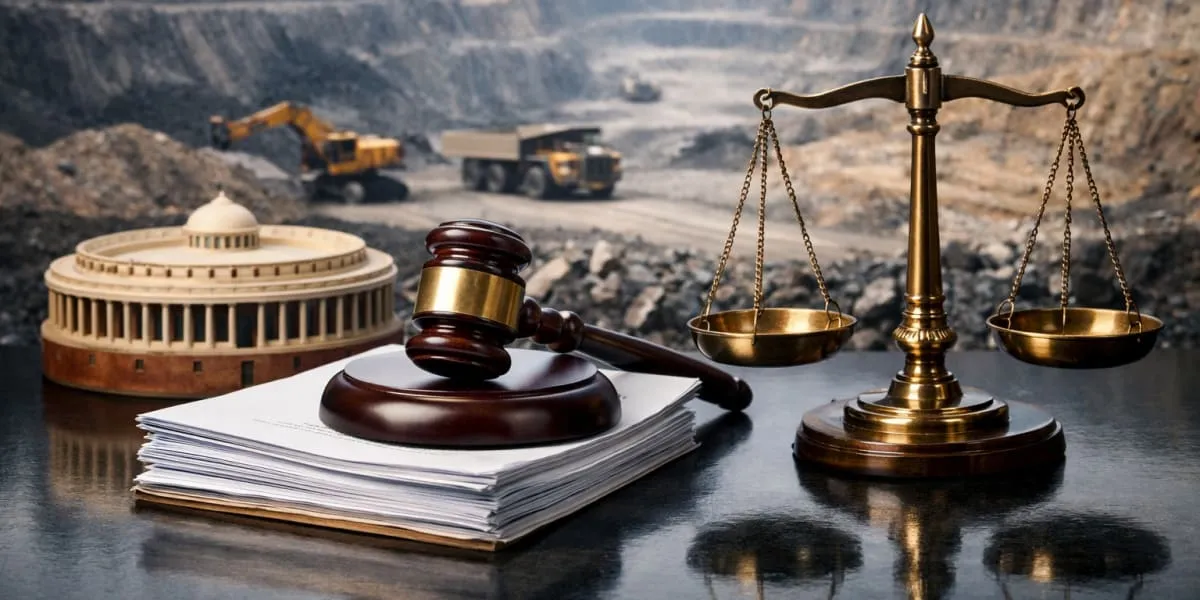
The government introduced the Mines and Minerals (Development and Regulation) Amendment Bill, 2026 in the Lok Sabha to prohibit state governments from imposing taxes or other levies on mineral rights and mineral-bearing land. The bill seeks to reduce the financial burden on mining operations and improve the commercial viability of the sector in order to attract investment. The measure was presented as part of a wider effort to bring mineral-bearing land within central regulatory control.

The bill proposes insertion of a new section nine D in the Mines and Minerals (Development and Regulation) Act, 1957 (MMDR Act) that would prevent states from imposing tax, cess or other levies on mineral rights or mineral-bearing land except in accordance with conditions or restrictions prescribed by the Central government. It would therefore centralise the framework for such levies and require future state impositions to follow parameters set by the Centre. Drafting in the bill also seeks to define mineral-bearing land by the parameters that the Centre will prescribe.

The proposal followed a Supreme Court ruling delivered on 25 July 2024 in the Mineral Area Development Authority versus Steel Authority of India Ltd case, which affirmed that the power to tax mineral rights resides with state governments and clarified that royalty paid to the central government on minerals was not a tax. The government argued that excessive and unpredictable fiscal burdens make some mining operations commercially unviable, discourage extraction and can lead to closures, particularly for small and medium-scale operators. The bill proposes that levies already deposited with or recovered by states before the amendment comes into effect would not be refunded.

The ministry said the changes aim to reduce multiple and inconsistent taxes that hamper the development of the mineral industry and raise compliance costs. Queries to revenue departments in major mineral-producing states were not immediately answered. Tax advisers noted that the amendment responds to concerns about legacy liabilities, litigation and uncertainty arising after the MADA judgment and that it seeks to provide a framework for future state taxation.

The bill also seeks to accelerate exploration and production of critical minerals such as lithium, nickel and cobalt to strengthen domestic supply chains and reduce dependence on China. Officials indicated that clearer fiscal and regulatory rules are expected to enhance predictability and support investment in mining and downstream industries. The move is presented as a step towards faster development of minerals critical for renewable energy and defence manufacturing.

The government introduced the Mines and Minerals (Development and Regulation) Amendment Bill, 2026 in the Lok Sabha to prohibit state governments from imposing taxes or other levies on mineral rights and mineral-bearing land. The bill seeks to reduce the financial burden on mining operations and improve the commercial viability of the sector in order to attract investment. The measure was presented as part of a wider effort to bring mineral-bearing land within central regulatory control. The bill proposes insertion of a new section nine D in the Mines and Minerals (Development and Regulation) Act, 1957 (MMDR Act) that would prevent states from imposing tax, cess or other levies on mineral rights or mineral-bearing land except in accordance with conditions or restrictions prescribed by the Central government. It would therefore centralise the framework for such levies and require future state impositions to follow parameters set by the Centre. Drafting in the bill also seeks to define mineral-bearing land by the parameters that the Centre will prescribe. The proposal followed a Supreme Court ruling delivered on 25 July 2024 in the Mineral Area Development Authority versus Steel Authority of India Ltd case, which affirmed that the power to tax mineral rights resides with state governments and clarified that royalty paid to the central government on minerals was not a tax. The government argued that excessive and unpredictable fiscal burdens make some mining operations commercially unviable, discourage extraction and can lead to closures, particularly for small and medium-scale operators. The bill proposes that levies already deposited with or recovered by states before the amendment comes into effect would not be refunded. The ministry said the changes aim to reduce multiple and inconsistent taxes that hamper the development of the mineral industry and raise compliance costs. Queries to revenue departments in major mineral-producing states were not immediately answered. Tax advisers noted that the amendment responds to concerns about legacy liabilities, litigation and uncertainty arising after the MADA judgment and that it seeks to provide a framework for future state taxation. The bill also seeks to accelerate exploration and production of critical minerals such as lithium, nickel and cobalt to strengthen domestic supply chains and reduce dependence on China. Officials indicated that clearer fiscal and regulatory rules are expected to enhance predictability and support investment in mining and downstream industries. The move is presented as a step towards faster development of minerals critical for renewable energy and defence manufacturing.

Related Stories

Gold Stories

Next Story
Infrastructure Urban

Sabarmati Riverfront Two Plots Up for Auction at Rs2.24 bn Base Price

Two commercial plots on the western bank of the Sabarmati Riverfront will be auctioned with a base price of Rs 112 crore each, equivalent to Rs 1.12 bn apiece and Rs 2.24 billion in total. The parcels are located adjacent to the Metro Rail Bridge in Ahmedabad and form the first commercial offering after a prolonged pause. The Riverfront Development Corporation has framed the sale as part of a phased commercial release to revive development along the riverfront. The combined base valuation has been set by the corporation to reflect market rates along the riverfront. The corporation has fixed a ..

Next Story
Infrastructure Urban

Andhra Pradesh to Connect Over One Million Streetlights

Andhra Pradesh will undertake a statewide smart streetlighting programme across all 123 Urban Local Bodies (ULBs), bringing around 1.05 million (mn) streetlights under an AI enabled monitoring and management system. The programme will be implemented by Energy Efficiency Services Limited (EESL) with the Commissioner and Director of Municipal Administration under the state Municipal Administration and Urban Development Department. The project aims to convert conventional streetlighting into a digitally managed municipal service monitored and maintained remotely. The initial phase will cover abou..

Next Story
Infrastructure Urban

AMC To Procure Four Machines For Guard Rail Cleaning

Ahmedabad Municipal Corporation will introduce four specialised machines for cleaning guard railings along major roads and the central verges of BRTS and Metro corridors. The civic body plans to replace manual labour with mechanised cleaning to improve maintenance of road infrastructure and greenery. The purchase is estimated at Rs 82.8 million (mn), excluding GST. The proposal sets the base price of each machine at about Rs 20.7 million (mn) so four units total Rs 82.8 million (mn) before GST. 18 per cent GST will be applicable separately. During the warranty period each machine will operate ..

Advertisement

Subscribe to Our Newsletter

Get daily newsletters around different themes from Construction world.

STAY CONNECTED

Advertisement