Government Notifies Coking Coal as Critical and Strategic Mineral
COAL & MINING

Government Notifies Coking Coal as Critical and Strategic Mineral

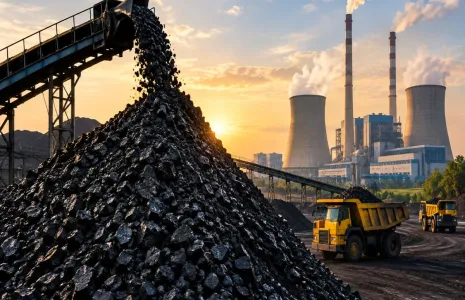
The Central Government has notified coking coal as a Critical and Strategic Mineral under the Mines and Minerals (Development and Regulation) Act, 1957 (MMDR Act), marking a policy shift intended to strengthen mineral security and support the domestic steel sector. The decision follows recommendations of the High-Level Committee on Implementation of Viksit Bharat Goals and inputs from NITI Aayog. The amendment inserts coking coal in the First Schedule and lists it in the Part that identifies critical and strategic minerals.

India has an estimated 37.37 billion tonnes (bn t) of coking coal resources, concentrated mainly in Jharkhand with additional deposits in Madhya Pradesh, West Bengal and Chhattisgarh. Despite domestic availability, imports of coking coal rose from 51.20 million tonnes (mn t) in 2020–21 to 57.58 million tonnes (mn t) in 2024–25, with around 95 per cent of sectoral requirement currently met through imports. The trend has resulted in substantial foreign exchange outgo.

The classification is expected to expedite approvals and improve ease of doing business by facilitating accelerated exploration, including of deep-seated deposits, and by encouraging private sector participation. Mining operations for critical minerals are exempt from public consultation requirements and permit the use of degraded forest land for compensatory afforestation, provisions that aim to reduce procedural delays. These measures are anticipated to unlock investment in exploration and beneficiation and to promote adoption of advanced mining technologies.

The reform is projected to reduce import dependence and strengthen supply chain resilience for the steel sector while supporting the objectives of the National Steel Policy. It is also expected to generate employment across mining, logistics and the steel value chain as private investment increases in exploration and processing. Royalty, auction premium and other statutory payments connected to mining leases will continue to accrue to the respective State Governments in accordance with the Act.

The move underlines national resource stewardship. It advances Viksit Bharat goals.

The Central Government has notified coking coal as a Critical and Strategic Mineral under the Mines and Minerals (Development and Regulation) Act, 1957 (MMDR Act), marking a policy shift intended to strengthen mineral security and support the domestic steel sector. The decision follows recommendations of the High-Level Committee on Implementation of Viksit Bharat Goals and inputs from NITI Aayog. The amendment inserts coking coal in the First Schedule and lists it in the Part that identifies critical and strategic minerals. India has an estimated 37.37 billion tonnes (bn t) of coking coal resources, concentrated mainly in Jharkhand with additional deposits in Madhya Pradesh, West Bengal and Chhattisgarh. Despite domestic availability, imports of coking coal rose from 51.20 million tonnes (mn t) in 2020–21 to 57.58 million tonnes (mn t) in 2024–25, with around 95 per cent of sectoral requirement currently met through imports. The trend has resulted in substantial foreign exchange outgo. The classification is expected to expedite approvals and improve ease of doing business by facilitating accelerated exploration, including of deep-seated deposits, and by encouraging private sector participation. Mining operations for critical minerals are exempt from public consultation requirements and permit the use of degraded forest land for compensatory afforestation, provisions that aim to reduce procedural delays. These measures are anticipated to unlock investment in exploration and beneficiation and to promote adoption of advanced mining technologies. The reform is projected to reduce import dependence and strengthen supply chain resilience for the steel sector while supporting the objectives of the National Steel Policy. It is also expected to generate employment across mining, logistics and the steel value chain as private investment increases in exploration and processing. Royalty, auction premium and other statutory payments connected to mining leases will continue to accrue to the respective State Governments in accordance with the Act. The move underlines national resource stewardship. It advances Viksit Bharat goals.

Next Story
Infrastructure Urban

Public Capex Push In Budget To Boost Tyre Industry: ATMA

The Indian tyre industry is expected to benefit from the government’s renewed emphasis on infrastructure development outlined in the Union Budget 2026–27, according to the Automotive Tyre Manufacturers Association (ATMA).ATMA said the tyre sector is closely linked to the performance of the transport and infrastructure ecosystem, and the sharp rise in public capital expenditure to Rs 1.2 trillion is a significant positive for sustained long-term demand growth.The association noted that the enhanced capex allocation reflects the government’s continued focus on building future-ready infrast..

Next Story
Infrastructure Transport

Underground Rail Line Planned In Siliguri ‘Chicken’s Neck’

Indian Railways is planning to construct underground railway tracks along a critical 40 km stretch of the Siliguri Corridor, popularly known as the Chicken’s Neck, to strengthen connectivity between the North East and the rest of India while enhancing security preparedness. According to the Indian Railways, the underground section is strategically significant due to the corridor’s narrow geography and proximity to international borders. Chetan Kumar Srivastava, General Manager of the Northeast Frontier Railway, said the proposed underground alignment is extremely important from a security..

Next Story
Infrastructure Urban

Agriculture Infrastructure Fund Boosts Post-Harvest Assets

The Agriculture Infrastructure Fund (AIF), a Central Sector Scheme of the Government of India, continues to strengthen post-harvest management infrastructure by enabling access to medium- and long-term debt financing through interest-subvented loans. The scheme focuses on improving agri-logistics, reducing post-harvest losses, promoting modern storage, processing and value-addition facilities, and enhancing farm-gate infrastructure to support efficient agricultural supply chains. Under AIF, banks and financial institutions provide loans with an interest subvention of three per cent per annum,..

Advertisement

Subscribe to Our Newsletter

Get daily newsletters around different themes from Construction world.

STAY CONNECTED

Advertisement

Advertisement

Advertisement

Advertisement

Open In App